Dublin HUG_banner_2560x650_v02
Rich Archbold

HubSpot on HubSpot

Setting the scene for an afternoon of AI, innovation, and action.

Rich Archbold - GM, SVP Business Systems, IT & Security - HubSpot

1:30 PM - 1:45 PM

This opening session sets the context for the day, exploring the shift from fragmented tools to a unified HubSpot stack and the impact of AI on go-to-market teams.

Session Recording

Rich introduces key themes, tracing the journey from fragmented systems to a unified HubSpot stack and then into the realities of AI-driven change. It highlights how his team has responded to disruption by committing to experimentation, embedding AI across the customer lifecycle, and rethinking how marketing, sales, success, and support work together in a single platform.

Each section captures a distinct moment in the talk: Rich’s background and role, the pain of disconnected tools, the benefits of HubSpot within HubSpot, the pressures of the AI era, and the specific AI-powered initiatives delivering measurable impact. The final section previews the talks and hands-on sessions that follow in the broader programme.


Session Summary

Dive into the key moments from Rich’s session, where he shared how HubSpot runs its entire go-to-market engine on HubSpot, and how leaning into AI has driven real impact across marketing, sales, customer success, and support. These highlights capture the most important shifts, challenges, and wins shaping HubSpot’s AI-powered evolution.

Rich’s Role and the HubSpot on HubSpot

Rich’s Role and the HubSpot on HubSpot Context

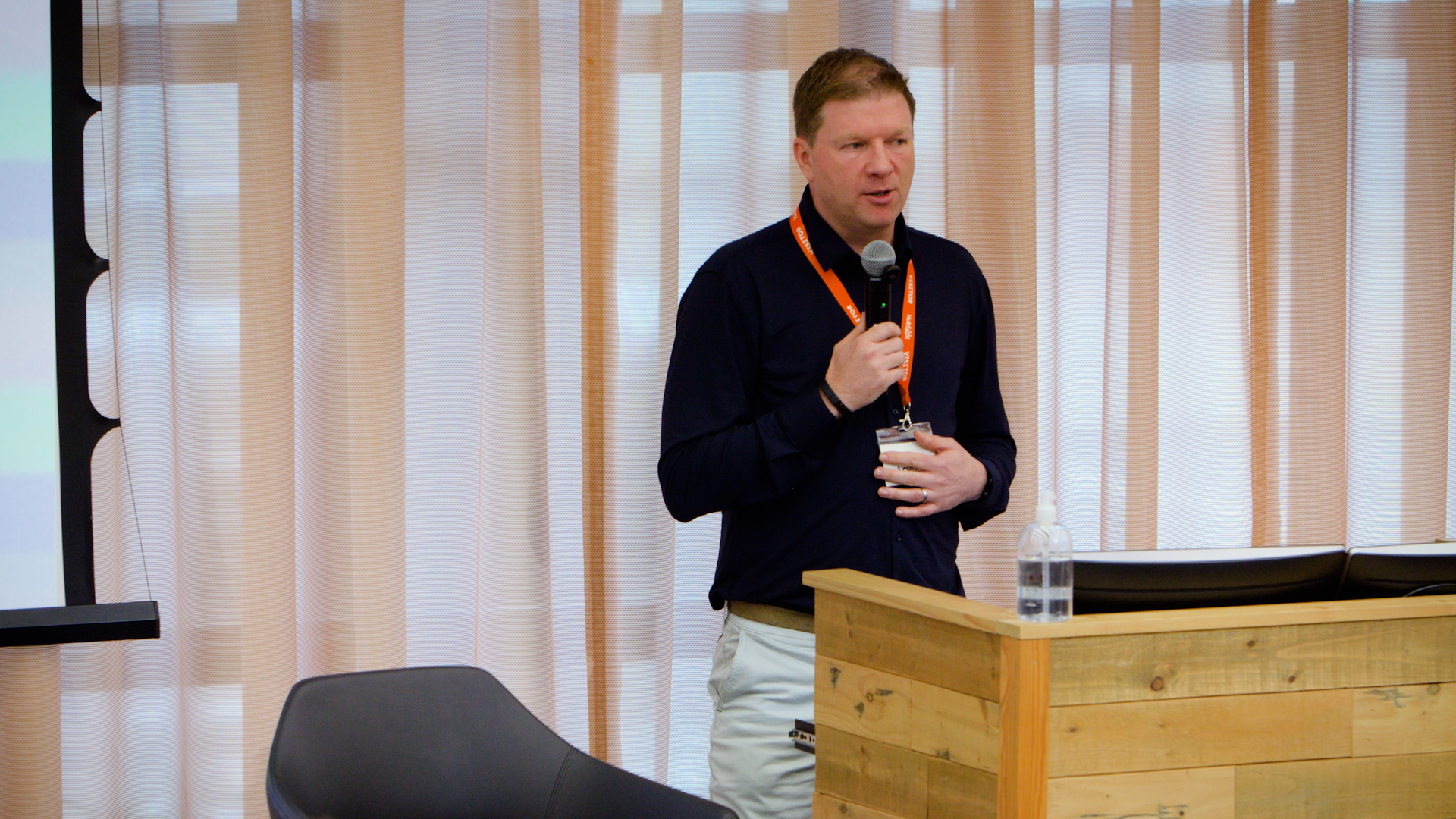
Rich opens by welcoming the audience and introducing himself as GM, SVP Business Systems, IT & Security at HubSpot. One of the parts of his role he enjoys most is leading the HubSpot on HubSpot team, which is responsible for running HubSpot’s own go-to-market operations on the HubSpot platform. Speaking directly to fellow HubSpot users, he positions the session as a two-way exchange, hoping they will share tips and tricks with him just as he plans to share lessons from HubSpot’s own journey.

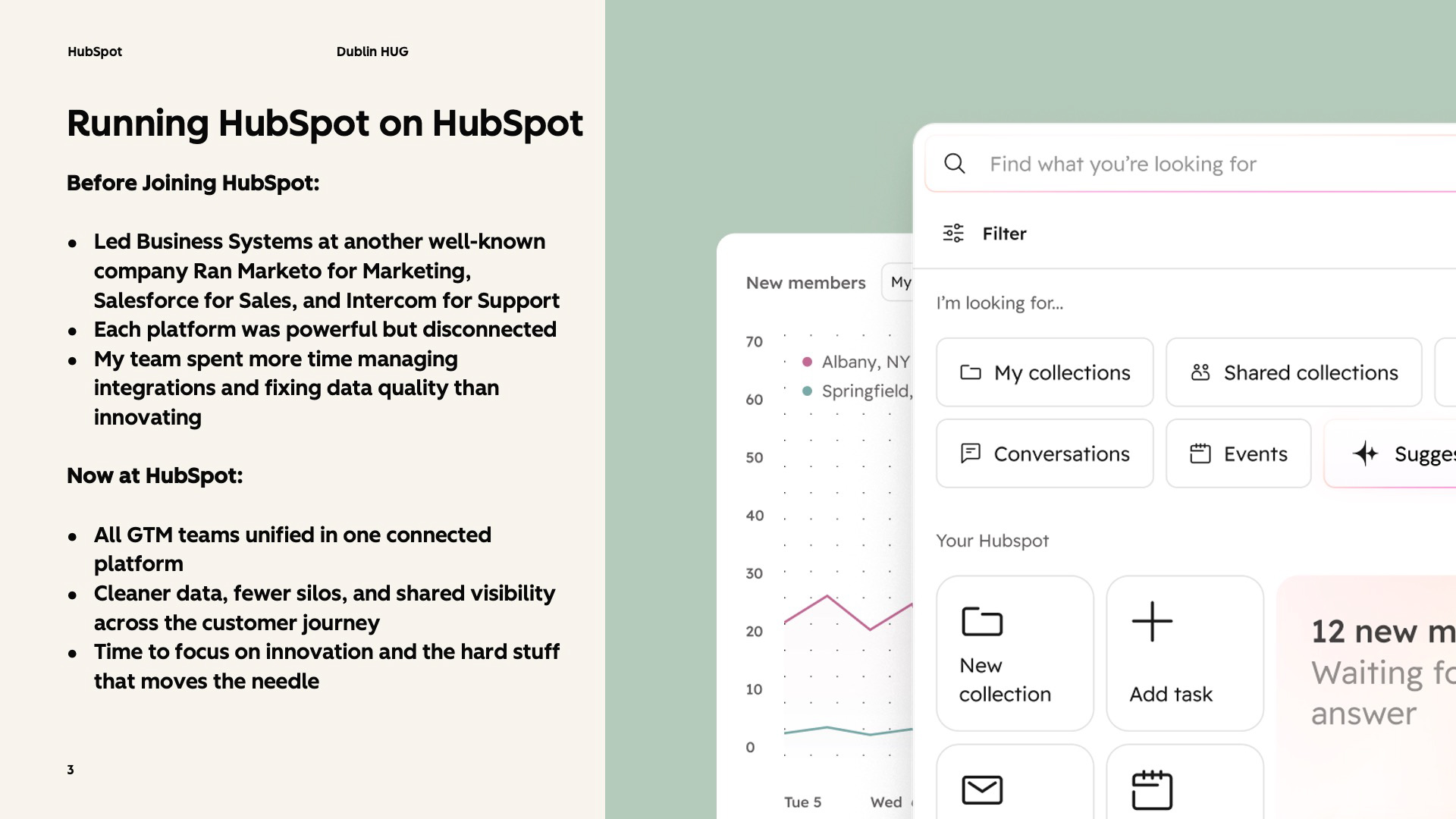
From the outset, he grounds the conversation in practical experience. Before joining HubSpot, he led business systems for another Irish company, where he managed a very different stack. That context sets up a clear before-and-after comparison between a fragmented ecosystem of best-of-breed tools and the unified environment he now operates within HubSpot.

The Pain of a Fragmented Tech Stack

Rich describes his previous technology landscape: Salesforce as the core CRM and sales platform, Marketo for marketing, and Intercom for customer support and success. He is careful to acknowledge that each of these products is “an amazing tool” and “super powerful” in its own right. The issue was not capability but connectivity. Because the tools were all separate, every meaningful workflow depended on integrations, with data being pushed and pulled between multiple systems.

The result was that his team spent an enormous amount of time maintaining integrations and managing data quality. Instead of driving change, they were trapped in operational overhead – fixing sync issues, reconciling records and dealing with “nasty” data problems. Rich explains that this left very little time to get ahead of the business or truly transform it, which was both difficult and frustrating. It led him to believe there had to be a better way to support go-to-market teams.

The Pain of a Fragmented Tech Stack
Unified on HubSpot

Unified on HubSpot: Freeing Time for Innovation

Joining HubSpot, Rich found that the company truly does run HubSpot on HubSpot, with all go-to-market teams working from the same platform and sharing a unified view of the

customer. This eliminated much of the integration complexity he had previously faced. Instead of constantly stitching systems together, his team could rely on a single source of truth and shared workflows across marketing, sales, customer success and support.

He emphasises that having the “easy stuff” actually be easy makes a meaningful difference. The absence of chronic data and integration issues meant the team could redirect their energy towards innovation, transformation and working ahead of the business. That shift in focus became critical in the next phase, as external conditions changed dramatically and AI began to reshape how prospects, customers and competitors behave.

Navigating 18 Months of AI-Driven Disruption

Rich then zooms out to the broader context of the last 18 months, which he characterises as “super hard”. AI has been transforming and disrupting “everything”, including the dynamics of inbound marketing and lead generation. He notes that the way inbound leads work is changing, with AI altering how buyers research and how companies show up in front of prospects. At the same time, the competitive landscape has intensified, with more competitors entering the market and arriving “way more prepared” thanks to AI.

He also touches on the internal pressure many leaders feel. If you are like him, he suggests, your boss is probably asking why you are not using AI to make everything “better and smarter and more efficient”. That combination of external disruption and internal expectations defines the environment his team has been operating in. Rather than resisting, they chose to lean into AI, seeing it as an opportunity to experiment and grow rather than just a source of risk.

Navigating 18 Months of AI-Driven Disruption
Leaning into AI Concrete Wins Across the Funnel

Leaning into AI: Concrete Wins Across the Funnel

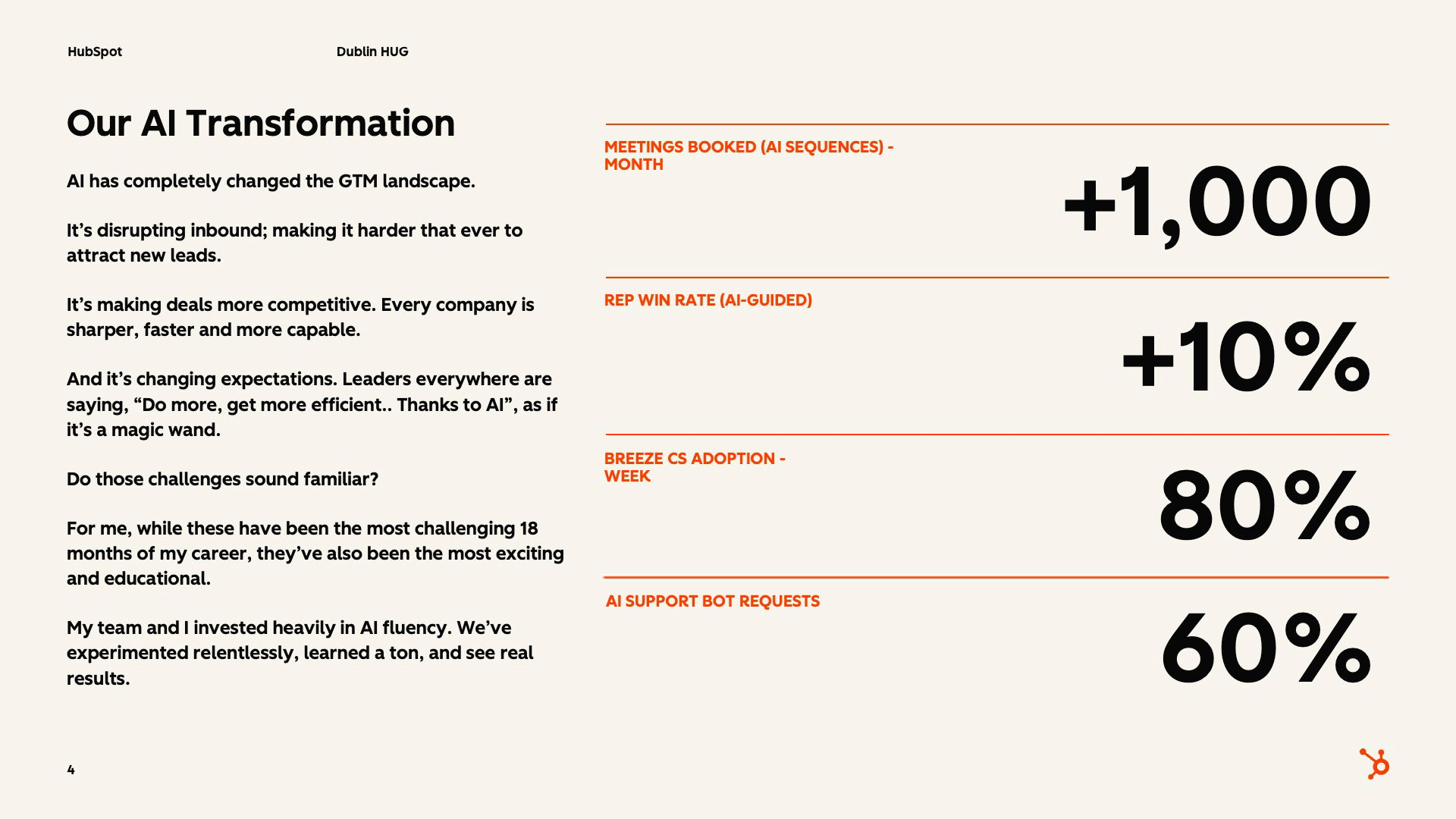
Despite the challenges, Rich says he is proud of what his team has achieved by committing to become AI-fluent and making experimentation a norm. He describes how HubSpot’s marketing team created Loop Marketing to keep inbound leads flowing during this disruptive period. On the sales side, they have used AI-powered data enrichment and sequences to book thousands of additional meetings each month for reps, leveraging the extensibility of the HubSpot CRM.

Rich then outlines several AI-driven initiatives in customer success and support. The team has built an AI-powered guided selling tool embedded directly in the sales workspace, helping reps increase their win rate by 10%. They have also developed an AI-powered customer success assistant, similar to Breeze, which 80% of customer success reps use weekly and value highly, and which contributes to improved activation and retention. Finally, an AI-powered support bot, similar to Customer Agent, now fully handles 60% of support queries with no drop in CSAT, delivering a major operational efficiency gain. He concludes this section by stressing that AI is real, here to stay, and genuinely exciting if teams are willing to lean in and learn.


Sales Workspace

Explore the latest Sales Workspace tools and how they help boost productivity and improve pipeline visibility. Katie Magorrian from HubSpot’s Customer Success team walks through real scenarios and shares best practices to help your sales team get the most out of the workspace.


✦   Dublin HubSpot User Group

Prospecting Agent & Target Account

Explore the latest AI-powered sales tools in HubSpot, including the Prospecting Agent and new Target Accounts features. Fiachrá Duffy demos what’s possible and dives into a live Q&A on how sales teams can get the most from these updates.


✦   Dublin HubSpot User Group

Prospecting Agent & Target Account

Explore the latest AI-powered sales tools in HubSpot, including the Prospecting Agent and new Target Accounts features. Fiachrá Duffy demos what’s possible and dives into a live Q&A on how sales teams can get the most from these updates.


✦   Dublin HubSpot User Group

Dublin HUG = Your  New Community 

Share the vibe, shape the next one

HUG Dublin - OCT 2025-070 (1)
IMG_4227
HUG Dublin - OCT 2025-091
HUG Dublin - OCT 2025-069
IMG_4227