Loop Marketing: How HubSpot Uses AI to Power Campaigns
Real-world examples of how HubSpot applies AI across the full campaign lifecycle.
Kieran Flanagan - Marketing, AI & GTM SVP - HubSpot
1:45 PM - 2:15 PM
In this session, Kieran Flanagan, SVP Marketing, AI & GTM at HubSpot, introduces Loop Marketing – HubSpot’s emerging playbook for acquiring, monetising and retaining customers in an AI-transformed world. Drawing on his journey from early European inbound initiatives in 2013 to today’s fragmented, AI-driven landscape, Kieran explains why traditional demand generation models are breaking and why Loop is designed to help teams adapt.
Rather than a deep tactical workshop, this segment gives a strategic overview of what has changed in search, awareness and buyer behaviour, and how marketers can respond. Kieran outlines the four core stages of Loop Marketing – Express, Tailor, Amplify and Evolve – and walks through a concrete example of how to apply this framework to AI engine optimisation so teams can stay agile and keep growing in an era of rapid disruption.
Session Summary
Kieran Flanagan’s talk into five core themes that together explain why Loop Marketing exists and how it works. Each section focuses on a distinct part of Kieran’s narrative: the context for Loop Marketing, how AI is reshaping demand and measurement, the need to prioritise taste over tactics, the four-stage Loop framework itself, and a step-by-step example of Loop applied to AI engine optimisation. The goal is to give you a clear, structured view of the playbook so you can start to consider how it might apply to your own marketing.
.jpg)
From Early Inbound to the Birth of Loop Marketing
Kieran opens by situating Loop Marketing in his longer journey with inbound. He recalls being part of a small group in an office in 2013, one of the first times inbound was seriously discussed in Europe. Returning now to introduce Loop feels like a full-circle moment: a new version of inbound, designed for a very different environment. He stresses that Loop exists because everything about how businesses acquire demand, monetise it and turn it into lasting customer relationships is changing at once.
He explains that his goal in this session is not to deliver the full, detailed Loop presentation, which would be lengthy, but to provide a focused overview. He wants to outline what has changed in the landscape and then give a clear introduction to Loop as a playbook. The fine-grained tactics and “every nuance” of how to execute it are intentionally left aside here, in favour of helping marketers understand the big shifts they are already feeling as they try to grow their businesses today.
How AI Is Disrupting Search, Awareness and Demand
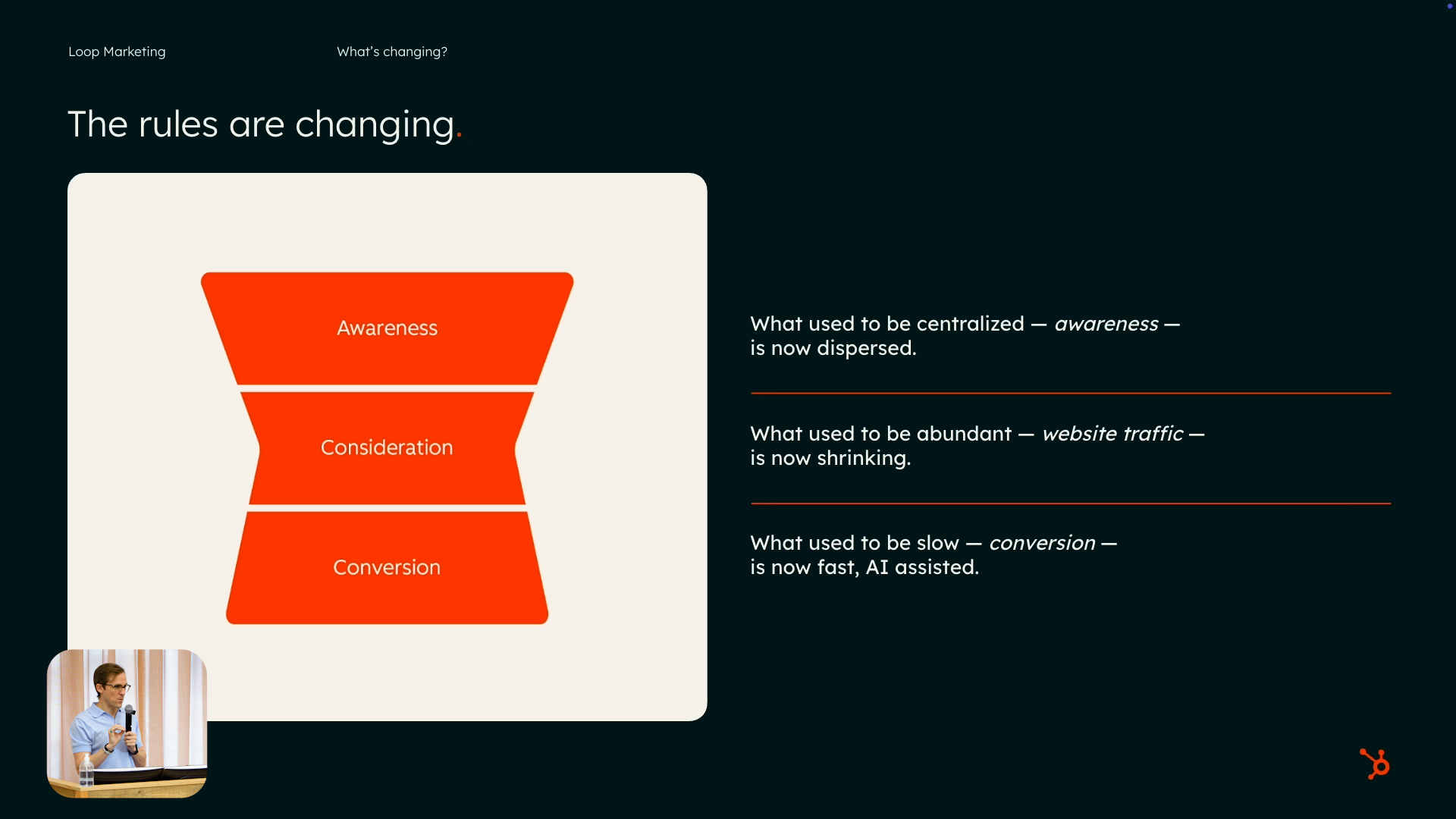
Kieran then walks through the major disruptions driving the need for a new playbook, with Google at the centre. His own career pivot from software engineering into marketing began with search and SEO, and search has been a core growth driver for HubSpot ever since. Historically, around 80% of B2B buying journeys started with a Google search. Now, he notes, it is predicted that by 2027–2028, roughly 75% of those journeys will begin in large language models instead, which is why HubSpot is investing in what he calls AI engine optimisation.
At the same time, awareness has become highly scattered and B2B is starting to resemble B2C. Even before AI, content consumption began shifting towards individual creators and human-led channels such as podcasts, newsletters and YouTube. HubSpot’s acquisition of The Hustle in 2021 was part of a deliberate move into media to meet this change. AI has accelerated the trend by disrupting traditional brand channels like search and paid, making it harder to centralise awareness or decide where to focus. Kieran notes that marketers are being stretched across too many priorities, often by founders and CEOs, and that the real challenge is focusing on what matters most.


From Volume to Value and the Need for Taste
To describe the current reality, Kieran frames this as “the era of value, not volume”. He explains that HubSpot is seeing less measurable demand at the top of the funnel: lower traffic, fewer visible clicks and rising paid costs, compounded by AI-driven changes in Google search. Yet, despite this, the team is still hitting its targets for deals and customers because AI is helping them extract more value from the demand they do have. He cites data suggesting that traffic from AI engines can convert around four times higher than traditional organic search, with some sources reporting even higher multiples, because buyers now arrive on sites having already done most of their research in an LLM and are in more of a buying mindset.
However, the pace of change makes operating in this environment extremely demanding, even for a large team used to running experiments and pilots. Planning horizons measured in quarters or half-years are now too slow; marketers need much more agile cycles. On top of this, there is what Kieran calls the “AI slop era” – channels flooded with low-quality, AI-generated content and generic comments, especially on platforms like LinkedIn. To stand out, he argues, brands must develop real taste and distinctive points of view. AI should be used as a powerful assistant for personalising and drafting content, not as a copy-and-paste engine. The old playbook of scaling content volume to win no longer works; instead, marketers must be more authentic, thoughtful and crafted in how they create.

Introducing Loop Marketing: Express, Tailor, Amplify, Evolve
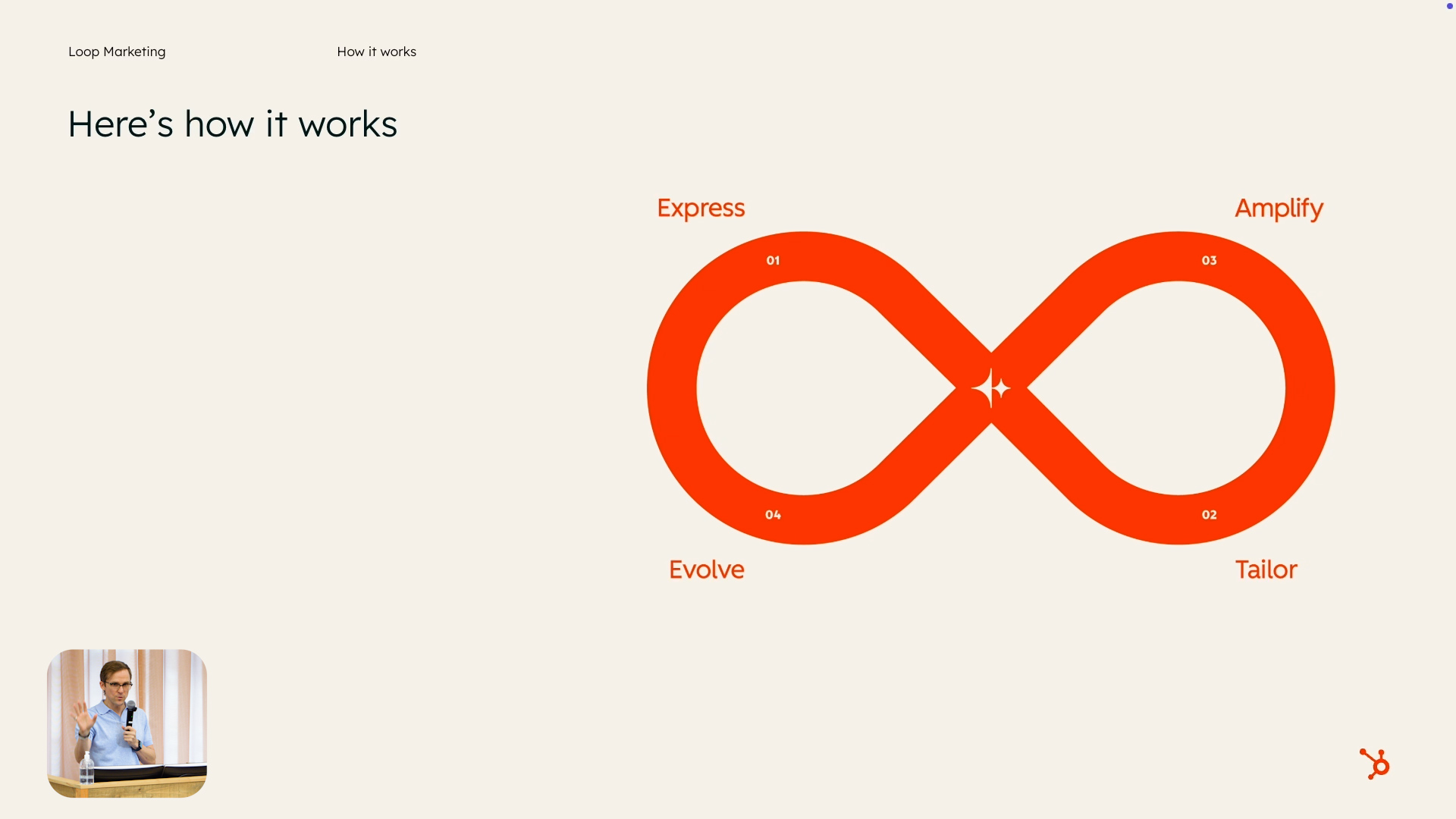
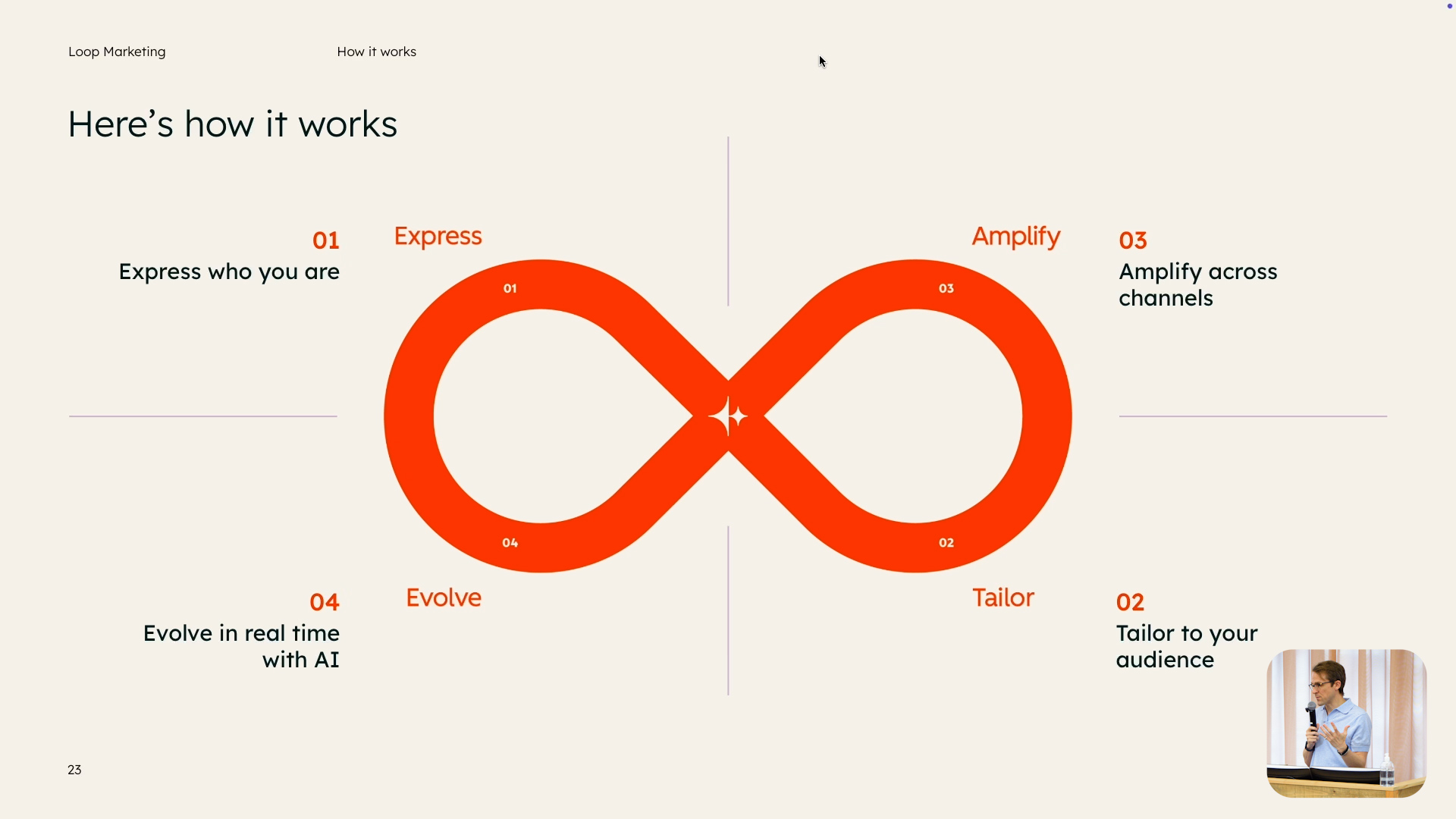
Having set the scene, Kieran introduces Loop Marketing as HubSpot’s evolving answer to these changes. The playbook currently has four core stages – Express, Tailor, Amplify and Evolve – and is still being developed and refined. He expects that HubSpot will continue to iterate on the framework and release updates as the team learns more from real-world application across channels and markets.
He spends time unpacking the first two stages. Express is about defining who you are marketing to and how you want to show up: using AI to develop buyer personas, brand voice, style guides and ideal customer profiles, often without relying solely on internal data. He notes research showing that LLMs can predict purchase intent with high accuracy based purely on language, underlining AI’s ability to mimic and model customers. Tailor is where HubSpot is seeing substantial upside today. By integrating AI across workflows that book meetings for the sales team and dynamically personalising emails using data gathered in the Express stage, they have achieved around a 30% increase in monthly meetings and a dramatic increase in conversion rate. The same principle applies to content: AI can generate first drafts tailored to specific personas and platforms, while humans add the final 20% to ensure originality and quality


Applying Loop to AI Engine Optimisation in Practice
Kieran then brings the full Loop framework to life with a concrete example: using it for AI engine optimisation. In the Express stage, a team defines its ideal customer profile (ICP) in detail, because the big difference between search and LLMs is how people ask questions. In traditional search, especially in B2B, buyers might use three to five keywords. In an LLM interface such as ChatGPT, they can ask in hundreds of different ways about products and services. Having a clear ICP allows marketers to move into the Tailor stage and use AI to generate a comprehensive list of the questions that persona could ask about their brand.
Those questions become prompts that feed into AI search tools, which can report on the brand’s share of voice: how often it appears in answers to relevant queries. The Amplify stage focuses on creating niche content – such as extensive FAQ sections – that addresses those questions, and on earning citations from authority sites and communities that LLMs use to judge credibility. The Evolve stage is about closing the loop: monitoring whether share of voice is improving, refining the ICP or prompts, expanding or pruning content and pursuing more high-value citations. Kieran describes this as “loop, loop, loop” – a continuous process designed for agility, where each iteration makes the playbook more accurate and effective. He closes by noting that HubSpot is working this way across multiple channels and will continue to launch content, tutorials and education as Loop Marketing matures.
Sales Workspace
Explore the latest Sales Workspace tools and how they help boost productivity and improve pipeline visibility. Katie Magorrian from HubSpot’s Customer Success team walks through real scenarios and shares best practices to help your sales team get the most out of the workspace.
✦ Dublin HubSpot User Group
Prospecting Agent & Target Account
Explore the latest AI-powered sales tools in HubSpot, including the Prospecting Agent and new Target Accounts features. Fiachrá Duffy demos what’s possible and dives into a live Q&A on how sales teams can get the most from these updates.
✦ Dublin HubSpot User Group
Prospecting Agent & Target Account
Explore the latest AI-powered sales tools in HubSpot, including the Prospecting Agent and new Target Accounts features. Fiachrá Duffy demos what’s possible and dives into a live Q&A on how sales teams can get the most from these updates.
✦ Dublin HubSpot User Group