Building a Connected Customer Journey with AI in HubSpot Banner-1
Stephen Higgins HubSpot

Sales Perspective: The Rise of the GTM Engineer

How AI is helping sales teams expand capacity, reduce admin, and focus on the human interactions that drive revenue.

 Stephen Higgins –  Sales Director EMEA, HubSpot

2:00 PM – 2:30 PM

Stephen Higgins explores how HubSpot is using AI across the sales organisation to reduce manual work, improve prospecting, strengthen pipeline management, and support better deal execution. The session offers a practical view of how sellers can use AI to increase productivity and decision quality without losing the human judgment that customers still value most. 

Session Recording

In this session, Stephen Higgins, Senior Sales Director at HubSpot, shares an inside look at how the company is rethinking sales in the age of AI. Filmed during an in-person event in Dublin, the recording explores HubSpot’s vision for turning traditional sales reps into “GTM Engineers” who use AI systems to research accounts, run smarter prospecting, personalise deal execution, and manage pipeline with far less manual admin.

Viewers will gain a practical understanding of how HubSpot is operationalising AI across the sales organisation to increase seller capacity, improve customer experience, strengthen forecast accuracy, and help sales teams focus on the high-value human interactions that drive better commercial outcomes.


Session Summary

The GTM Engineer: Redefining the Unit of Growth at HubSpot

From Headcount Scaling to Human-AI Sales Systems

Stephen Higgins, Senior Sales Director EMEA at HubSpot and an 11-year veteran of the company, delivered a compelling insider look at how HubSpot is fundamentally re-architecting its sales organisation around a new role: the Go-to-Market (GTM) Engineer. Drawing from his own journey—starting as a frustrated marketer who bought every bad email automation tool on the market before discovering HubSpot—Higgins made a persuasive case that AI will not replace salespeople but will instead report to them, turning individual sellers into the orchestrators of powerful AI agent teams.

Why the Linear Growth Model Is Breaking

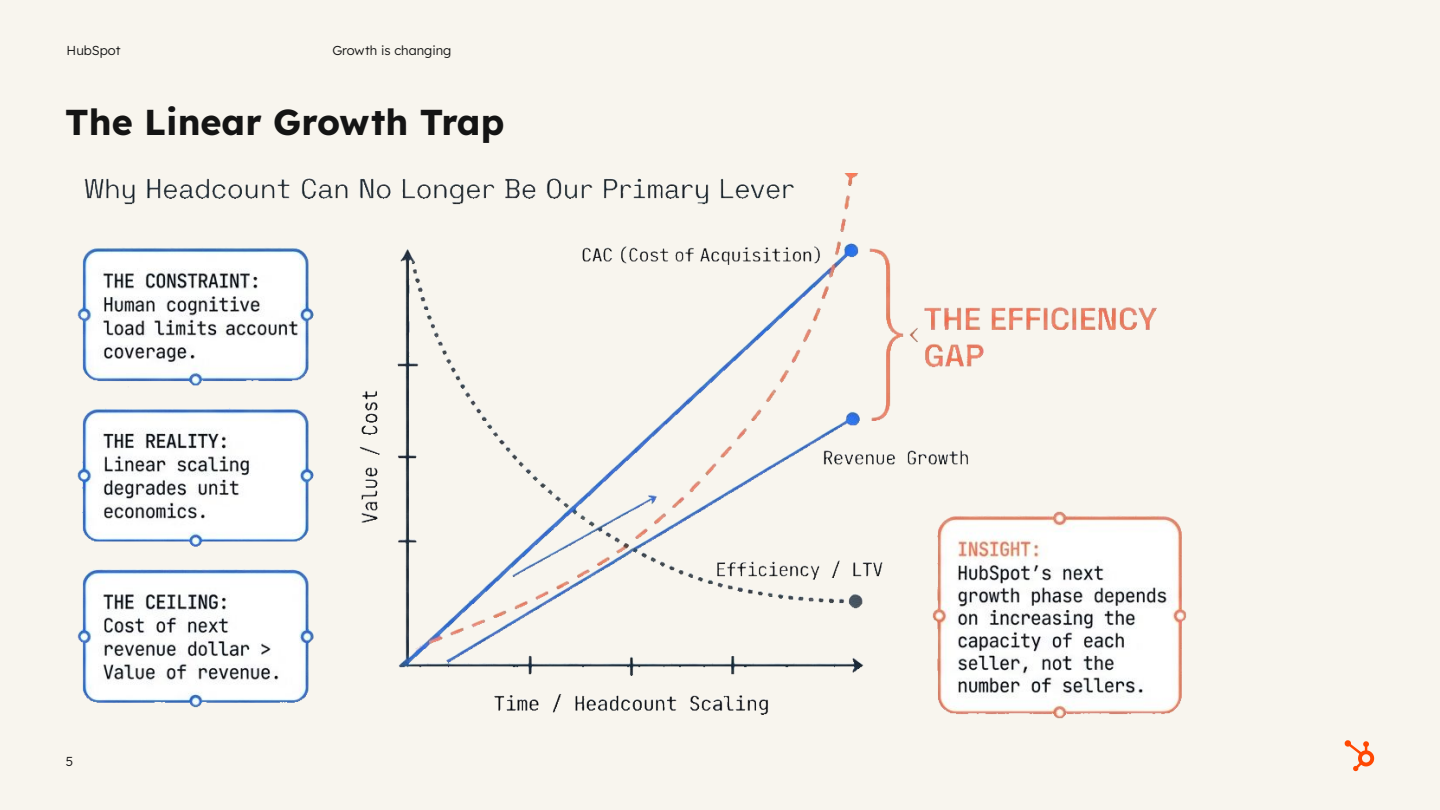
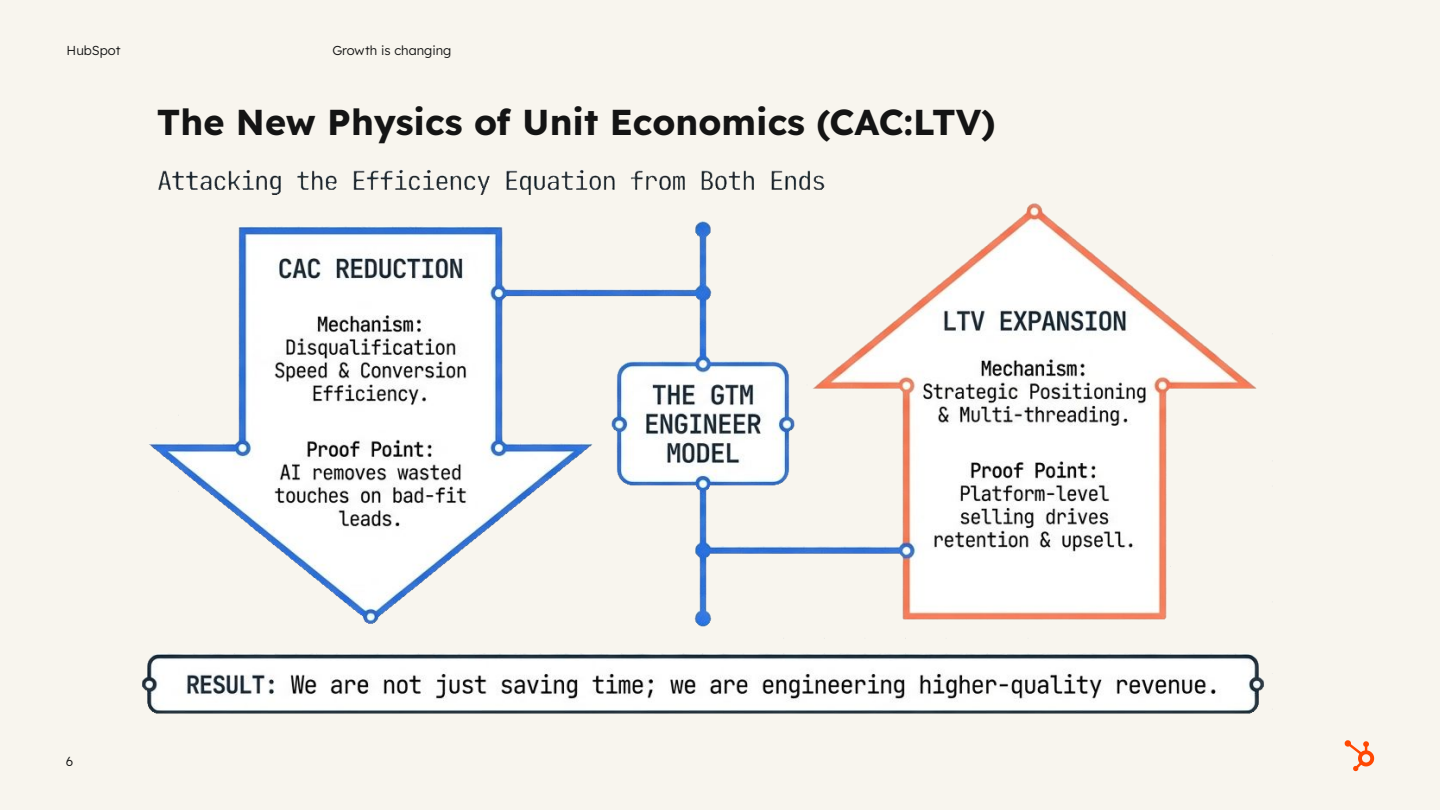
At the heart of the presentation is a hard economic truth: companies like HubSpot have traditionally grown through headcount, but human cognitive load places a hard ceiling on account coverage, and linear scaling eventually degrades unit economics. The cost of acquiring the next dollar of revenue begins to exceed the value of that revenue. HubSpot's answer is not to hire more people but to dramatically increase the capacity of each existing seller—reducing customer acquisition cost while simultaneously raising lifetime value. Higgins argued that sellers who embrace this shift will find themselves in some of the highest-paid roles in the world within two to three years, while those who refuse to adapt will be left behind.

A presenter in a white shirt gestures toward dual screens while addressing an audience in a modern conference room.

The Linear Growth Trap and New Unit Economics

Higgins opened the substantive portion of his talk by explaining why HubSpot's traditional growth playbook—adding headcount to add revenue—has reached a point of diminishing returns. Human cognitive load limits the number of accounts any individual can meaningfully work, and the administrative burden of CRM updates, research, and prospecting consumes time that should be spent on high-value conversations. The result is a "linear growth trap" where acquisition costs rise faster than revenue.

  • Human cognitive load caps the number of accounts a seller can effectively manage
  • Administrative friction—research, CRM updates, prospecting logistics—erodes quota-generating capacity
  • Linear scaling degrades economics: the cost of the next dollar eventually exceeds its revenue value
  • HubSpot's next growth phase depends on increasing per-seller capacity, not adding sellers
  • The goal is a dual-sided improvement: reduce CAC (cost of acquisition) while increasing LTV (lifetime value)
HubSpot slide illustrating the Linear Growth Trap, showing how rising acquisition costs outpace revenue growth over time.

Quota Capacity Expansion vs. Inflation

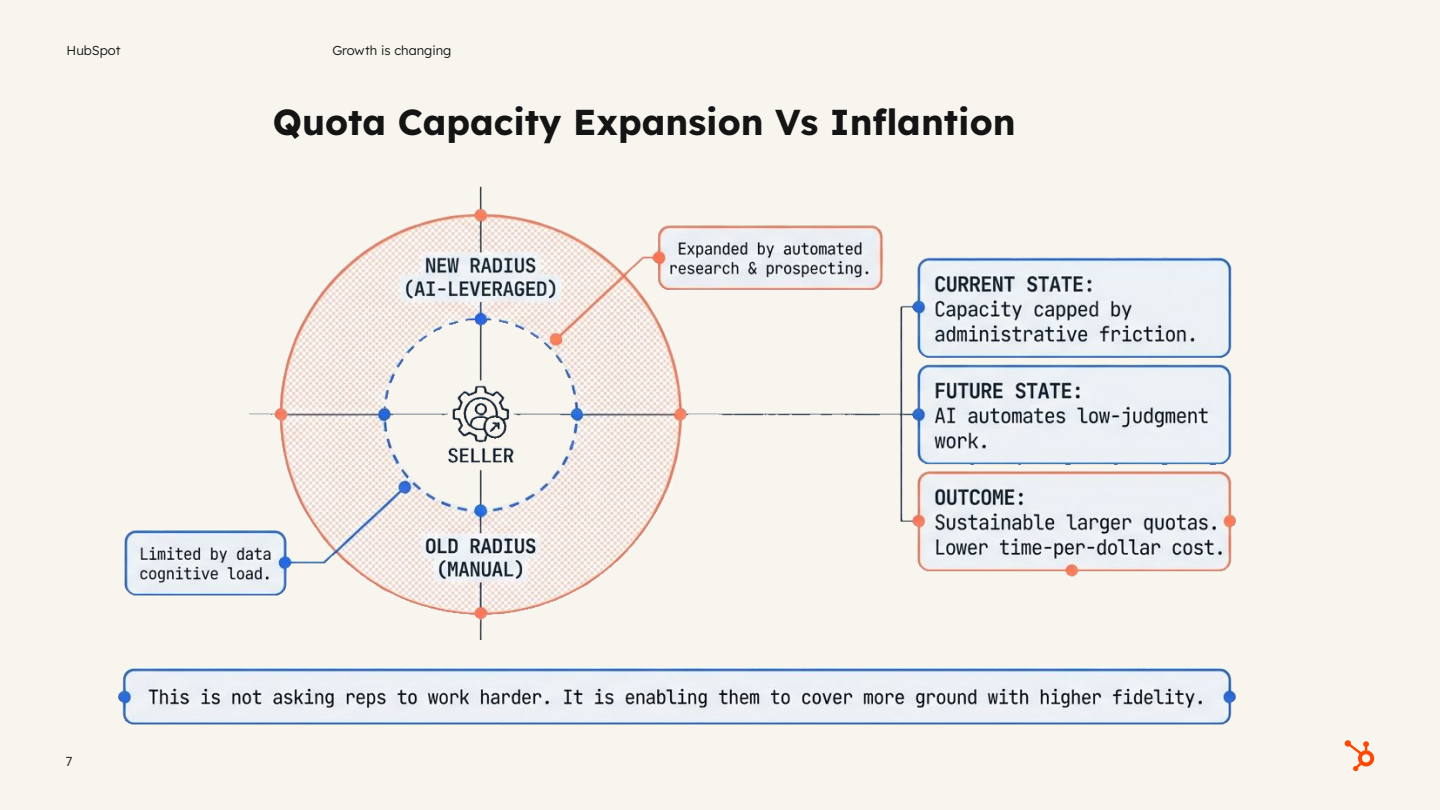
Rather than simply inflating quotas and expecting reps to grind harder, HubSpot is investing in removing the administrative friction that caps seller capacity. Higgins framed this as "quota capacity expansion"—unlocking more productive selling time by offloading research, prospecting logistics, and CRM management to AI systems, so every seller can cover more accounts and retire more quota without burning out.

  • Capacity is capped by administrative friction, not by talent or effort
  • AI automation removes the manual work that prevents sellers from having high-value conversations
  • The result is genuine capacity expansion—more accounts worked at a higher quality—rather than quota inflation
  • Sellers who adapt will earn significantly more; Higgins predicted GTM engineers will be among the highest-paid roles in the world within two to three years
HubSpot diagram comparing AI-leveraged quota capacity expansion versus inflation for sales teams with manual versus automated workflows.

Meet the GTM Engineer: A New Role Evolution

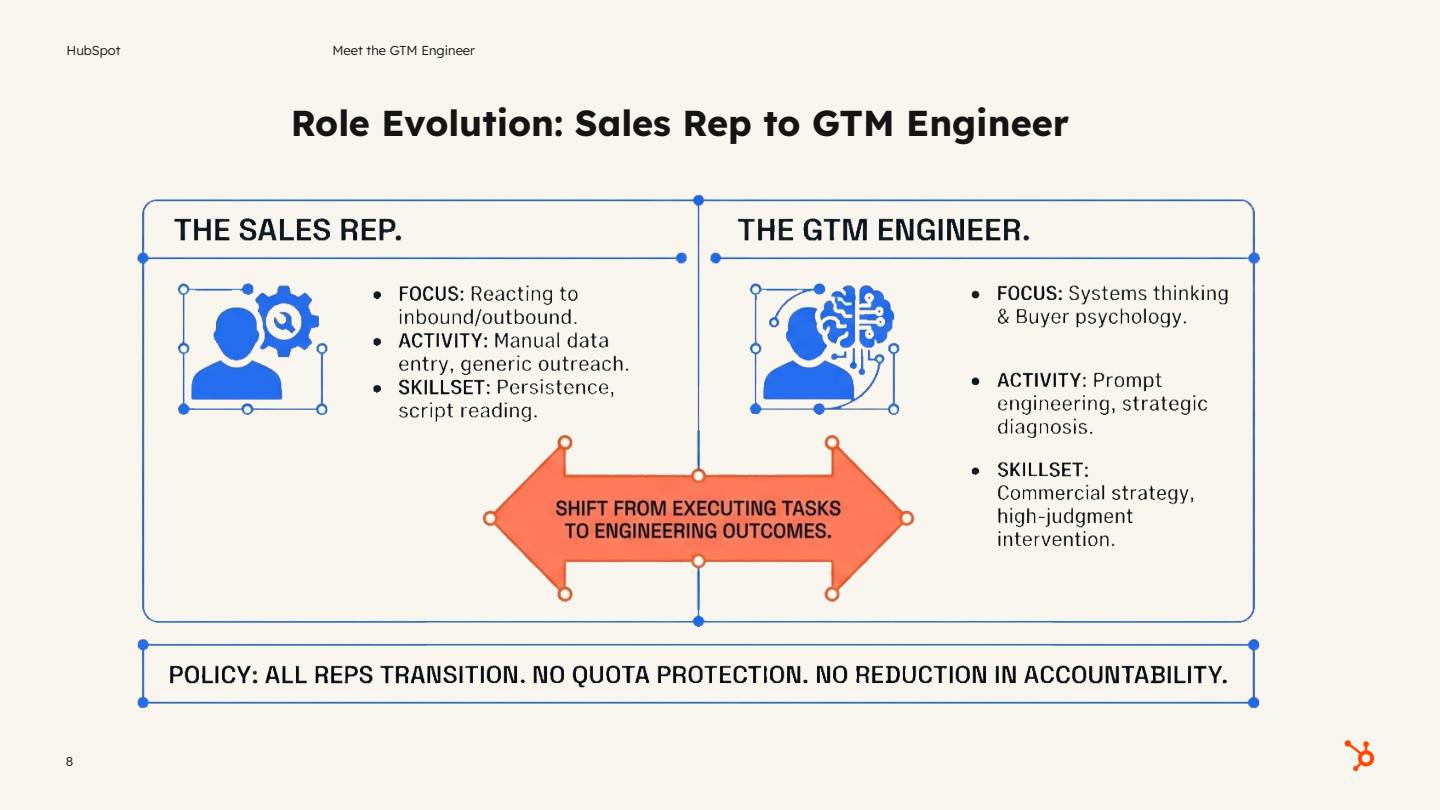
The centrepiece of Higgins' presentation was the formal introduction of the GTM Engineer as the evolutionary successor to the traditional sales rep. Where the old-world rep was reactive, activity-driven, and reliant on manual data entry and generic outreach, the GTM Engineer is a systems thinker who understands buyer psychology, acts as a prompt engineer capable of strategic diagnosis, and brings commercial strategy and high-judgment intervention to every deal.

  • Traditional sales rep focus: reacting to inbound/outbound, manual data entry, generic outreach, persistence, and script reading
  • GTM Engineer focus: systems thinking, buyer psychology, prompt engineering, strategic diagnosis, commercial strategy
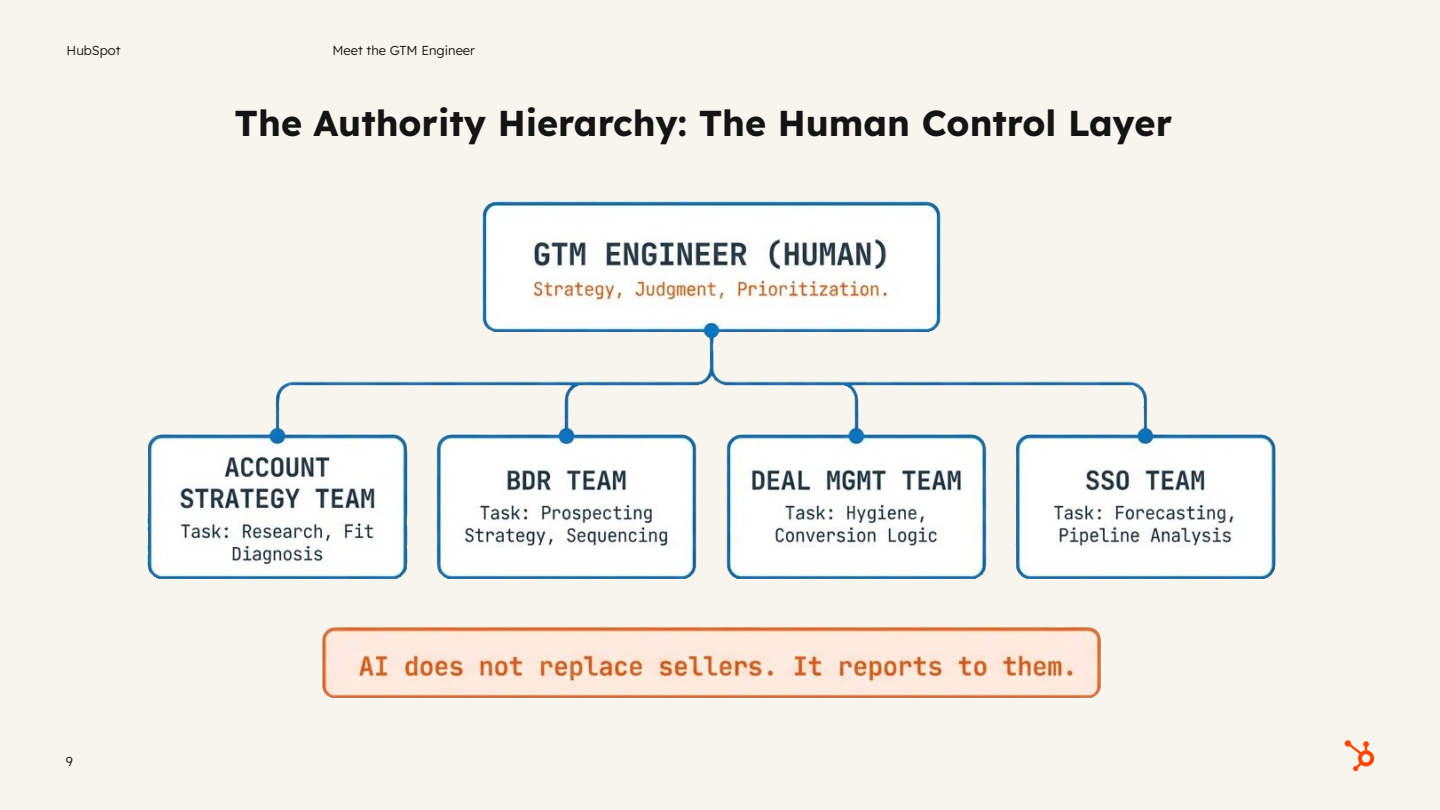
  • The GTM Engineer functions as "an enterprise unto themselves"—orchestrating AI teams that handle research, prospecting, deal management, and forecasting
  • AI does not replace the seller; it reports to the seller
  • The human remains the context layer and validation layer that buyers trust
HubSpot slide comparing the traditional sales rep role to the new GTM Engineer role evolution.

The AI Authority Hierarchy: Four Agent Teams

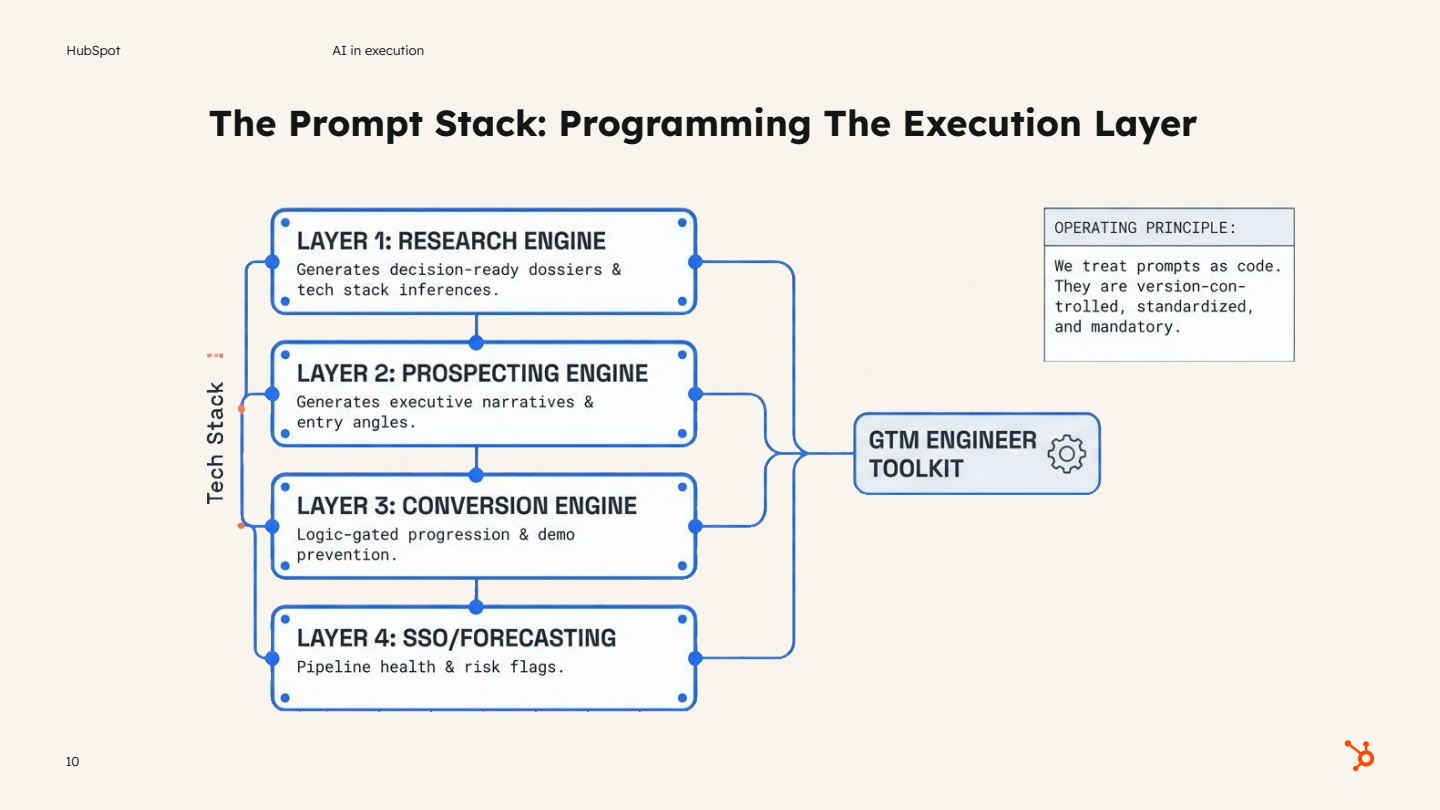
Higgins revealed what he called HubSpot's "insider secret"—the detailed architecture of AI agent teams that report to each GTM Engineer. He described it as the most powerful organisational structure ever designed in sales, with the human sitting at the top of an authority hierarchy overseeing four specialised AI teams. HubSpot is building all of this internally first ("eating their own dog food") and plans to make it available to all HubSpot customers.

1. AI Account Strategy Team

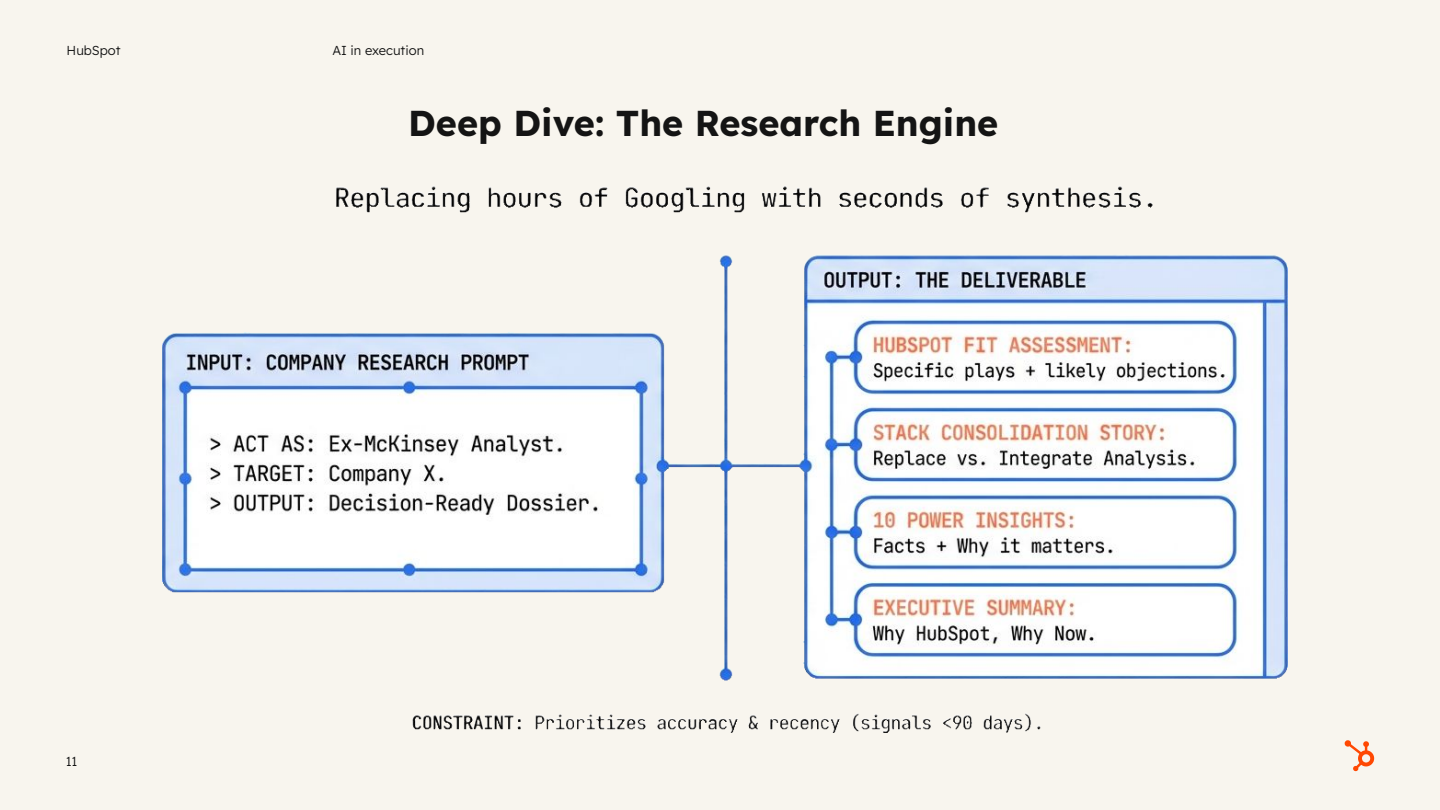
When a HubSpot salesperson receives their roughly 400 net-new accounts, the AI Account Strategy Team acts as a room full of McKinsey-level consultants. They research every account in depth—key stakeholders, business model, go-to-market strategy, tech stack, competitors—and build a complete account plan for each one, including recommended products, talk tracks per persona, and optimal timing.

  • Builds full account plans for all 400 accounts instantly
  • Identifies key stakeholders, business context, competitive landscape, and tech stack
  • Recommends which products to position and provides persona-specific talk tracks
  • Gives the GTM Engineer a research-complete starting point before any outreach begins

HubSpot GTM Engineer authority hierarchy diagram showing human control layer over AI agent teams in sales operations.

2. AI BDR Team

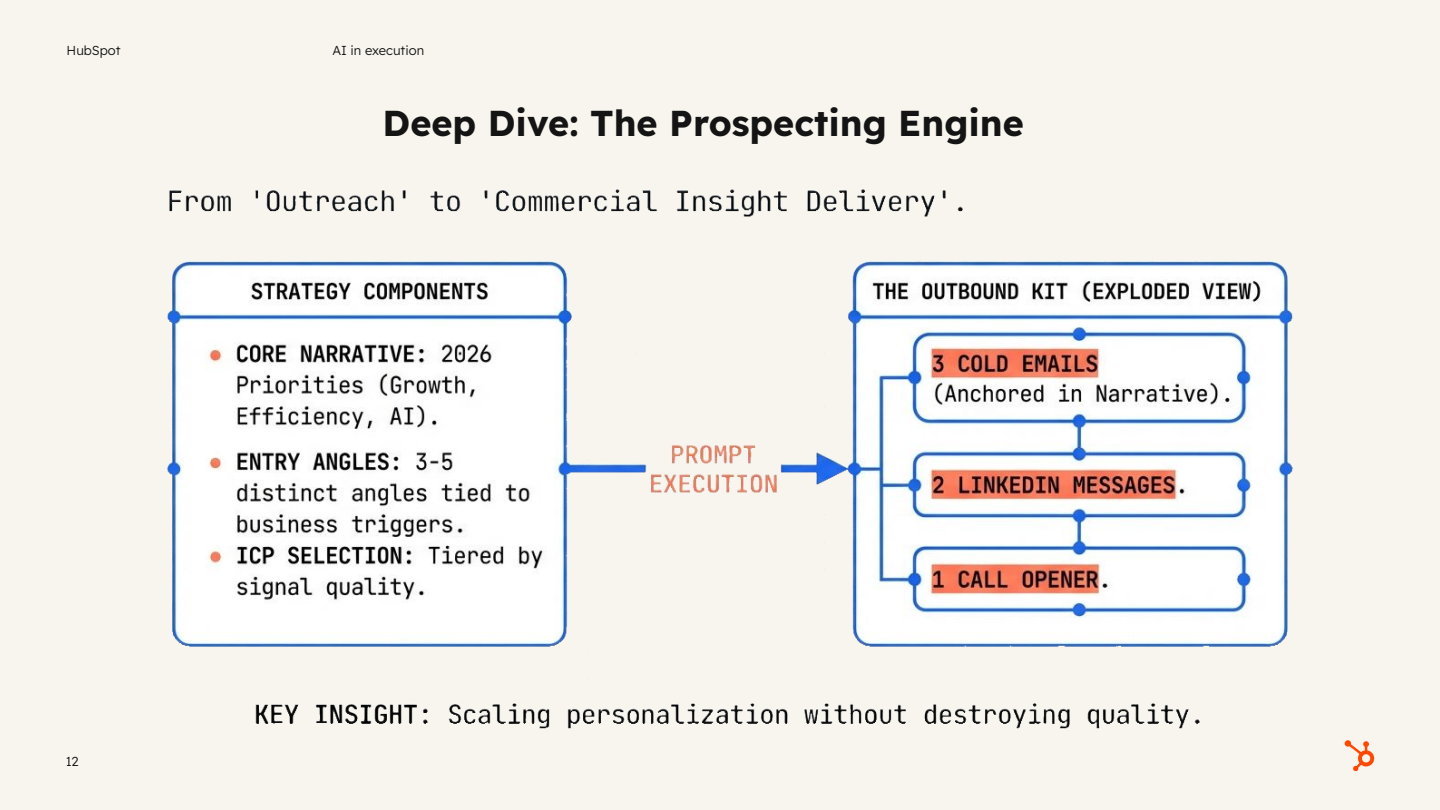
The researched accounts are then handed to an AI BDR team that Higgins described as "the best BDR team in SaaS"—they never stop working, never take holidays, and operate from the highest-quality information possible. This team builds prospecting strategies per account, constructs multi-channel sequences (email, LinkedIn, phone), and critically, queues the human to step in only when high-value intent signals appear.

  • Builds per-account prospecting strategies and multi-channel sequences
  • Operates autonomously across email, LinkedIn connections, and other touchpoints
  • Queues the human for phone calls based on intent signals—downloads, clicks, chat requests
  • Provides BDR teams with complete scripts and talk tracks when handing off leads
  • Runs a 360-degree feedback loop: failed outreach feeds back into the account strategy system, which refines the approach and re-launches—"every time it fails, it actually gets better"
HubSpot prospecting engine diagram showing strategy components and outbound kit for AI-driven commercial insight delivery.

3. AI Deal Management Team

Once leads convert into active opportunities, they are passed to the AI Deal Management Team—another set of virtual McKinsey consultants. This team builds the assets needed to run an exceptional, bespoke sales process from discovery through to close, ensuring a world-class customer experience regardless of the rep's tenure or experience level.

  • Builds persona-specific discovery decks based on company size, industry, role, and context
  • Creates bespoke demo experiences tailored to the pain points uncovered during discovery
  • Generates business proposals, pricing recommendations, and negotiation talk tracks
  • Enables guided selling where counter-offers feed back into the engine for real-time adjustment
  • Recommends the right products and tiers to start with, improving revenue retention by avoiding over-selling
HubSpot's four-layer AI prompt stack diagram for programming GTM execution, from research to forecasting.

4. AI Sales Strategy & Operations (SSO) Team

The final layer addresses the admin nightmare of managing deals in the CRM. The AI SSO team takes all context from the previous three stages and provides continuous pipeline management, forecast analysis, and strategic guidance—eliminating the need for managers to chase reps for deal updates.

  • Performs continuous pipeline analysis—30, 60, 90, and 120-day forecasts
  • Identifies red flags and weaknesses in the pipeline proactively
  • Delivers pinpoint forecast accuracy without manual CRM updates
  • Frees sellers from administrative reporting so they can focus on selling
  • Keeps all deal data current and actionable for management review
HubSpot AI Research Engine diagram showing company research prompt input and decision-ready dossier output deliverables.

The Self-Learning 360 Platform Effect

One of the most compelling aspects of the architecture Higgins described is the continuous feedback loop across all four AI teams. When prospecting fails, the failure data feeds back into the account strategy system, which refines the approach and re-launches the outbound motion. This means the system improves with every interaction—successful or not—and is only possible because all components operate on a single integrated platform.

  • Failed outreach automatically improves the next outreach cycle
  • The platform functions as a large-scale, always-running experiment
  • Integrated data means every touchpoint learns from every other touchpoint
  • Customer interactions become more relevant and less annoying over time
  • This self-reinforcing loop is a core argument for why a unified platform beats point solutions
HubSpot slide illustrating the GTM Engineer Model for improving CAC:LTV unit economics through dual-sided efficiency optimization.

How Sales Management Changes

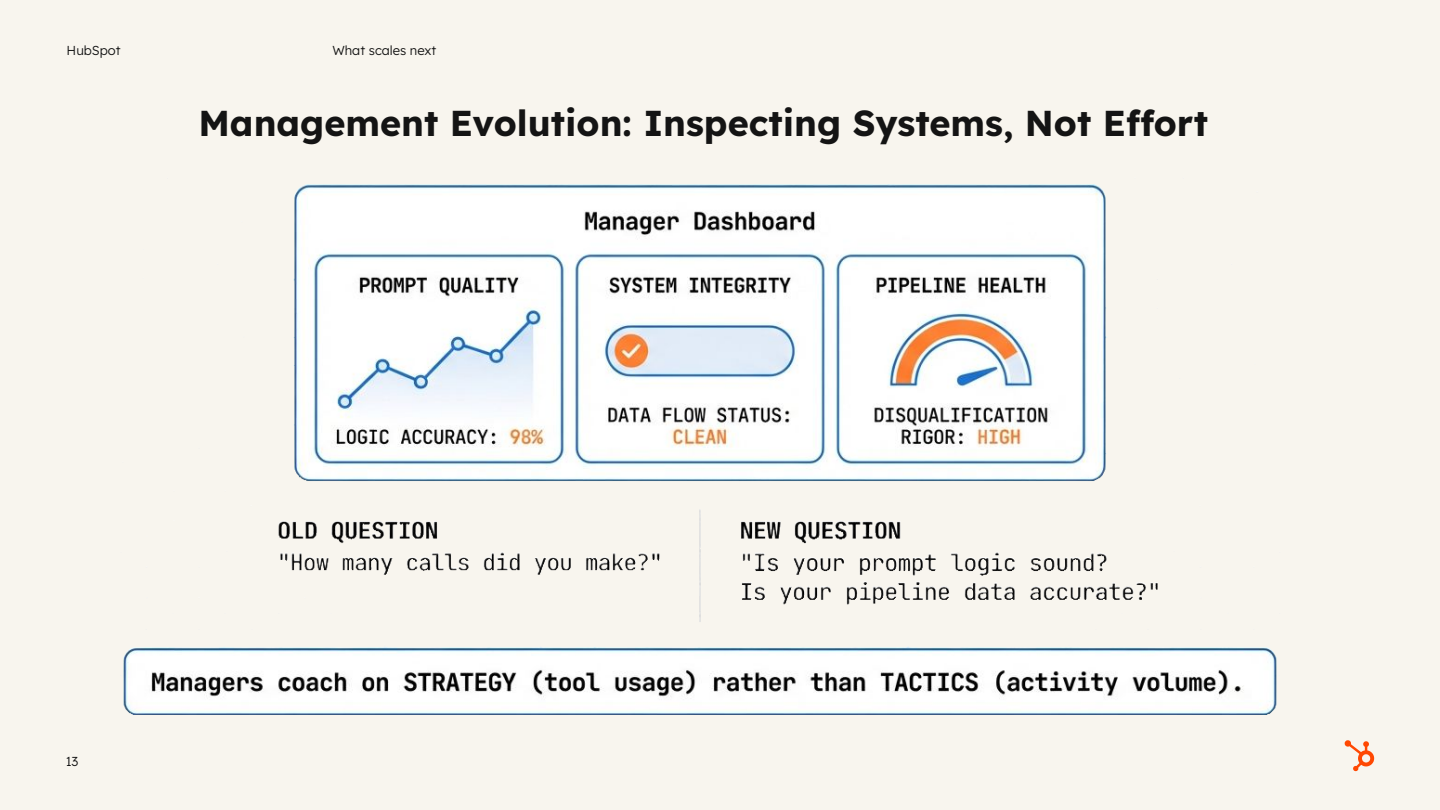
The GTM Engineer model doesn't just transform the seller's role—it fundamentally changes what managers inspect and coach on. The old management question of "how many calls did you make today?" becomes irrelevant in a world where AI handles activity volume. Instead, managers must evaluate the quality of the systems their sellers are building and operating.

  • Old question: "How many calls did you make today?"
  • New questions: "How sound is your prompt logic?" — "Is your pipeline data accurate?" — "Show me how your SSO agent is performing"
  • Managers inspect AI system health, not human activity volume
  • Coaching shifts to system optimisation—how bespoke and well-tuned are the seller's prompts and agent configurations?
  • The toolkit is provided by the company; the seller's skill is in how well they customise and optimise it
HubSpot slide showing management evolution from tracking activity volume to inspecting AI systems, prompts, and pipeline health.

Prompt Engineering as a Core Sales Skill

A significant portion of HubSpot's current enablement investment is teaching sellers to become effective prompt engineers. Higgins noted that early AI adoption at HubSpot suffered from people "using AI like Google"—typing simple queries rather than crafting structured prompts. The difference in output quality when sellers learn proper prompt engineering is, in his words, "a game changer."

  • HubSpot is actively training its sales force in prompt engineering
  • Sellers receive a prompt stack they can build upon and customise
  • Early AI usage was poor because people treated AI tools like search engines
  • Structured prompting produces dramatically better results from the same tools
  • The ability to build and optimise prompts is becoming a differentiating career skill
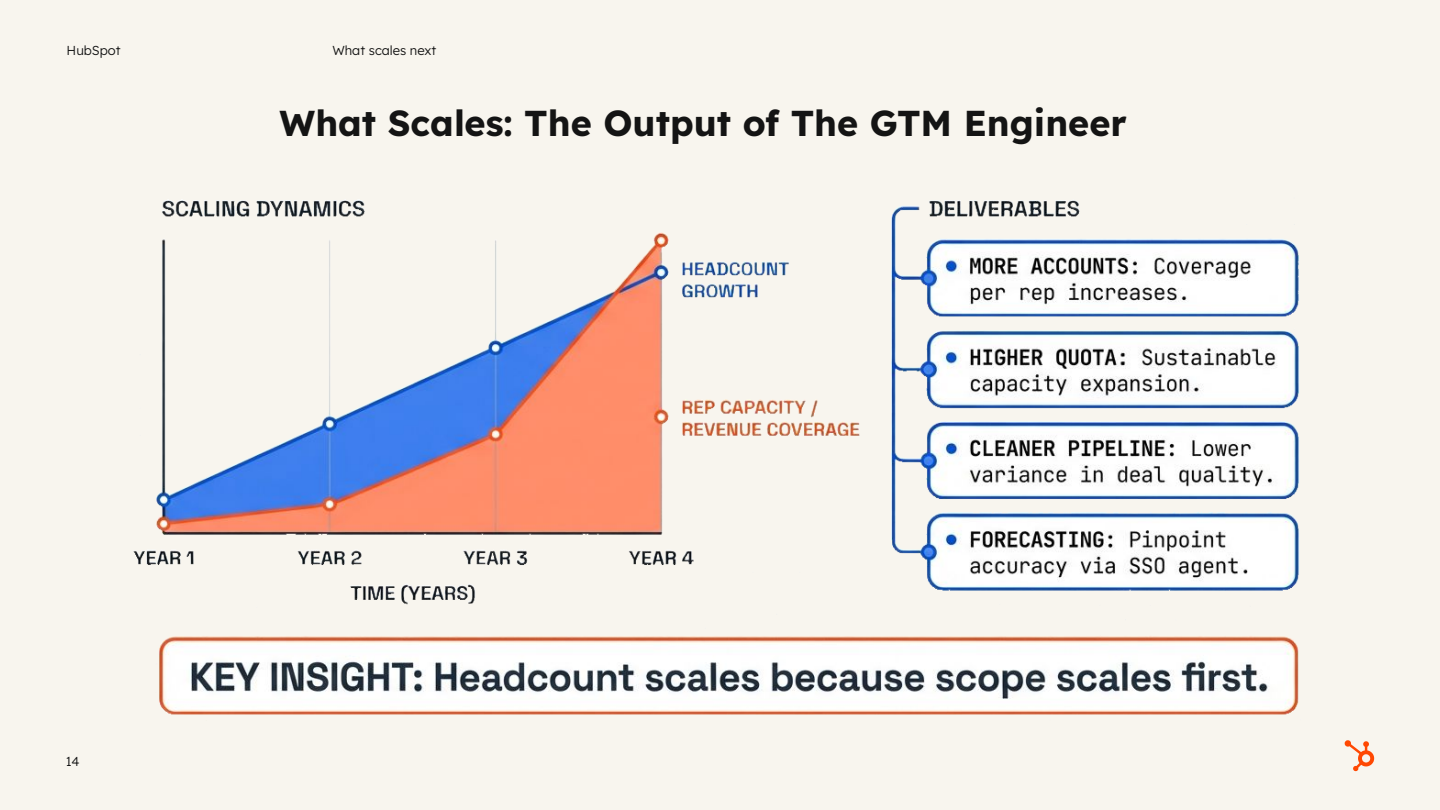
HubSpot slide showing GTM Engineer scaling dynamics chart comparing headcount growth versus rep capacity over four years.

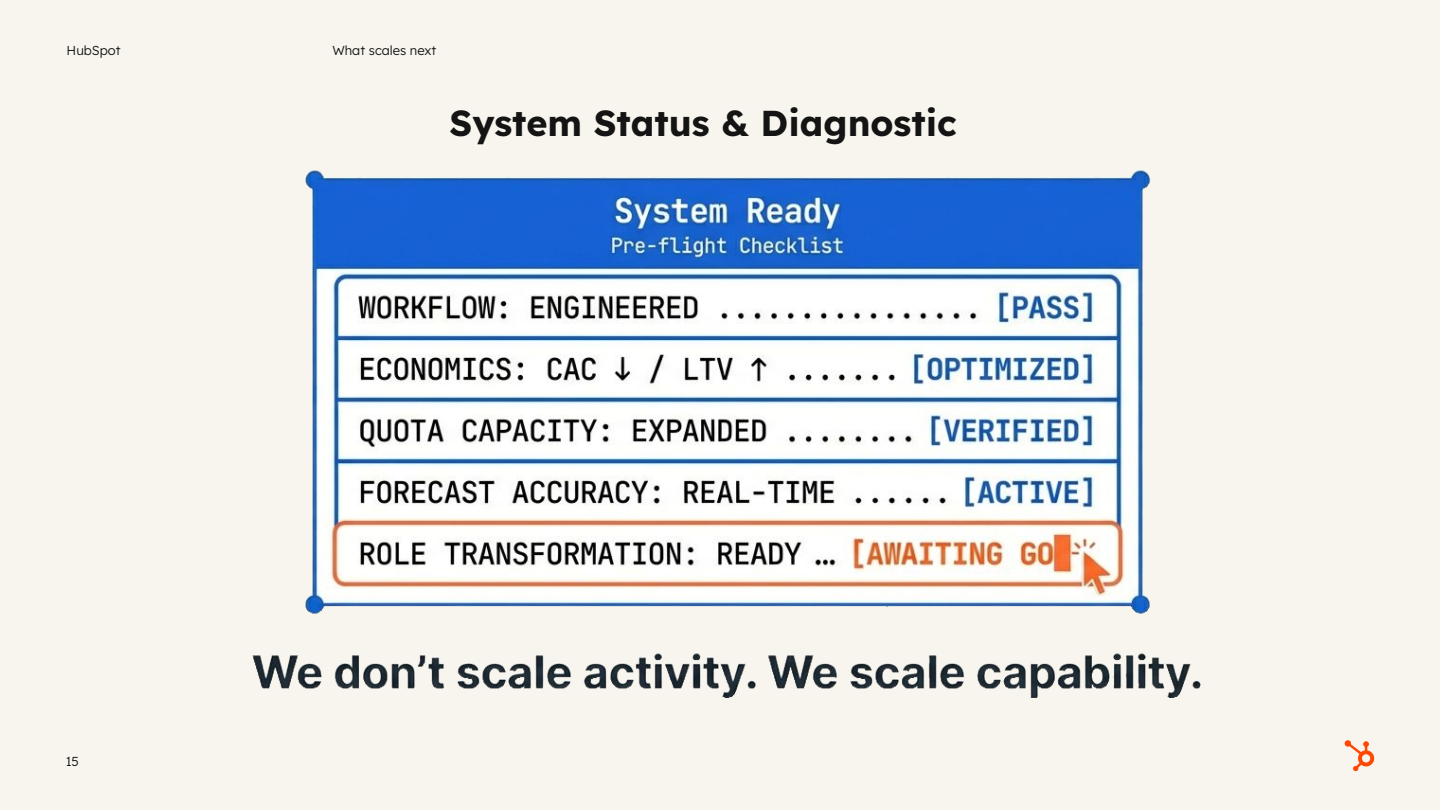
Scaling Dynamics and the Pre-Flight Checklist

Higgins shared HubSpot's system diagnostic framework—a pre-flight checklist for determining whether the GTM Engineer model is working. The metrics focus on whether workflow engineering is sound, unit economics are improving, quota capacity has expanded, forecast accuracy is real-time, and role transformation is underway. Crucially, what would have previously been a five-year transformation is being executed by end of year.

  • Workflow engineering: Are AI systems properly configured and operational?
  • Unit economics: Is CAC:LTV ratio improving?
  • Quota capacity: Has per-seller scope meaningfully expanded?
  • Forecast accuracy: Is it real-time and reliable?
  • Role transformation: Have sellers adopted the GTM Engineer mindset?
  • Timeline: what was once a five-year plan is now an end-of-year target
  • HubSpot plans to make all of these tools available to its customers
HubSpot system status diagnostic slide showing pre-flight checklist for scaling sales capability with workflow and economics metrics.

The Human Context Layer Is Non-Negotiable

Higgins closed with a clear message: the human context layer is the most important part of the AI equation. Buyers love using AI for research but still want to validate with a human. The GTM Engineer's role as the trusted validation point is what makes the entire system work. AI is "useless without you," he told the audience, urging everyone to view AI as something that reports to them and scales their individual capabilities.

  • Buyers use AI for research but validate with humans
  • The human is the trust layer that completes the AI-driven sales motion
  • People who refuse to change will be left behind
  • Now is the ideal time to get into sales—the opportunity is unprecedented
  • The key lesson: make AI report to you, not the other way around
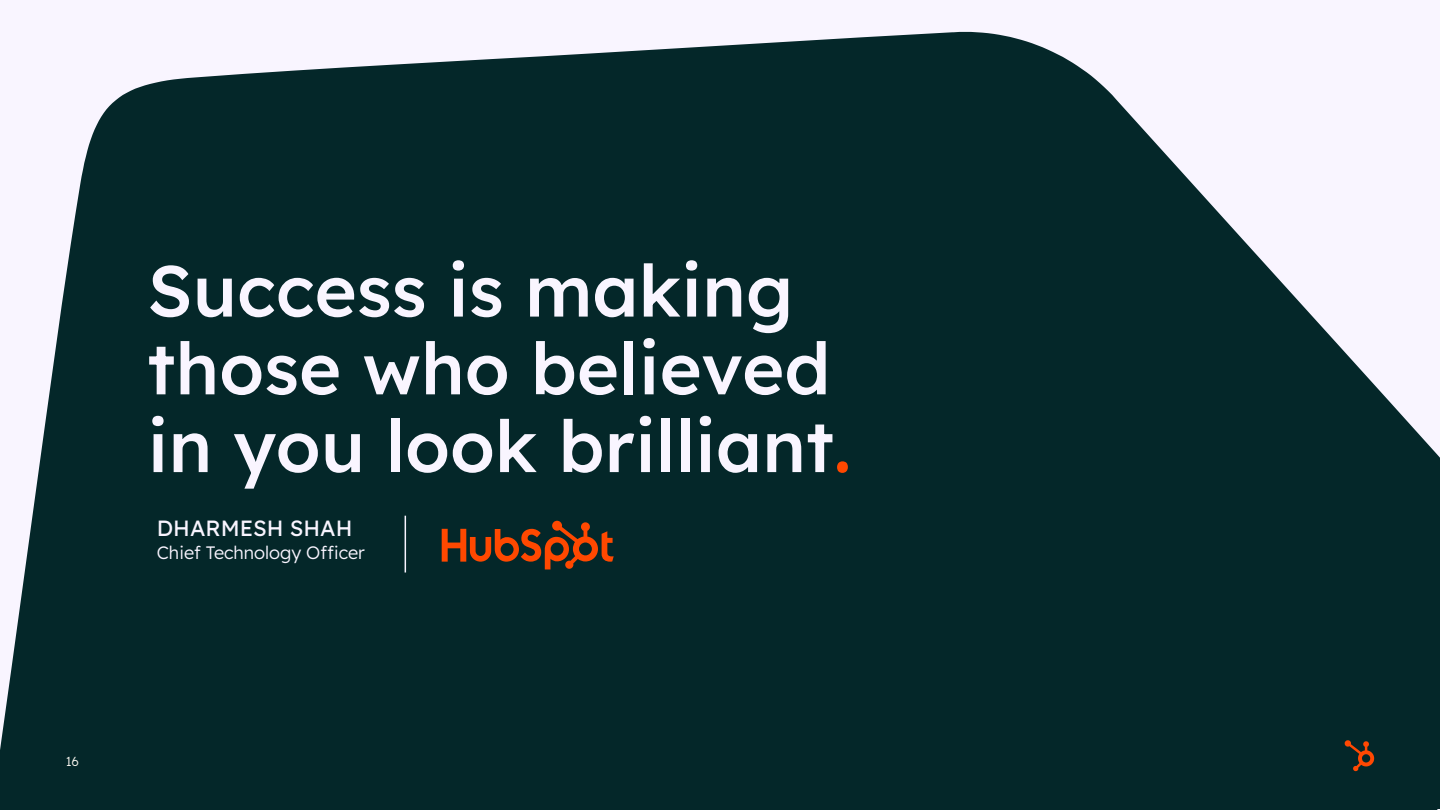
Inspirational quote by Dharmesh Shah, HubSpot CTO: Success is making those who believed in you look brilliant.

Questions & Answers

No formal audience Q&A was captured in this session's transcript. Higgins referenced that his presentation was preceding (or interrupting) a Q&A segment, and he also posed several rhetorical questions to the audience during his talk:

  • Implied Q: Will AI take sales jobs?
    A: "I don't think so" — AI will report to sellers, not replace them. The GTM Engineer role elevates salespeople into orchestrators of AI teams, making them more valuable and higher-earning.
  • Implied Q: Who gets left behind?
    A: People who won't change. Those who refuse to learn prompt engineering and AI system management will struggle, while the traditional "smooth talker" who adapts may actually become even better.
  • Implied Q: When will these tools be available to HubSpot customers?
    A: HubSpot is building everything internally first and plans to release it to customers. The first two agent layers (Account Strategy and BDR) are well advanced, with Deal Management and SSO in active development. The full transformation is targeted for completion by end of year.
  • Implied Q: How important is prompt engineering for AI results?
    A: It's a "game changer" and "totally, totally different." HubSpot's early AI usage was poor because people used AI like a search engine; structured prompting dramatically improves output quality.
“AI is not going to replace sellers. It's actually just going to report to them. The go-to-market engineer is somebody who is a master at building systems where they are the human contact layer. This will be one of the highest paid jobs in the world.”
Stephen Higgins
Senior Sales Director EMEA, HubSpot

Live Session Transcript

Follow along in real time, then easily copy the full transcript or your favourite snippets to use with your LLM of choice for questions or content creation.

Built on HubSpot - Powered by avgen.ai (alpha) by Cat Media

Dublin HUG = Your  New Community 

Share the vibe, shape the next one

HUG Dublin - OCT 2025-070 (1)
IMG_4227
HUG Dublin - OCT 2025-091
HUG Dublin - OCT 2025-069
IMG_4227