


Session Summary 
The AEO Playbook: How To Show Up in AI Search
The Search Landscape Is Being Rewritten by AI
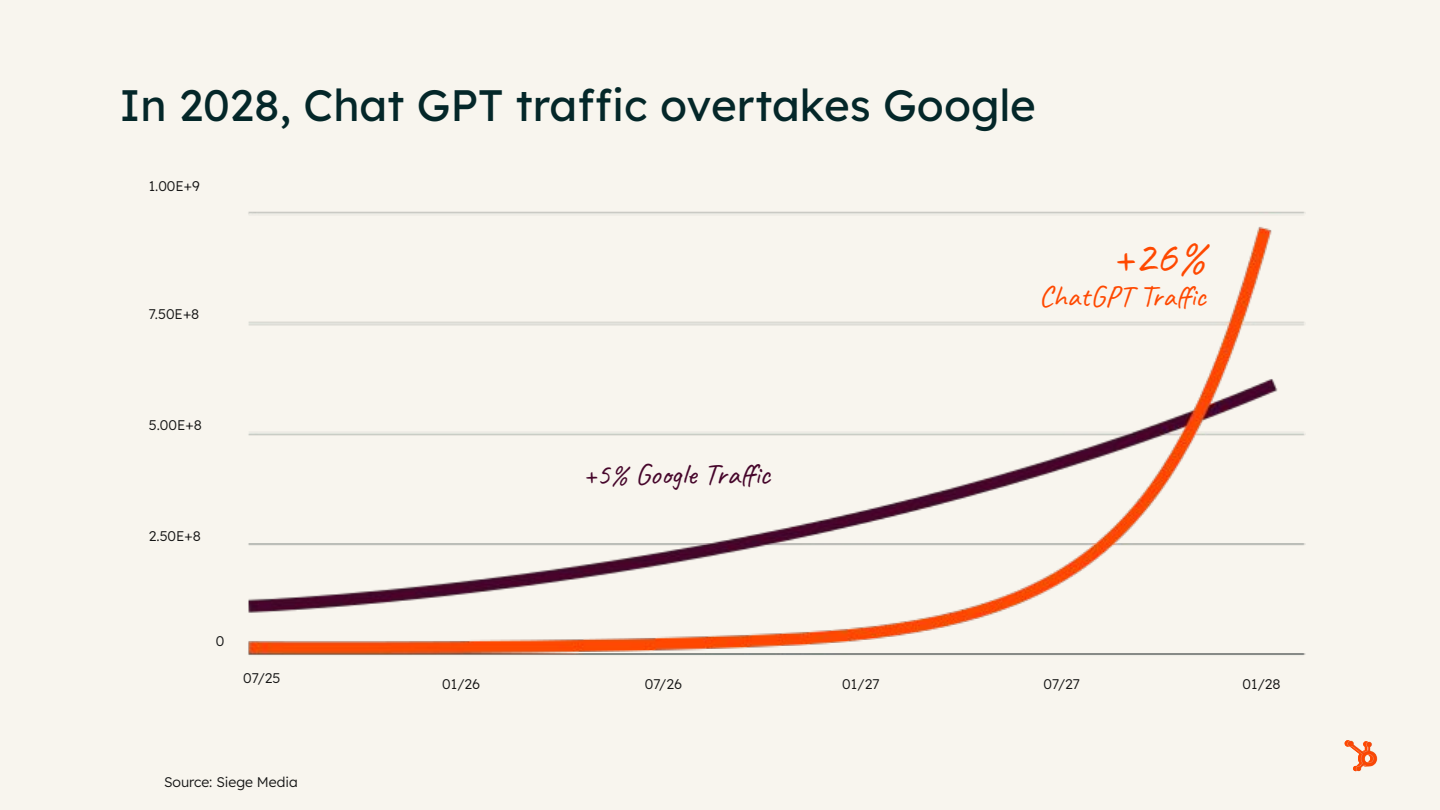
Rakky Curvelo, Senior Brand and PR Marketing Manager at HubSpot Brazil, delivered a compelling keynote on how the rules of search visibility are fundamentally shifting. For over two decades, the marketing playbook was straightforward: publish content, optimize for Google, earn clicks, and nurture prospects through the funnel. That era is rapidly ending. With ChatGPT traffic projected to overtake Google by 2028—growing at 26% versus Google's 5%—and Google AI Overviews already appearing in six out of ten searches and cutting click-through rates in half, brands must rethink how they earn attention online. The question is no longer whether to adapt, but how quickly teams can pivot to this new paradigm.
From Clicks to Citations: A New Kind of Visibility
Rakky introduced Answer Engine Optimization (AEO) as the evolution of SEO—a discipline focused not on ranking in blue links, but on becoming the brand that AI tools quote when users ask questions. At HubSpot, this shift has already produced dramatic results: an 1,850% increase in AI-sourced leads and 3× better conversion rates from AI traffic. The session walked attendees through the mechanics of AEO, from how AI models process meaning through vector space rather than keywords, to the specific content structures and off-site signals that determine which brands get cited. The core message was clear: brands that make their content machine-readable, entity-rich, and externally validated will win the next decade of search.
What's Changing: The Great Decoupling of Impressions and Clicks
Rakky opened with a stark illustration of the seismic shift in search behavior. The traditional journey—Google search → blog → content offer → product page—was linear and predictable. Today, AI-powered search tools deliver answers directly, meaning users enter the funnel much later but with far higher intent. Google's own AI features are accelerating this trend: impressions are rising while clicks are falling, a phenomenon SEO expert Darvin Santos calls "the great decoupling."
- ChatGPT traffic growth (26%) is projected to surpass Google (5%) by 2028
- Google AI Overviews now appear in ~60% of searches and halve the click-through rate
- Impressions trend upward while clicks trend downward—doing SEO "right" no longer guarantees traffic
- Users complete their research inside AI tools and arrive at product pages ready to buy, entering the funnel at a later stage
- HubSpot has measured 3× higher conversion rates from AI-sourced traffic compared to traditional search
Traditional Search vs. AI-Powered Search: Two Different Journeys
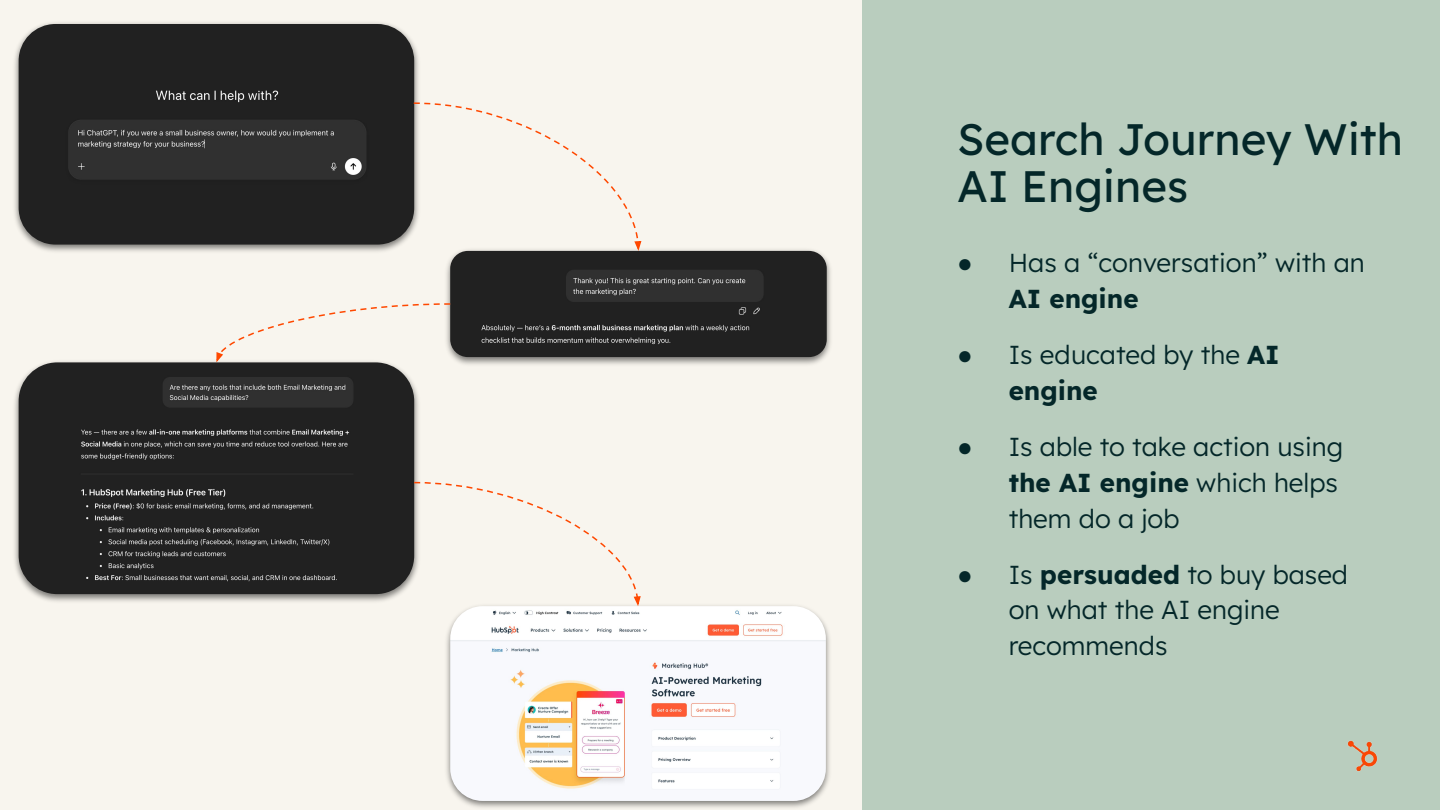
Rakky contrasted the old and new user journeys side by side to illustrate why AEO demands a fundamentally different approach. In the traditional model, a user types a keyword into Google, clicks through to a blog, downloads a content offer, and eventually reaches a product page. In the AI-powered model, the user asks a conversational question, receives a synthesized answer immediately, and—if your brand is part of that answer—clicks directly to your product page, bypassing the top and middle of the funnel entirely.
- Traditional: Keyword → SERP → Blog → Content Offer → Product Page (linear, click-dependent)
- AI-Powered: Conversational question → AI answer with brand citation → Product Page (compressed, conversion-ready)
- The AI tool provides the overall answer, and users go straight to the conversion path
- This makes AI tools an incredibly valuable demand source—not just a visibility channel
What Is Answer Engine Optimization (AEO)?
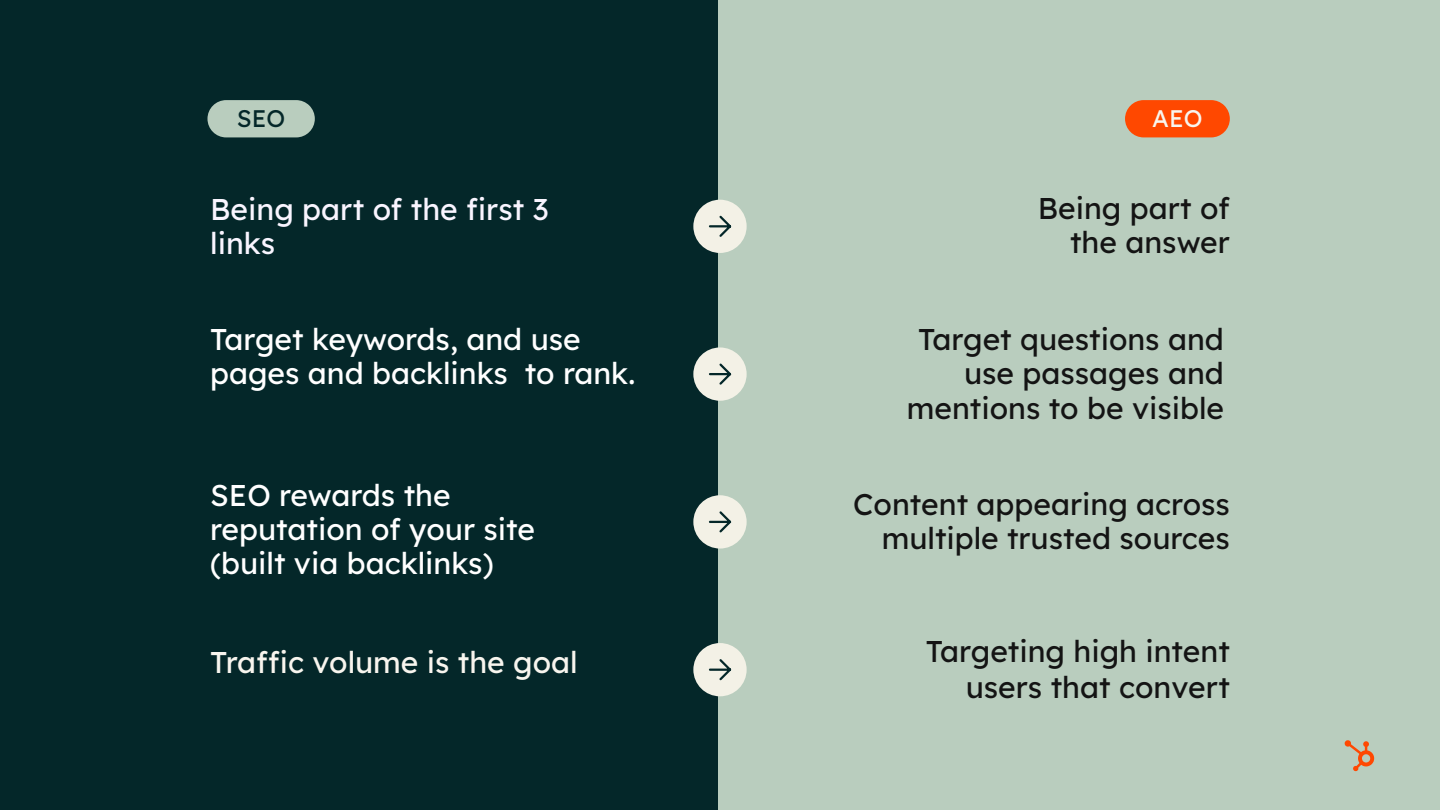
AEO is the evolution of SEO—but instead of building for clicks and blue links, you build to be part of the answer. Rakky explained that AI search ranks by meaning, not keywords, using vector space to understand semantic relationships. Every piece of content occupies a location in a "universe of meaning," and things that mean the same thing cluster together even if they use different words. To win in this environment, brands need both direct visibility (AI quoting your content from your own source) and indirect visibility (AI citing third-party sources that reference you).
- SEO goal: Rank in the top 3 links → AEO goal: Be part of the AI-generated answer
- SEO tactic: Target keywords, build backlinks → AEO tactic: Target questions, use passages for mention visibility
- SEO signal: Website reputation → AEO signal: Content appearing across trusted external sources
- SEO metric: Volume of traffic → AEO metric: High-intent conversions
- Direct visibility: AI quotes your content outright from your source
- Indirect visibility: AI cites a third-party source that references your brand
Three Steps to AEO Visibility
Rakky outlined three foundational steps that any team can begin applying to start appearing in AI-generated answers. Each step addresses a different dimension of how AI engines select and surface content.
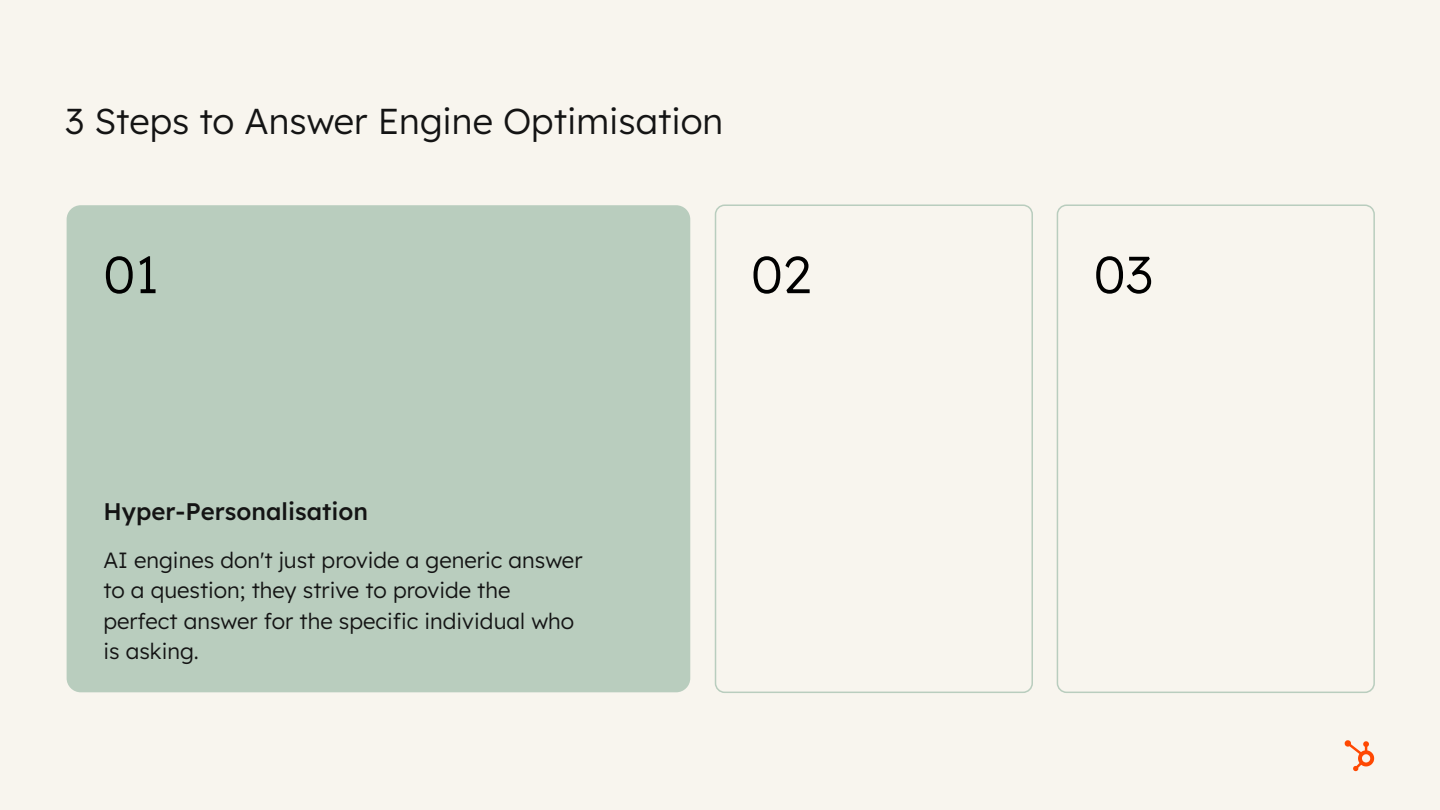
Step 1: Hyper-Personalization
AI engines don't serve one-size-fits-all answers—they serve context for specific questions. Every user has a digital fingerprint (chat history, tone, phrasing), and AI models match that fingerprint to tailor replies. Instead of optimizing for broad terms like "best CRM," teams should optimize for highly specific questions such as "How can a founder automate investor updates within HubSpot?"
- Map the specific intent journeys your prospects actually take
- Think the way your buyer thinks—match their phrasing, not your marketing copy
- Optimize for the complete, conversational question, not the keyword fragment
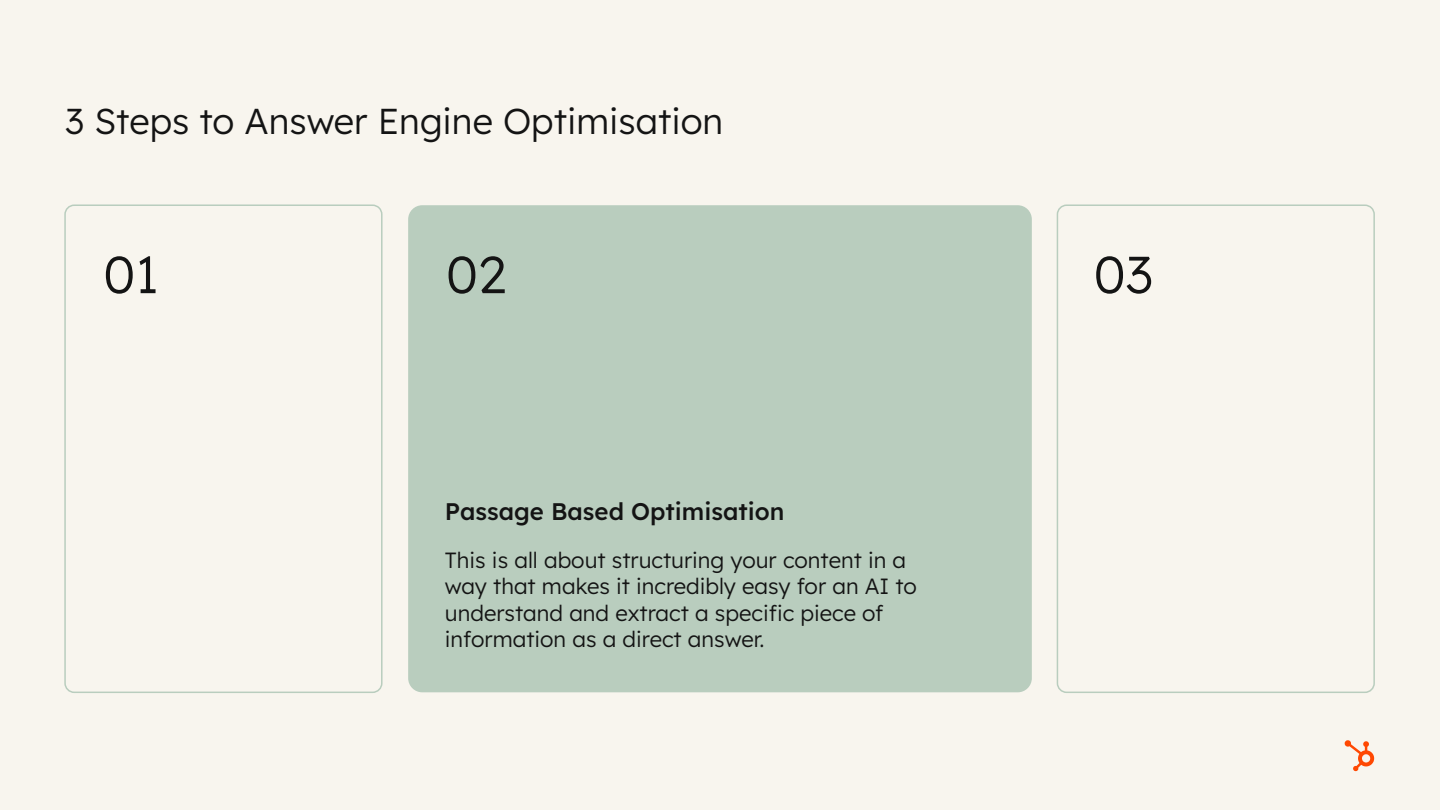
Step 2: Passage-Based Optimization
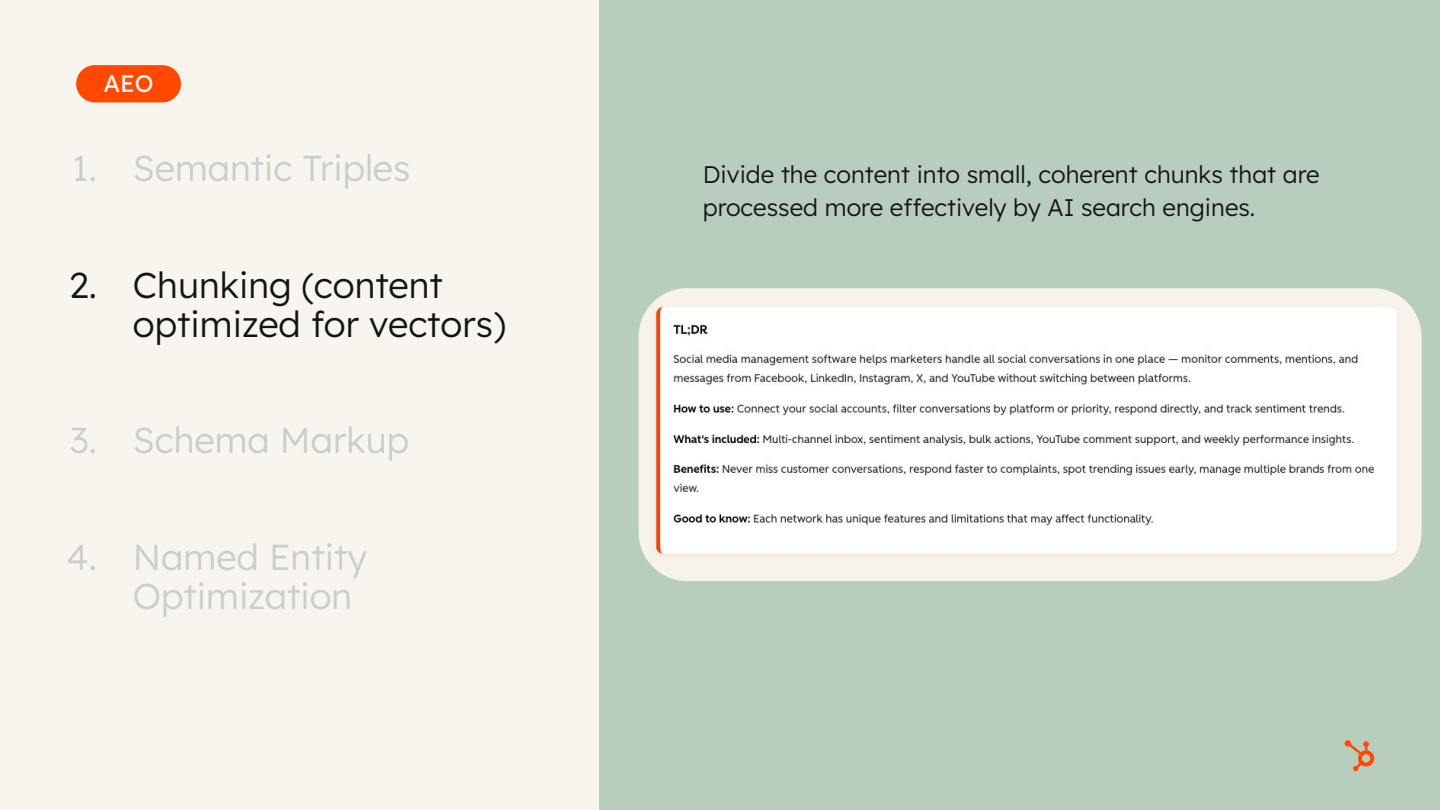
Make it easy for AI to extract precise answers from your content by structuring pages as small, self-contained passages of 100–200 words that each answer a distinct question. Instead of vague statements, use specific, factual passages that AI can chunk and serve independently.
- Break content into coherent chunks—each one answering a single question
- Use a TL;DR summary format: how, what, benefits, good-to-know sections
- Provide the full content beneath for human readers, but lead with machine-readable snippets
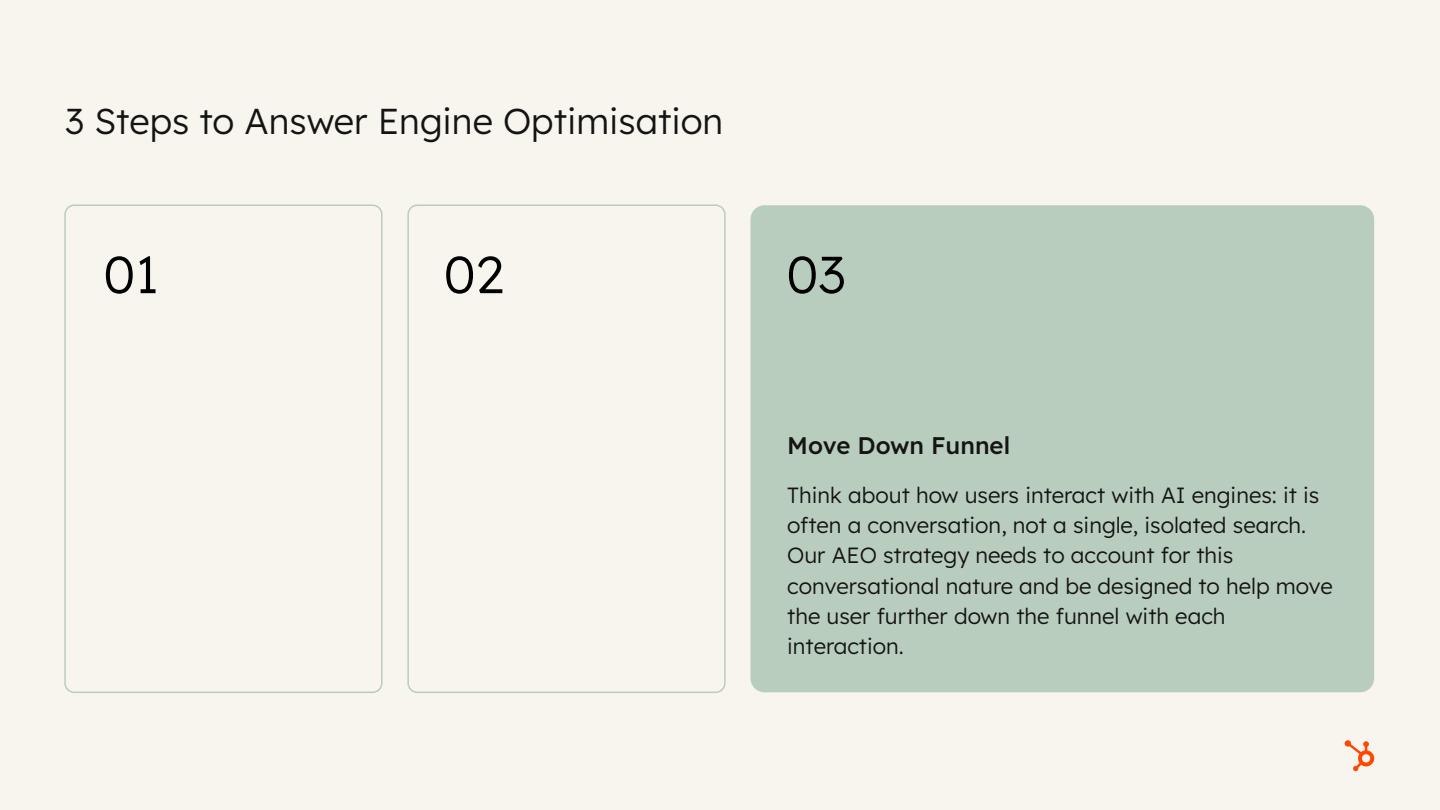
Step 3: Move Down Funnel
Recognize that AI interactions are conversations, not isolated searches. Users ask follow-up questions that move progressively down the funnel. Your AEO strategy must account for the nature of these conversational threads and ensure your brand appears at each stage—especially at the recommendation and resolution stage.
- Build content that addresses sequential, conversational queries, not just single keywords
- Optimize for the final recommendation stage where AI suggests specific products or services
- Ensure your brand is the one AI tools quote at the decision point
HubSpot's Four AEO Building Blocks
Rakky revealed the four technical building blocks that HubSpot's cross-functional task force—spanning marketing, SEO, AI product, and web development—uses to make content machine-ready and brand-consistent. These tactics form the operational backbone of their AEO channel.
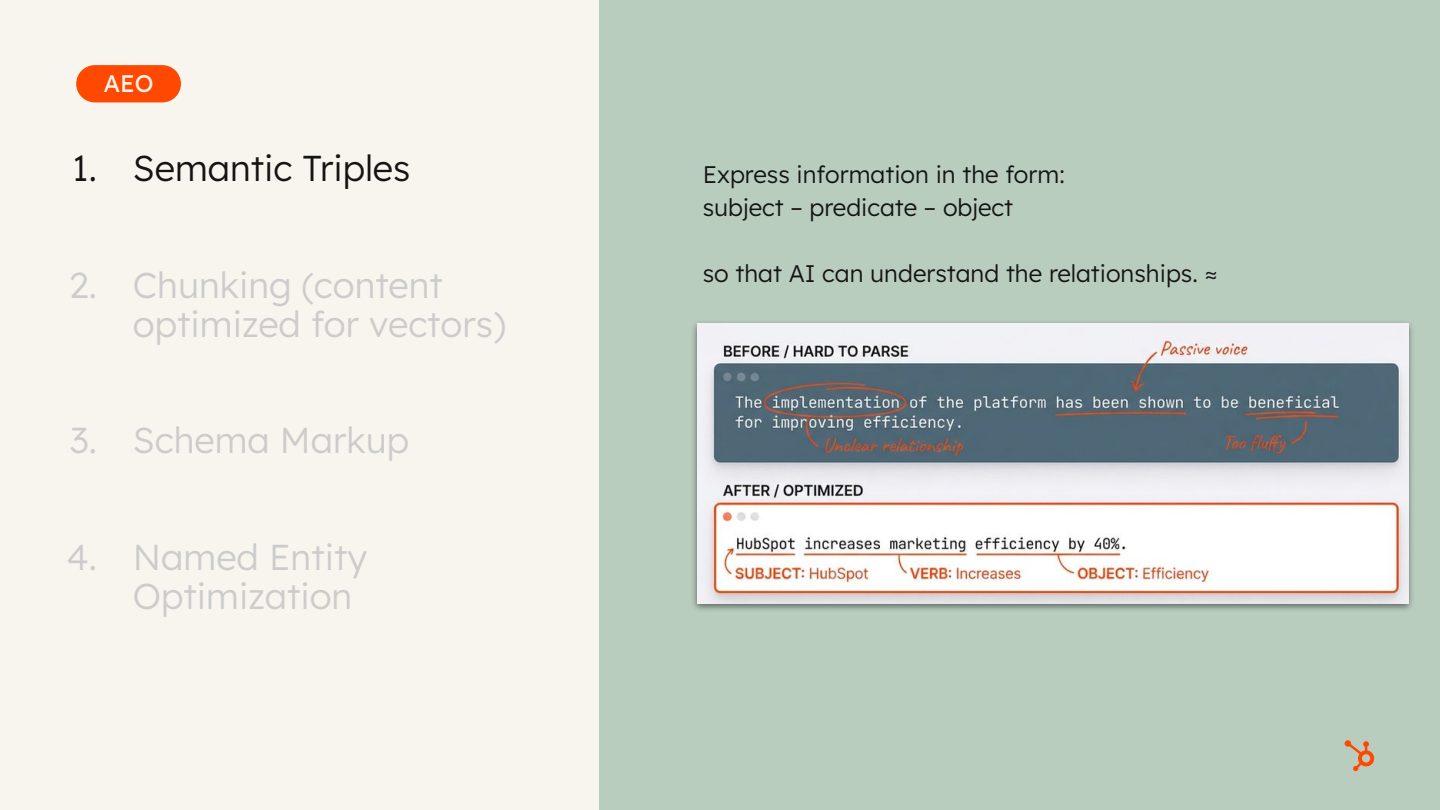
1. Semantic Triples
Express information in Subject → Predicate → Object form so AI can parse the relationship between entities. Replace passive, vague language with direct, factual statements.
- Before: "The implementation of our platform has been shown to be beneficial to improving efficiency"
- After: "HubSpot increases marketing efficiency by 40%" (Subject: HubSpot, Verb: increases, Object: efficiency)
2. Chunking
Divide content into small, self-contained blocks (100–200 words) that each answer a specific question. Think of it as Lego: small pieces that can be assembled into different constructions by AI engines.
- Lead with a TL;DR summary block: how, what, benefits, good-to-know
- Follow with full-length content for human readers
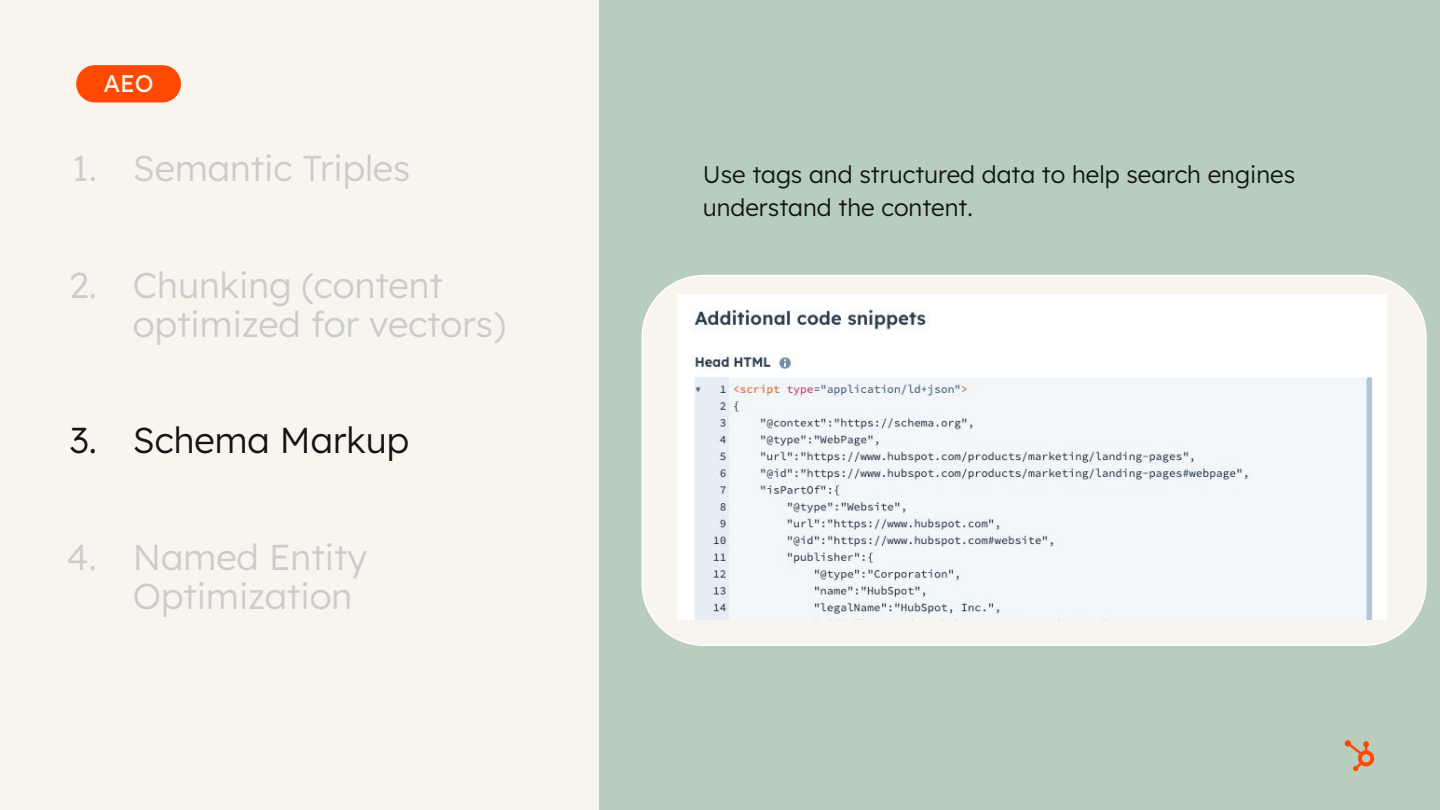
3. Schema Markup
Use JSON-LD structured data in the HTML head as the "metadata handshake" that tells AI exactly what each page is about. This is familiar from SEO but critical for AEO as well.
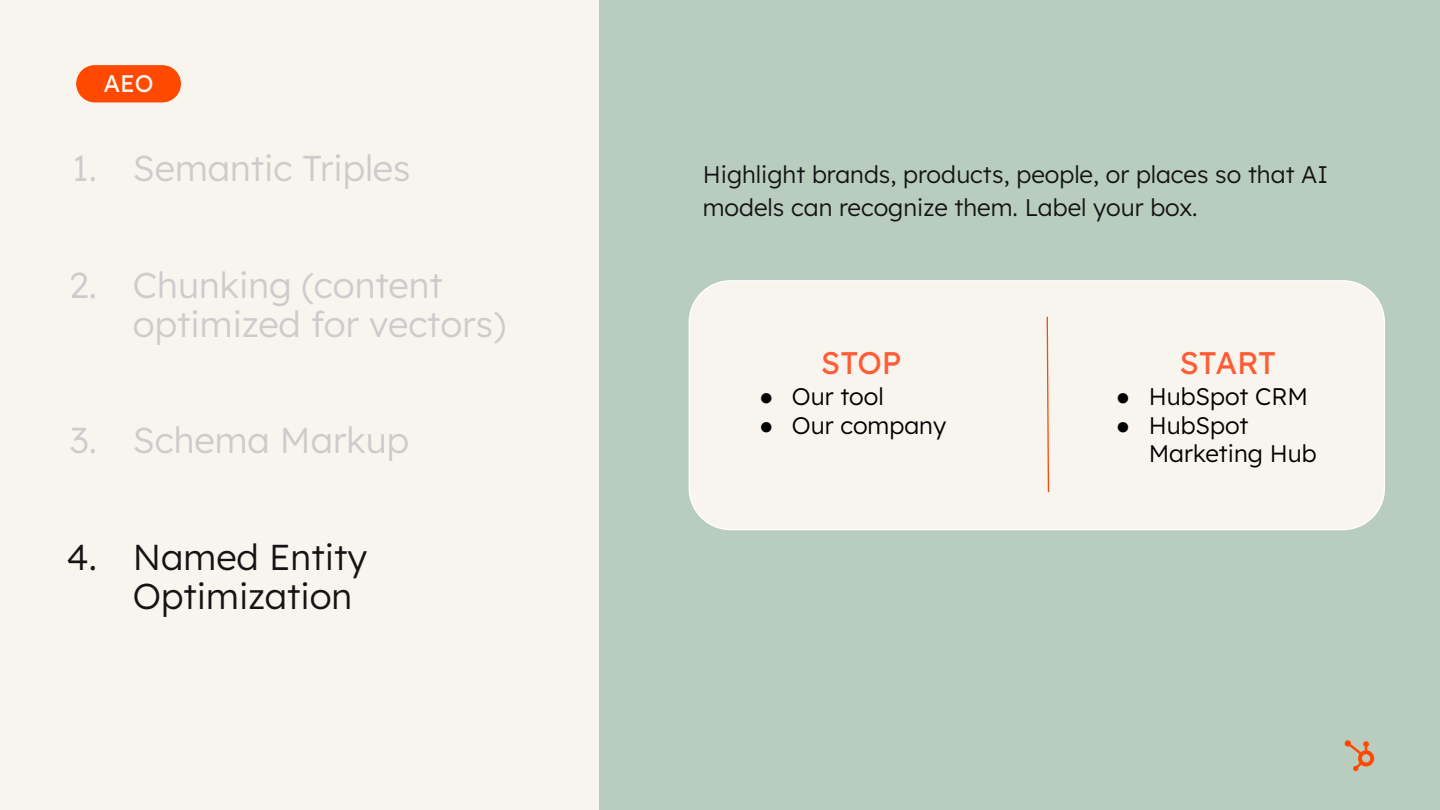
4. Named Entity Optimization
Replace generic references ("our platform," "our team") with specific branded entity names ("HubSpot CRM," "HubSpot Marketing Hub," "HubSpot customer success team") so AI tools consistently associate your brand with the right topics and answers.
The Off-Site Trust Ecosystem
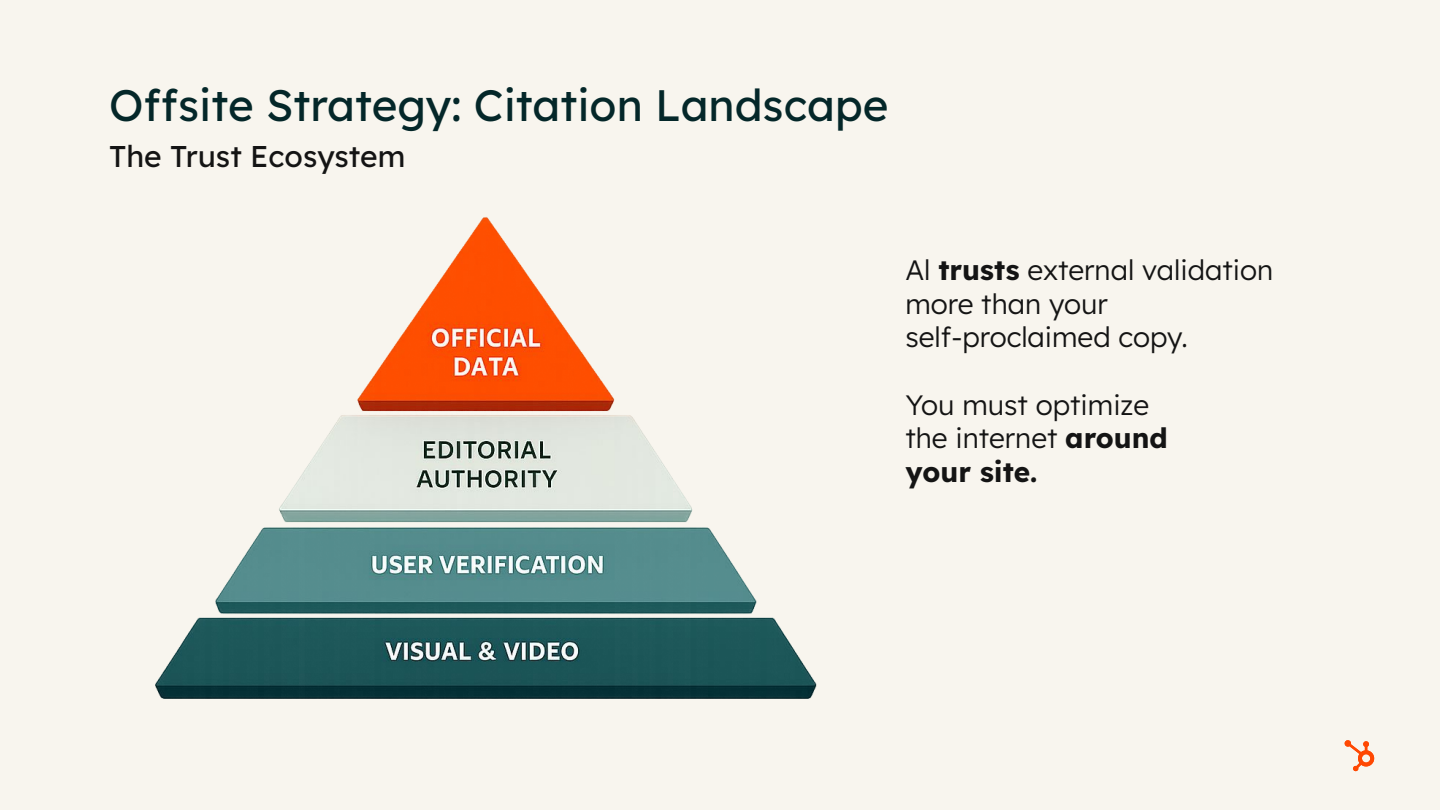
Rakky emphasized that AI trusts external validation almost more than self-proclaimed copy. The era of your blog ranking first and converting everyone is over. Now the question is: who quotes you, who recommends you, who cites you? She presented a trust pyramid that defines the layers of off-site signals AI engines rely on.
- Layer 1 – Official Data (top): Your own documentation, content, Academy resources, knowledge base
- Layer 2 – Editorial Authority: Third-party coverage from tech reviewers, major media outlets, newspapers, and magazines
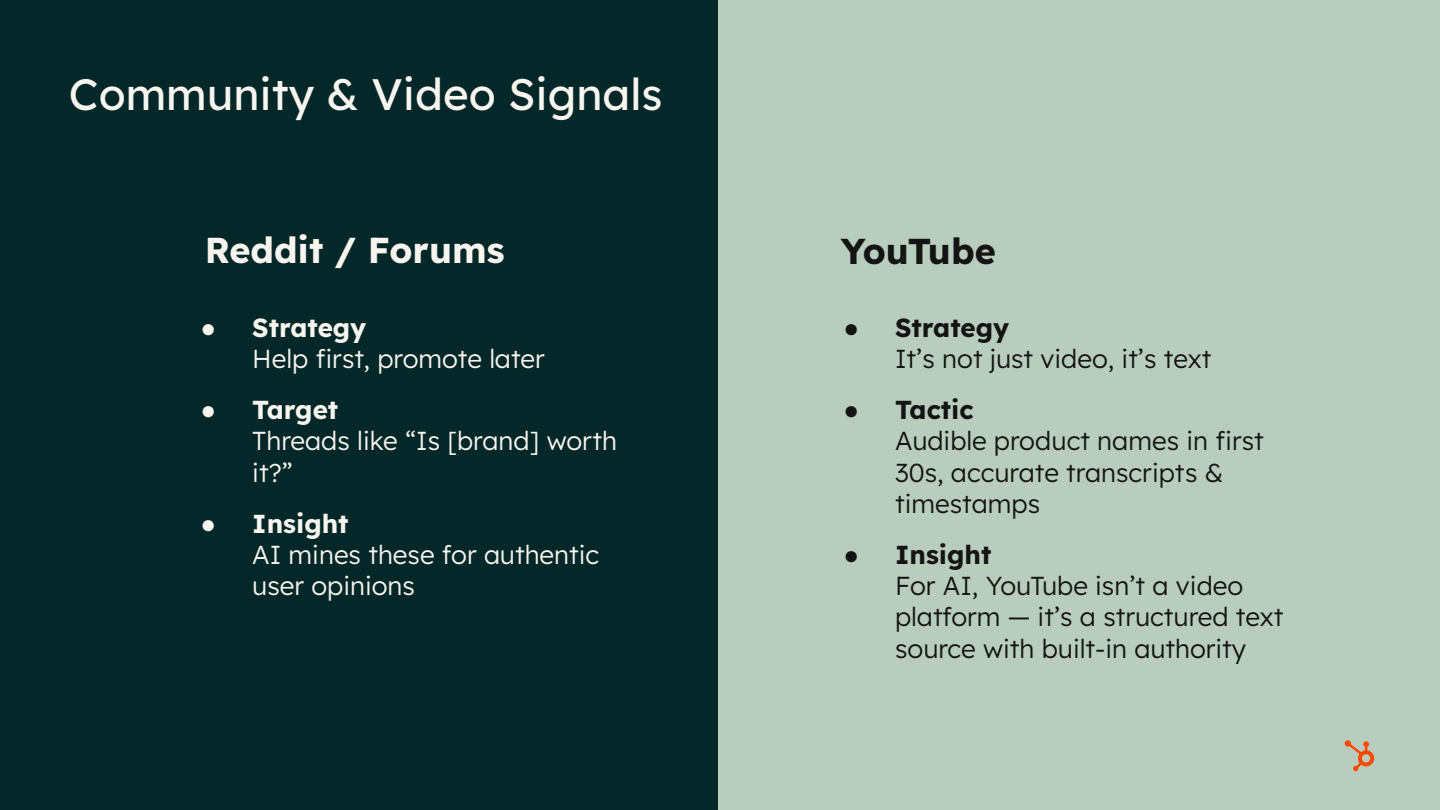
- Layer 3 – User Verification: Customers discussing your brand on Discord, Reddit, forums, Stack Overflow
- Layer 4 – Visual & Video: YouTube content, transcripts, social media—providing video and visual signals
Platforms like Reddit and YouTube are especially important because AI engines weight community consensus and video content as high-trust signals.
Measuring AEO Performance: The Scorecard
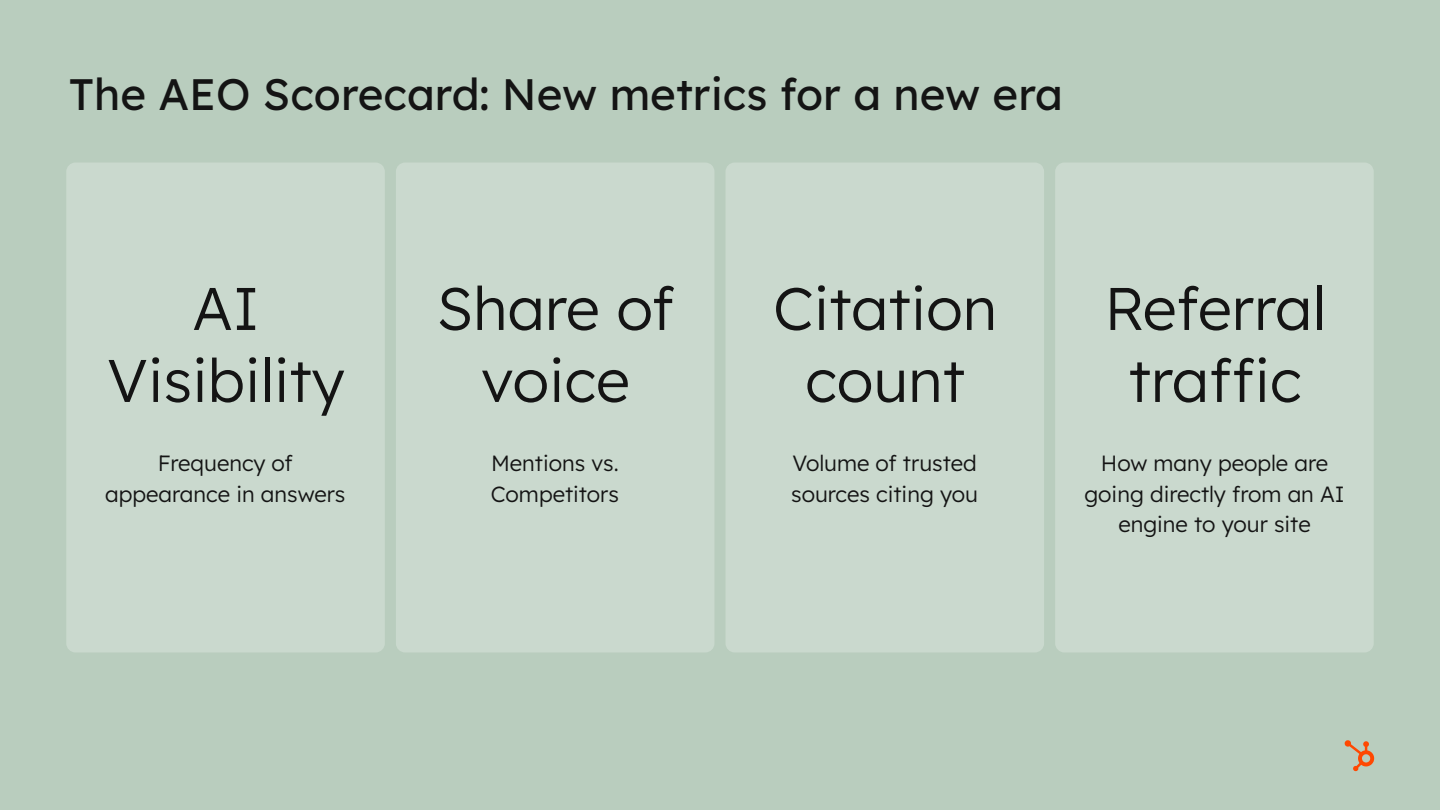
Rakky introduced four key metrics that teams should use to measure their AEO performance, forming an "AEO Scorecard" to track progress and benchmark against competitors.
- AI Visibility: The frequency your content appears in ChatGPT, Perplexity, Gemini, Claude, and other AI tools
- Share of Voice: How often your brand appears in AI results versus your competitors
- Citation Count: The volume of trusted external sources citing your brand
- Referral Traffic: The number of users going directly from AI tools to your website
HubSpot's AEO Results and Your Action Plan
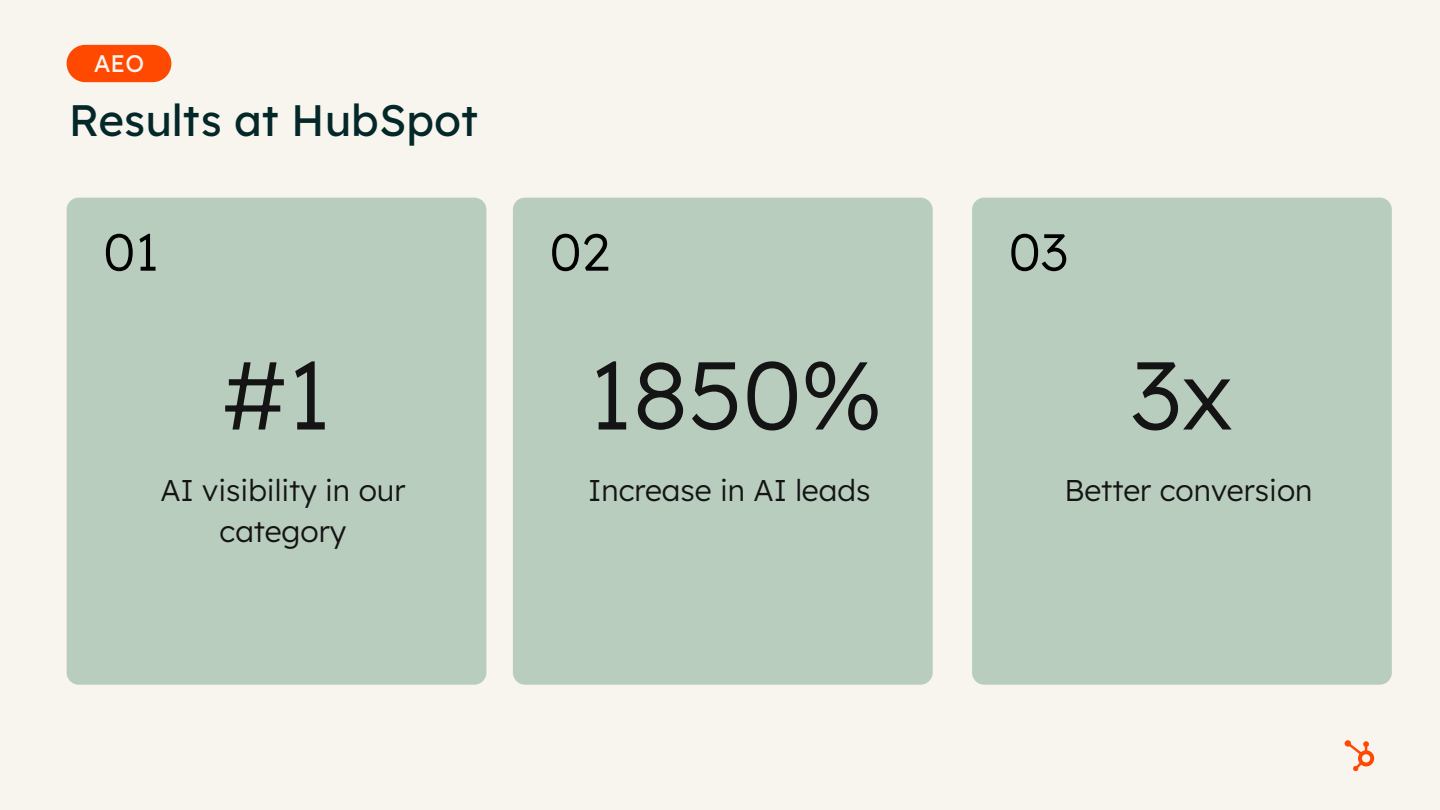
Rakky closed with HubSpot's real-world AEO results and a concrete five-step action plan that any team can begin implementing immediately. The data validates the strategy: AEO is not theoretical—it is producing measurable business outcomes at scale across six languages.
HubSpot's Results
- #1 brand on AI visibility in their category
- 1,850% increase in AI-sourced leads
- 3× better conversion rate from AI traffic vs. traditional search
- Results replicated across English, German, French, Japanese, Spanish, and Portuguese markets
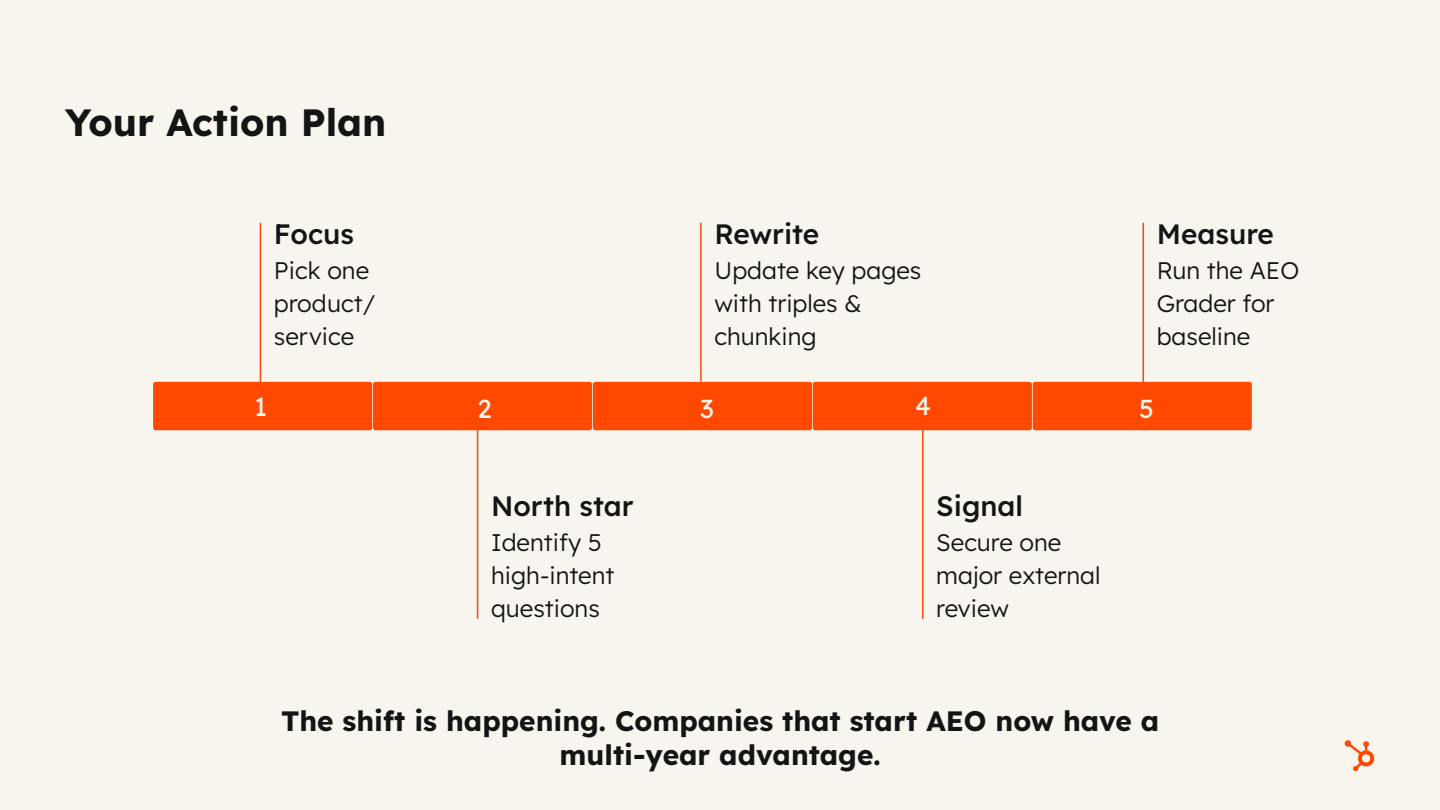
Your Five-Step AEO Action Plan
- Focus: Pick one product or service to start with
- North Star: Identify 5 high-intent questions your prospects are asking right now
- Rewrite: Restructure your pages with semantic triples and chunking
- Signal: Secure one major external review (Reddit, Discord, review platform)
- Measure: Run the HubSpot AEO Grader at gohubspot.com/aeo-grader to benchmark your brand
Q&A
No live audience Q&A session was held during this keynote. Rakky noted that time did not permit questions and directed attendees to connect with her via LinkedIn (QR code provided) for any specific questions about AEO strategy or implementation.

.jpg?width=1200&length=1200&name=HUG%20Dublin%20-%20OCT%202025-070%20(1).jpg)


