
Shana Sumers
FOUNDER, SPEAKER, CAREER COACH @ SHANA SUMERS LLC
Shana Sumers is a speaker, coach and athlete helping women build confidence, relationship capital and careers beyond sport.


FOUNDER, SPEAKER, CAREER COACH @ SHANA SUMERS LLC
Shana Sumers is a speaker, coach and athlete helping women build confidence, relationship capital and careers beyond sport.
 Shana SumersStop Networking. Build Relationship Capital.
One letter changed on the marquee — Inbound became Unbound — and the session opened by arguing that the same quiet substitution has happened to everyone’s job. The playbook that powered the last fifteen years has been handed to everybody at once, in the form of AI. When the playbook is universal, the speaker argued, the edge is no longer method. It is trust: who knows you, who vouches for you, and who says your name in rooms you will never walk into.
What followed was less a networking talk than a restructuring of how relationships should be treated on a balance sheet. Networking was cast as a verb that produces clutter — connections collected, nothing done with them. Relationship capital was cast as an asset that compounds, slowly and deliberately, like money left in an account for years. The session moved from that premise through a definition, a founder case study, a three-tier model of relationships, a five-step operating playbook, a second case study, and a short set of commitments the audience was asked to make before the end of the year.

The opening argument was blunt. Over the past eighteen months, the tasks people were known for — building the deck, writing the best email copy — have quietly migrated to Claude and ChatGPT. That is not framed as a loss of craft so much as a loss of distinction. The playbook is no longer proprietary; it is distributed, instantly, to everyone in the room and everyone outside it.
The consequence is a flattening of voice. AI has a rhythm, and that rhythm is now everywhere. Everybody sounds the same, and sameness is dull. Worse, it is corrosive: when output is indistinguishable, people stop being able to trust the words in front of them. The audience was asked to sit with that discomfort rather than solve it with better prompts.
So where does the edge go? Into the one thing that cannot be generated. Trust is what brings customers back to a business, clients back to a consultant, and colleagues back to your desk. People will research with AI and let search surface answers, and then they will still go looking for a human — their person — to confirm it.
“When everybody is receiving the same playbook, there’s nothing new or different… Your edge has disappeared.”
Becoming “their person” was given two conditions: consistency and visibility. Visibility, importantly, was defined as more than posting or being findable. It means telling people, regularly, exactly what to do, how you go about doing it, and the steps and methods behind it — making your work and your next moves legible enough that people know to come to you.
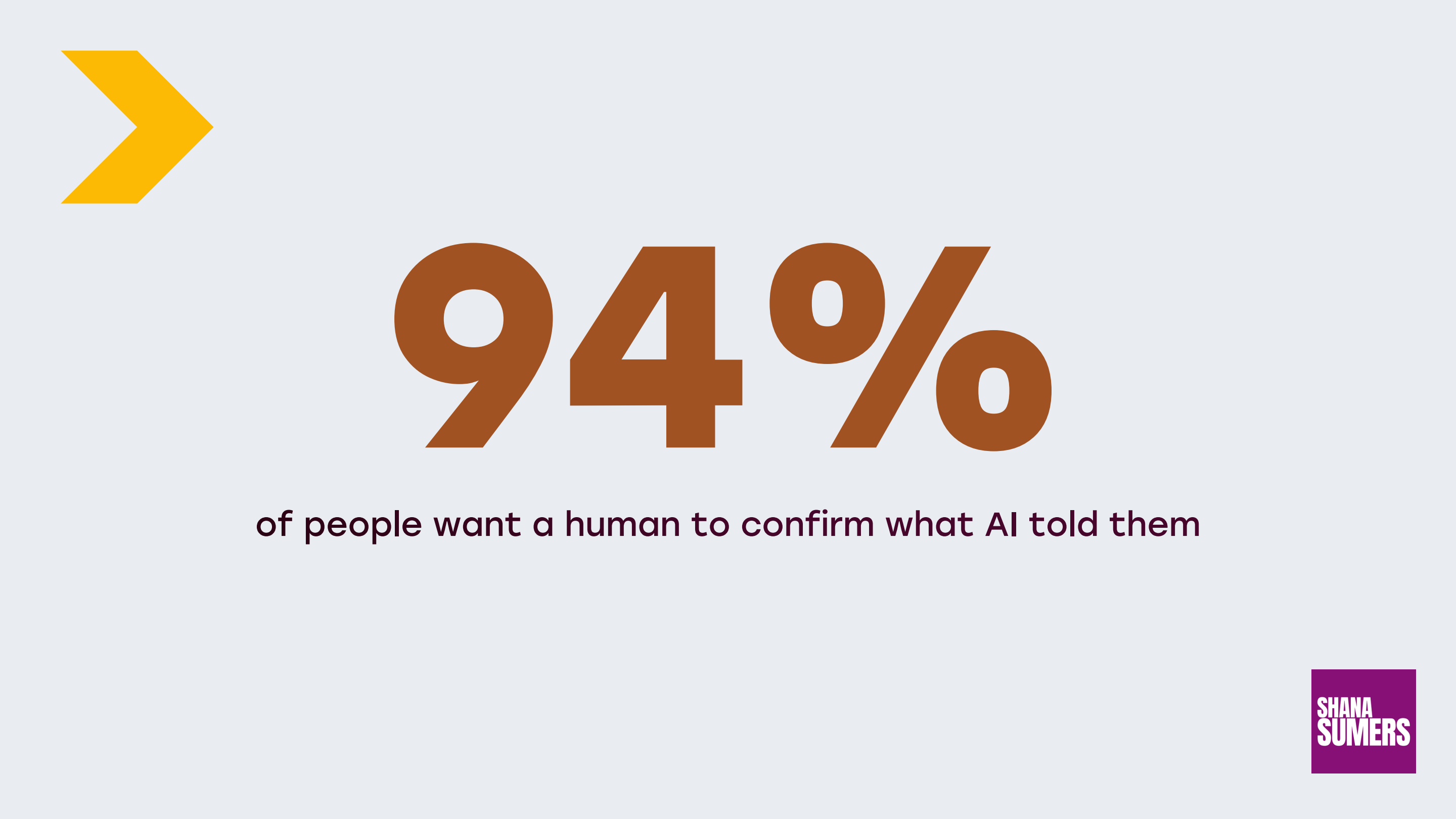
Networking, the speaker argued, is a verb — an activity of collection. You meet, you connect, you file the card, and then nothing happens. The claim put to the room was that over ninety per cent of people never follow up, and that nine times out of ten you cannot later recall how you met a contact or what they actually do. What survives is a company name or a recognisable brand, which is not a relationship.
Relationship capital was defined against that: an asset that compounds over time, in the way money left in a bank account grows across years. The two mental models were set side by side. The Rolodex is a long list of names that adds no value and whose contacts will not vouch for you. The portfolio holds fewer relationships, each one carrying invested time, energy and reciprocal value.
In the portfolio model you can say precisely what value they add and what value you add. And the compounding mechanism is specific: that person speaks your name in rooms you are not in.
“That person is speaking your name in rooms you are not in.”
AI sits awkwardly inside this. It can draft the message and send the email, and it genuinely accelerates the act of making contact. But everyone is learning the same playbooks and recognising the same patterns, so bot-written outreach is identified as bot-written outreach — and trust is already diminished at first touch. The position offered was pragmatic rather than purist: use AI to edit and support, but build the relationship yourself, because the destination is someone advocating on your behalf.

Hence the headline statistic of this segment: a warm introduction was described as ten times more effective than a cold email. The line the room repeated back: “Nobody loves a cold email, but everybody loves a warm intro.” The practical implications were straightforward — follow up after you meet someone, record how and why you met, invest in fewer and deeper relationships, and spend your effort engineering introductions rather than volume outreach.
The extended case study was Airbnb, told as a chain rather than a leap. Three founders proposed that strangers rent rooms inside people’s homes — an idea that attracted entirely natural suspicion. They met Michael Seibel, previously of Justin.tv and later described by the speaker as CEO of Y Combinator. Seibel could not match the capital they needed. He passed on the funding.
What he did not pass on was the relationship. He admired their hustle, became a mentor, and pitched them in rooms they were not in. Through Seibel they reached Paul Graham at Y Combinator, who initially told Seibel he was crazy to consider it. Seibel was insistent. Graham came round — “I see what you’re seeing in them… they are driven and are able to build these things” — and the founders were brought into Y Combinator.
Inside Y Combinator they met Reid Hoffman of LinkedIn and Greylock Partners, who also thought the idea was crazy at first, questioning who would rent a room or a whole house for a short period. He came to see what Graham and Seibel saw, led the Series A and invested over seven million dollars. The point of the story was not the outcome but the sequence: trust was built with one person, passed to a second, then to a third. Nobody was approached directly, and none of it was quick.
“Because he passed on providing the funds didn’t mean that he was going to pass on the opportunity to support these guys.”
Having established that relationships compound, the talk then insisted that they are not interchangeable. In business especially, not all relationships are equal, and the session offered a three-tier model for sorting them.
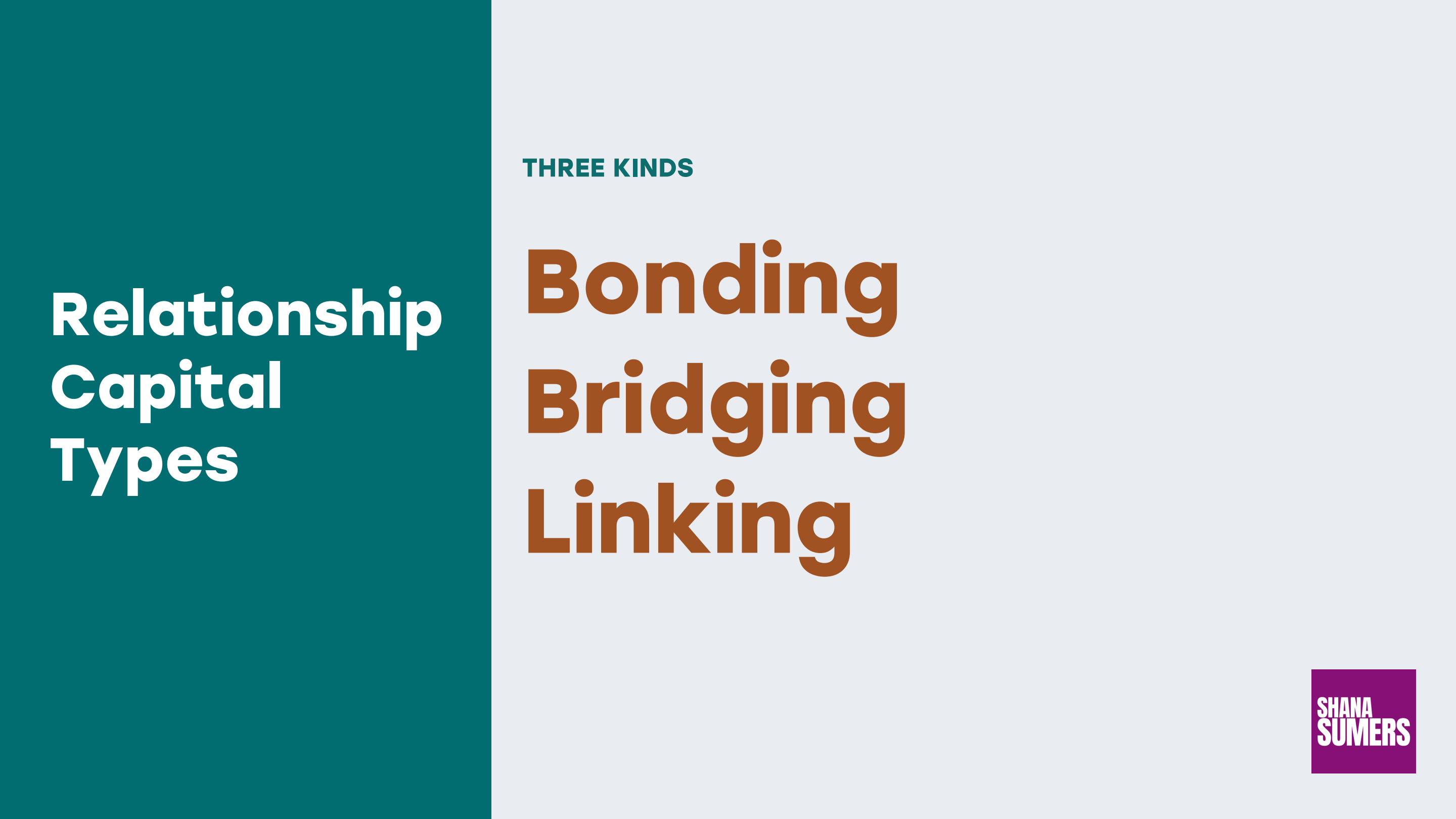
The common imbalance described was predictable: most people are over-saturated with bonding contacts and least saturated with linking contacts — and then walk into a networking room and try to jump straight to the linking tier. The opposite failure was also named. If almost everyone you know is linking, you risk being out of touch with the wider world and missing the investment and other opportunities that travel through it.
The prescribed remedy is an audit. List the people you know, sort them into the three buckets, and look for gaps and opportunities. If everyone lands in bonding, that is a signal to step deliberately outside your zone and build bridging and linking ties. And when you do, do not lead with the ask — the session used the image of Hillary Banks asking Daddy for five hundred dollars as the thing not to do. Introduce yourself, explain who you are, and ask intentional, high-quality questions rather than “How’s your day? How’s work?”
Good questions, the speaker noted, earn callbacks, replies to DMs and emails, and sometimes unprompted mentorship — you often do not need to ask someone to be your mentor, because they signal it themselves. The timing rule underneath all of it: you cannot start when you need something. Start building before you need it, and when the moment comes, the help, the money or the introduction is frequently offered without being requested.
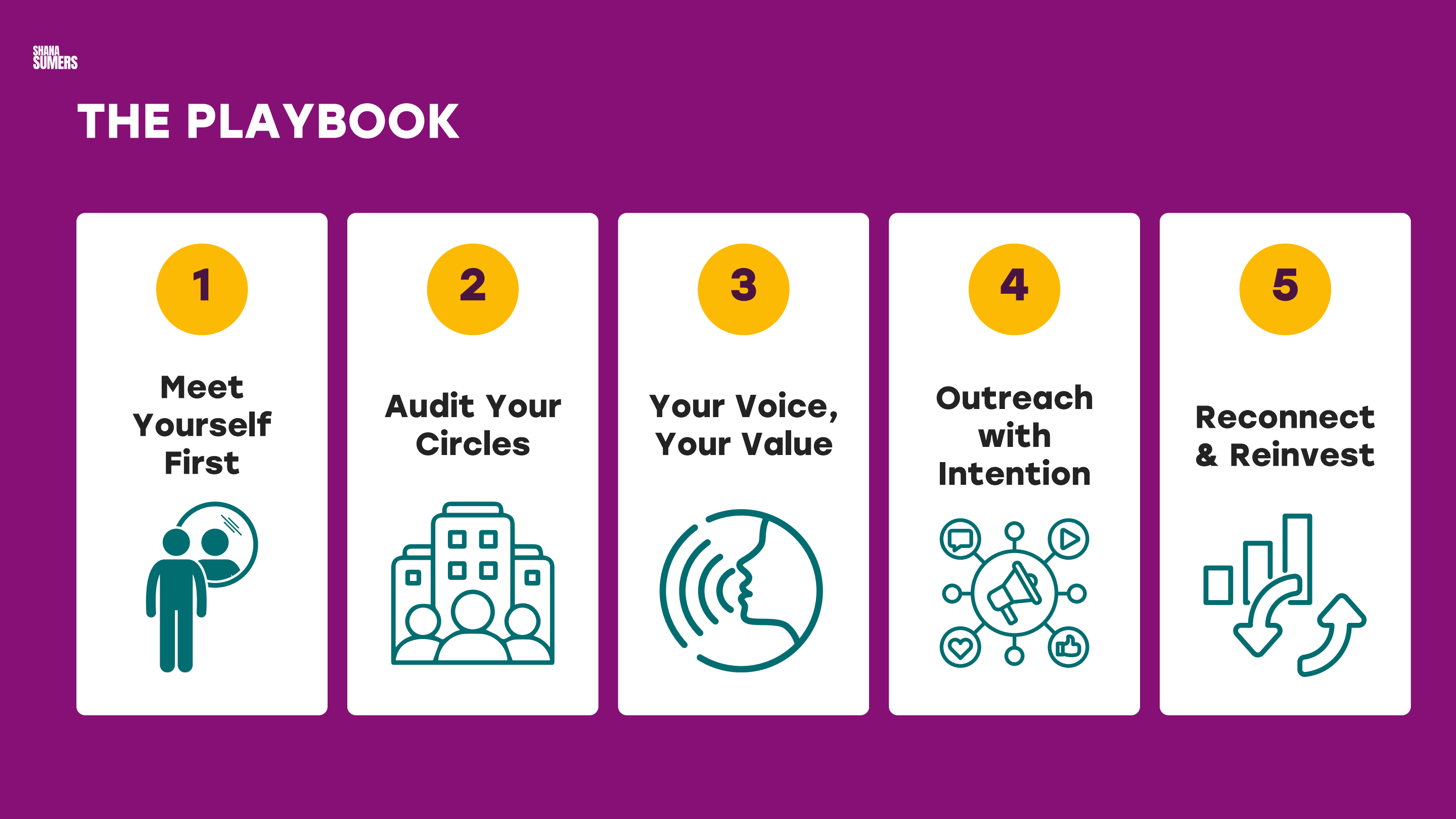
Step one is to check in with yourself. Audit who is already in your circle across bonding, bridging and linking, then review your personal vision, mission, branding and messaging. Clarity of self-description was treated as non-negotiable: if you cannot articulate what you do and how you do it, no one else can do it for you. The speaker used her own misstep as evidence — describing herself as “the Mayor of LinkedIn” made her memorable for the wrong reason, because people assumed she trained others on LinkedIn. She adjusted the positioning. Re-auditing circles, running checks and balances, and recognising your own voice in the room are part of the same recurring cycle.
From there the playbook turns outward. Be selective at events: research beforehand, target a handful of specific people rather than attempting the whole room, and broaden out only afterwards. Lead with value rather than an ask, and resist opening with requests for funding or large amounts of someone’s time. Crucially, do not put senior people on a pedestal — the session was explicit that you do not have to treat CEOs and founders that way, because people at every tier want conversations too. Your value comes from what you are already good at; those are precisely the things people trust you for and vouch for you on elsewhere.
Outreach should carry attention. Reference something concrete: “I read that article”, “I watched your video”, “I saw you speak at this conference”. This works even when you did not attend the talk — connecting from the conference and noting what someone said on stage still opens the door to a next step.
The final step was singled out as the most undervalued. Reconnect and reinvest is not an afterthought: “nine times out of ten, the revenue is already there.” Circle back to contacts who went quiet a year ago, or to people who have posted recently. Following up, the speaker said, makes people vouch for you tenfold. Introductions carry real weight in both directions — people often blame whoever passed a bad one along.
“Nine times out of ten, the revenue is already there.”

The second case study was closer to home: Morgan, founder and CEO of Lavity, and Arlan Hamilton of Backstage Capital. They met at a moment when each of them needed something and neither could supply it. Morgan was seeking large-scale funding. Arlan funded underestimated founders but did not have the funds at the time. What they did have was genuine trust in what the other was building.
So they worked for each other. Arlan, who was regularly in rooms with investors, spoke Morgan’s name consistently; Morgan supported her in return and stayed in regular contact. Arlan eventually introduced Morgan to her first few funders, and that sequence produced six million dollars.
The relationship kept compounding after the cheque. Lavity is now a media, travel and “house party” company; Arlan has invested millions elsewhere and has been a key sponsor, speaker and moderator for Lavity. The session presented it as the clearest illustration of reciprocity paying both ways over years rather than quarters.
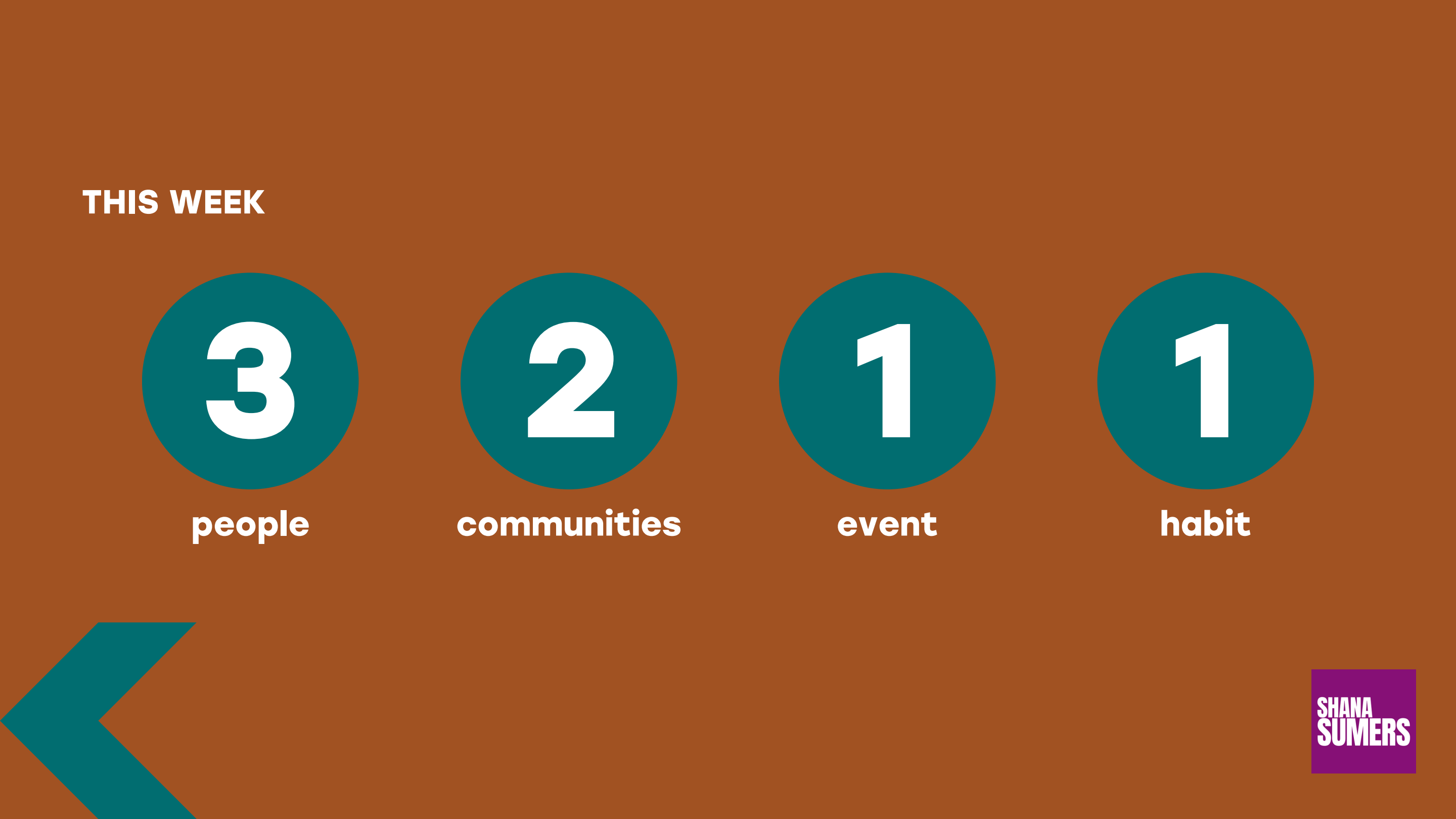
The close was framed as a promise rather than a takeaway. The audience was asked to leave the room and immediately identify the people they want to work with now or in one to two years, and start planting seeds with them — not because anything is needed yet, but precisely because nothing is. Four concrete commitments followed, all sized to be finished inside the remaining quarter.
The speaker then modelled the practice she had just taught by making her own ask from the stage: she is available for speaking, hosting, workshops and coaching, one-to-one or for businesses, and invited attendees to get in touch. A QR code was shared for follow-up, alongside an offer to send her prompt questions tailored to each of the three relationship tiers.
Three questions were taken from the floor before the session closed on time, with no open questions left unanswered.
The speaker described a route into tech that began somewhere else entirely: a degree in music therapy, a first career as a music therapist and percussionist, marching band included. She started volunteering for an early-stage dating app — social media, event support, general help. The company’s CEO kept handing her projects until she was effectively an unofficial contractor, then offered a one-month paid contract at roughly the same rate as her existing work. She worked intensively because the work was stimulating. The month, she learned afterwards, had been a test. She was hired, and pivoted into tech as social media manager, then content, then community — ultimately ten years as a community builder and leader, including five years at HubSpot and roughly four of those leading its community. That CEO remains the defining mentor, and is still reachable for a question or a favour at any time: “She was the first person who just allowed me to throw things at the wall and figure it out.”
Yes — the tiers are not fixed. Morgan DeBaun and Arlan Hamilton were cited again: when they first met they were effectively in each other’s bonding group, and as each grew they became decision-makers “in the room where it happens”, able to link each other’s work. A more everyday illustration was offered: a contact in a marketing role runs a strong campaign, and “all of a sudden they’re a director and now they’re the person writing checks.” Reconnect, and propose a collaboration or a joint campaign. The takeaway was to audit your network regularly so you know where people now sit.
The diagnosis was comfort: people stay too long inside the group that already knows them. The analogy drawn was athletic — bonding is the teammates training alongside you, bridging is the coaches and athletic trainers, and linking is the front office making the marketing and business decisions. Growth means leaving the day-to-day: sitting in the coach’s office, watching film, asking questions. That behaviour is what prompts onward introductions. The “3-2-1-1” approach was referenced, with the instruction to attend events where your bonding group will not be present.
“You have to take the dedicated time to take yourself outside of the day-to-day and go and sit in the rooms where it happens.”