
Dharmesh Shah
CO-FOUNDER AND CTO @ HUBSPOT
Dharmesh Shah is Co-Founder and CTO of HubSpot. Prior to founding HubSpot in 2006, Dharmesh was founder and CEO of Pyramid Digital Solutions, which was acquired by SunGard Data Systems in 2005.


CO-FOUNDER AND CTO @ HUBSPOT
Dharmesh Shah is Co-Founder and CTO of HubSpot. Prior to founding HubSpot in 2006, Dharmesh was founder and CEO of Pyramid Digital Solutions, which was acquired by SunGard Data Systems in 2005.

Twenty years after HubSpot began, its co-founder and CTO returned to the stage with a deceptively simple argument: the frontier has moved, the horsepower problem is solved, and the only variable still worth arguing about is what you build on top of it. This was not a talk about what artificial intelligence might do in five years. It was a talk about what already-available models can do on Monday morning, and about the new role — the go-to-market builder — that has quietly appeared inside marketing, sales, service and RevOps teams.
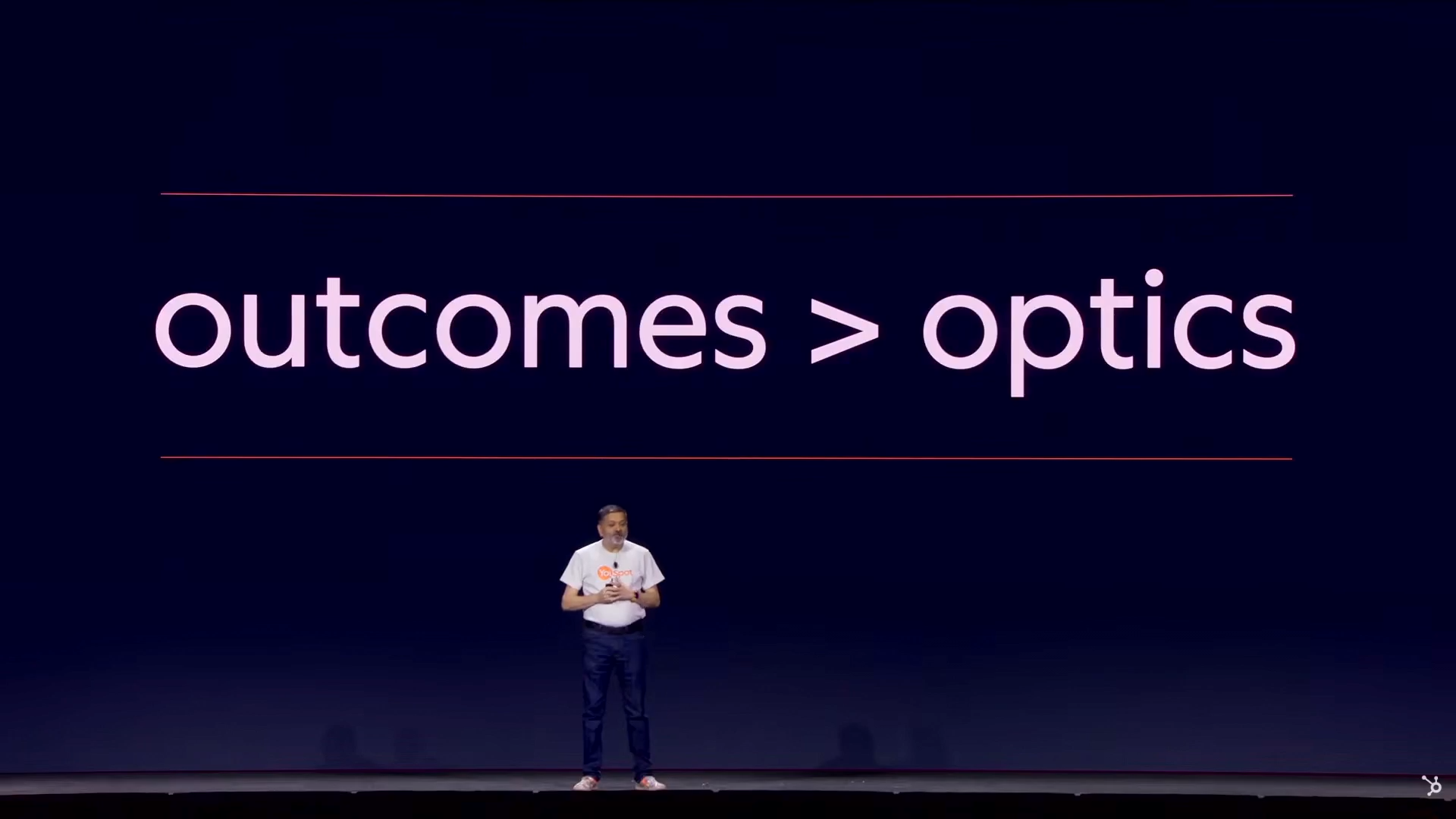
The through-line was a phrase borrowed from earlier in the day and then sharpened: outcomes beat optics. Stop chasing the state of the art, the speaker argued, and start operating in the state of the practical. What follows is an extended reconstruction of that argument, from the origin story of “customer zero and builder zero” to a live product launch aimed at the fastest-growing segment in business formation: the company of one.
The talk opened where most origin stories do — at a dinner table. Nineteen years ago, at an Italian restaurant in Boston, two founders sat over a Barolo on a founders’ night out and sketched out how to grow a company that was, at that point, very small. The speaker offered his own coinage for the relationship: a gromance, defined as “a bromance with a board deck”. HubSpot turned twenty in June.
The retrospective was not nostalgia for its own sake. It set up the structural claim of the whole keynote. The reason the early product worked, he argued, was that his co-founder was “customer zero” and he himself was “builder zero”. The software was built for HubSpot’s own growth, by the person who needed it, next to the person who would use it. Conversations happened daily; emails happened nightly. The distance between the person with the problem and the person with the build environment was almost nothing.
That distance, he suggested, has historically been the real constraint on software. For thirty-odd years building was reserved for a select few — people who had spent years learning to write code. The premise of the rest of the talk is that the constraint has now dissolved.
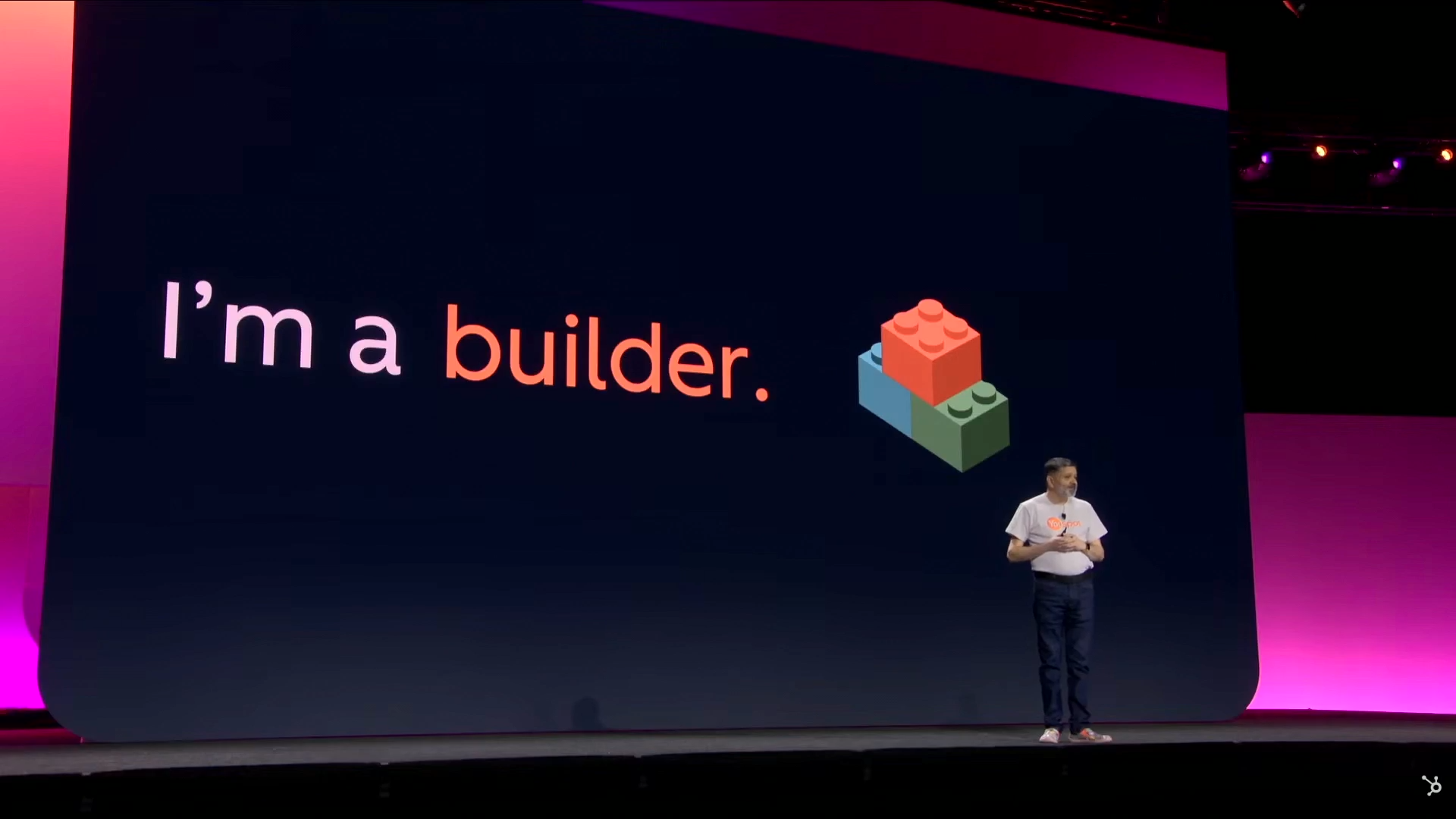
“Brian was customer 0. And I was builder 0.”
“Now everyone can be a builder” is an easy line to say and an easy line to misread, so the speaker spent time bounding it. He is not proposing that RevOps specialists start shipping commercial applications, and he is emphatically not proposing that anyone assemble their own customer platform from scratch. The warning was delivered as a public-service announcement: “Don’t let friends vibe code their own CRM.”
What he means by builder is specifically a go-to-market builder: a marketer, a sales rep, a support specialist or an operations person who assembles working systems on top of a platform they already trust. On HubSpot, that means three concrete things — automations that remove repeated manual work; custom applications that live inside the HubSpot interface rather than in a disconnected side tool; and custom agents created with the new agent builder introduced earlier in the event.
The distinction matters because it reframes the anxiety in the room. If building means engineering, most go-to-market professionals are spectators. If building means composing outcomes from existing, governed components, then the skills that already define good commercial operators — judgement, process design, knowing what “good” looks like — become the scarce inputs. That reframing is the hinge on which the second half of the keynote turns.
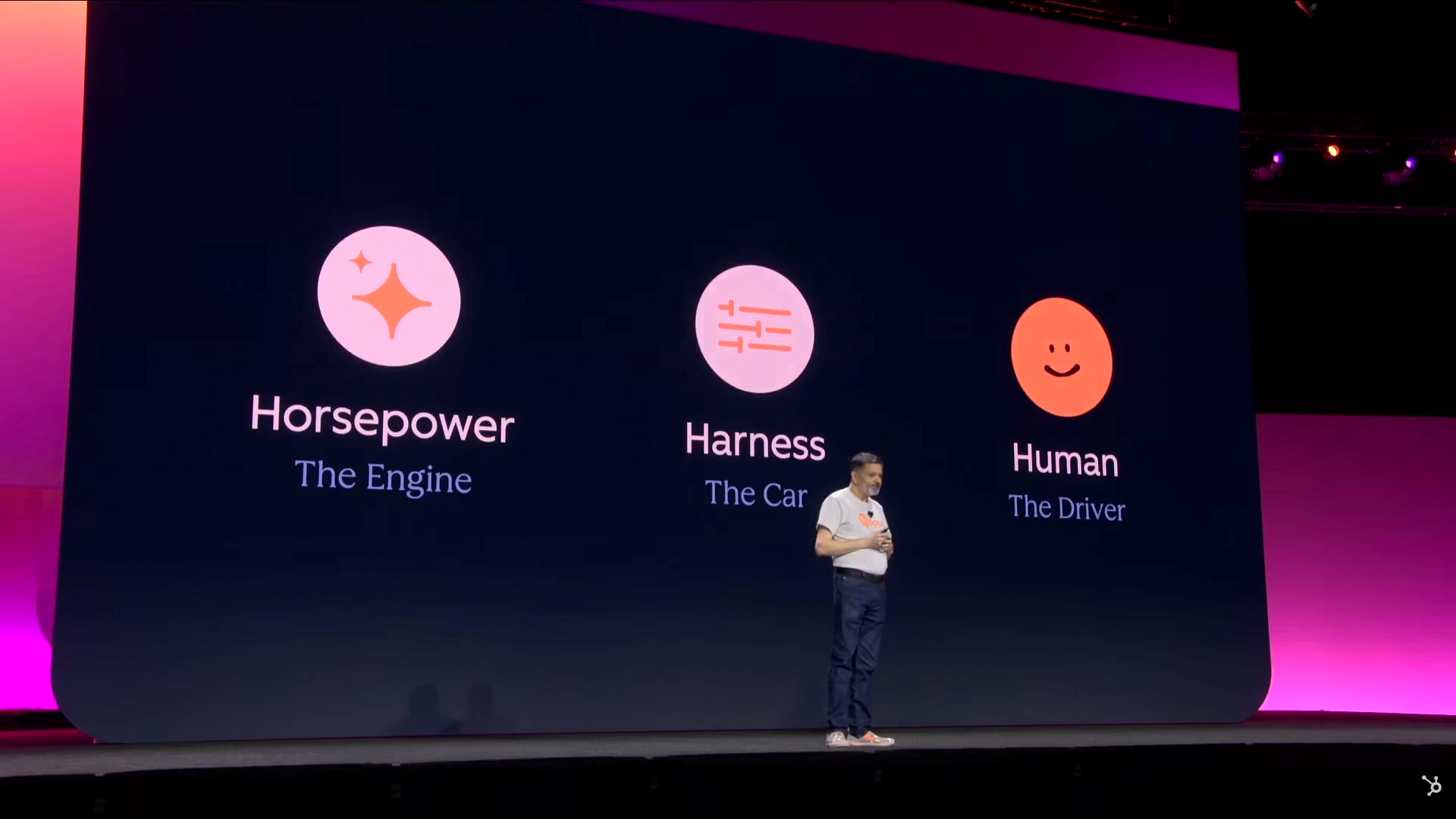
To make the rest of the argument legible to a mixed audience, the speaker introduced a deliberately plain framework. Horsepower is the AI model itself — the engine. The harness is everything built around that engine to make it useful: the wheels, the steering wheel, the satnav. The human is the person driving the car and deciding where it is going.
The value of the framework is that it separates three conversations that usually get tangled together. Debates about benchmark scores are horsepower debates. Debates about reliability, governance, context and tool access are harness debates. Debates about adoption, judgement and role design are human debates. Most organisations, he implied, are losing time arguing about the first while the second and third are the ones they actually control.
Each of the three then received its own passage in the keynote, in that order — and each ended with a ten-minute task the audience could complete without permission, budget or a project plan.
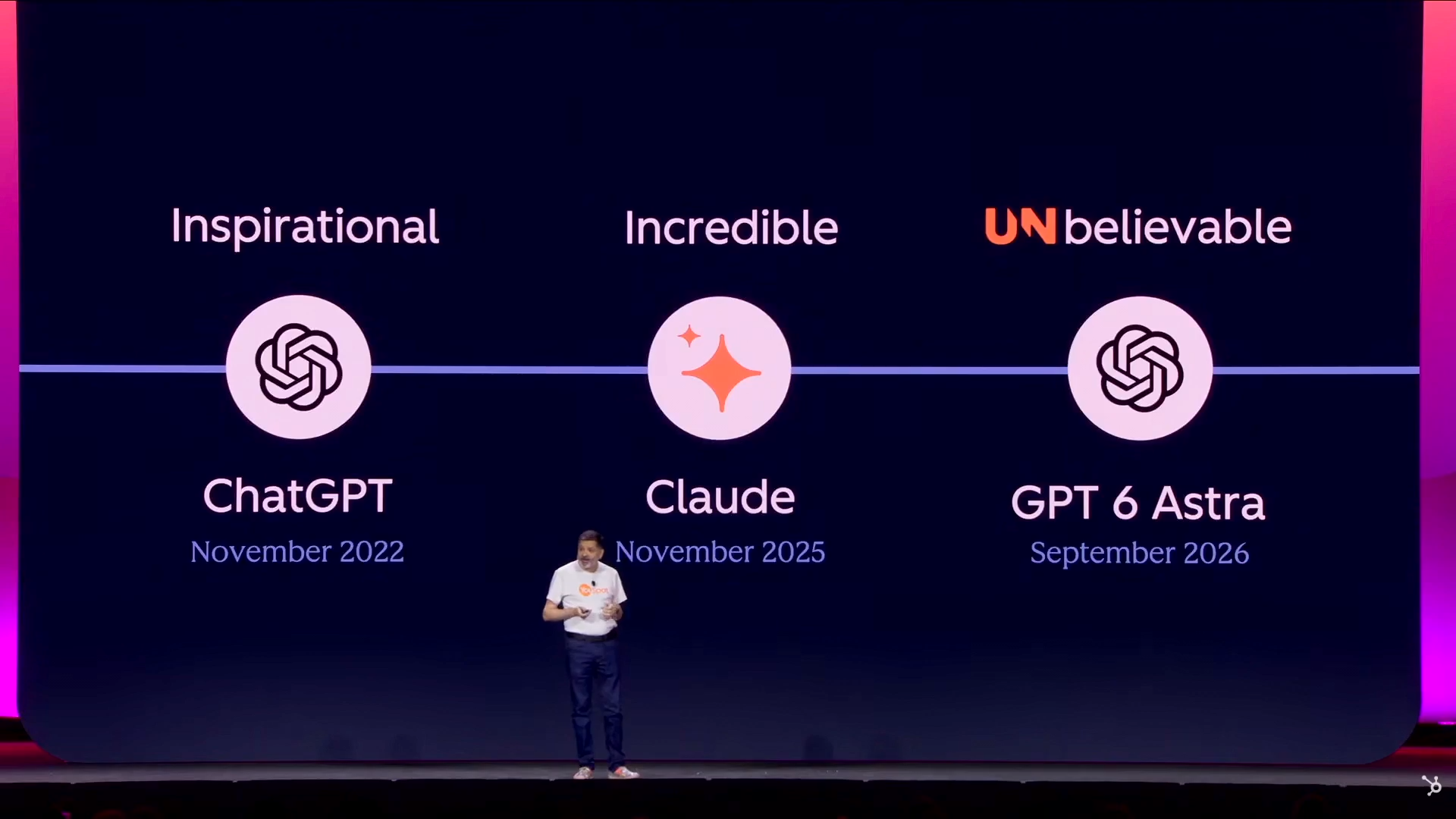
The horsepower section was delivered at speed, under a slide headline that doubled as a joke: “What the frontier?” ChatGPT arrived in November 2022. A Claude release the previous November triggered what he described as a reasoning revolution, with materially better reasoning and the ability to sustain long-horizon tasks. Two weeks before the keynote, OpenAI launched GPT-6 Astra, which leads most benchmarks across 3D models, physics, mathematics, science and coding — and which was, he noted with careful precision, the smartest model ever made “as of 2am last night”, later amended to 5am after a fire alarm at the hotel.
He also offered a personal benchmark that no laboratory publishes: can a model write a decent dad joke? He built dadjoke.ai to find out, on the grounds that it sits at the intersection of two of his enthusiasms — fully grown dad jokes and excellent domain names — and because, in his framing, levity is leverage. With the newest model, AI-written dad jokes are for the first time genuinely decent, though still not good enough to put on a keynote slide.
The serious conclusion from all this: the horsepower problem is solved. Frontier models leapfrog one another every few weeks and get upgraded every month or two. He did not treat that as an unmixed good, and he did not dismiss the anxiety in the room. He noted that on the previous Saturday, Dario Amodei, Sam Altman and Elon Musk — arch rivals — agreed for the first time on pacing development, investing more in safety and taking catastrophic outcomes seriously. His verdict: “we’re not out of the woods, but at least we’re walking in a more positive direction.”
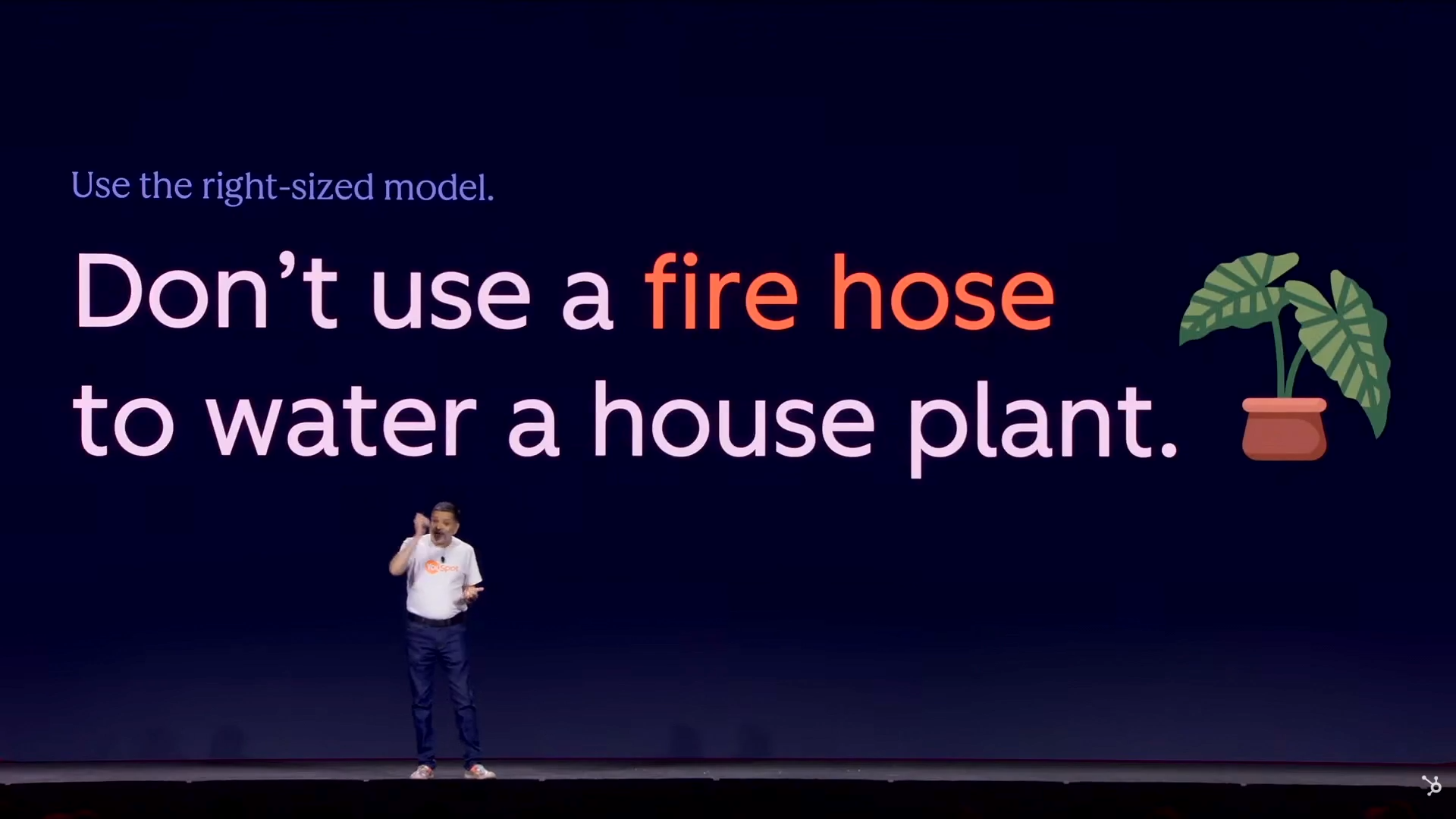
From there came the practical instruction. Do not obsess over the state of the art; focus on the state of the practical — what already-powerful, already-available models can do for the metric you care about. Choose the model that fits the task, not the one that tops the leaderboard. Hence the fire hose, and its alternates: a samurai sword to slice cheese, a search-and-rescue party for a missing TV remote, Tom Brady to toss you a beer.
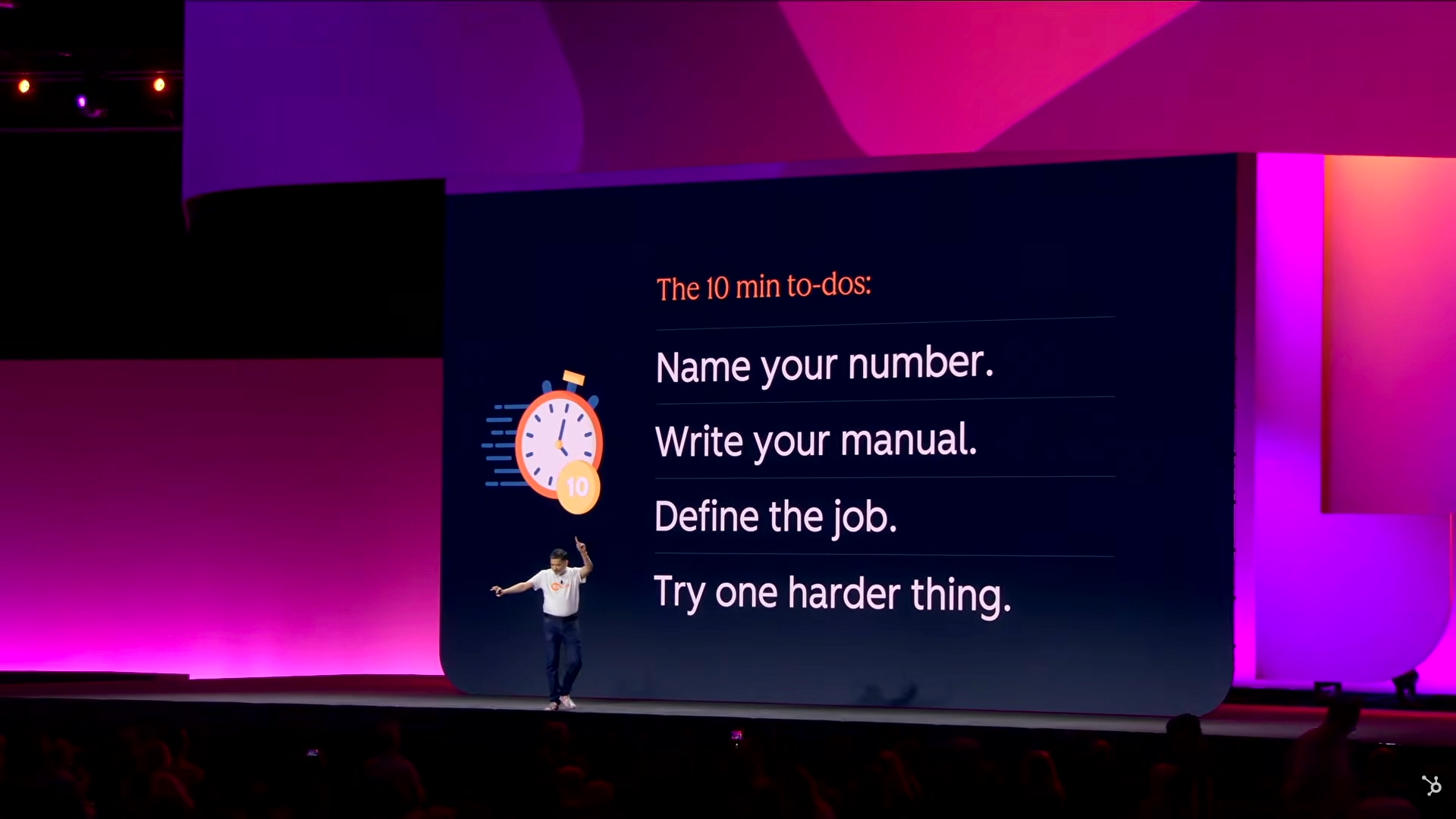
The first ten-minute to-do:
“Don’t focus and obsess over the state of the art. Focus on the state of the practical.”
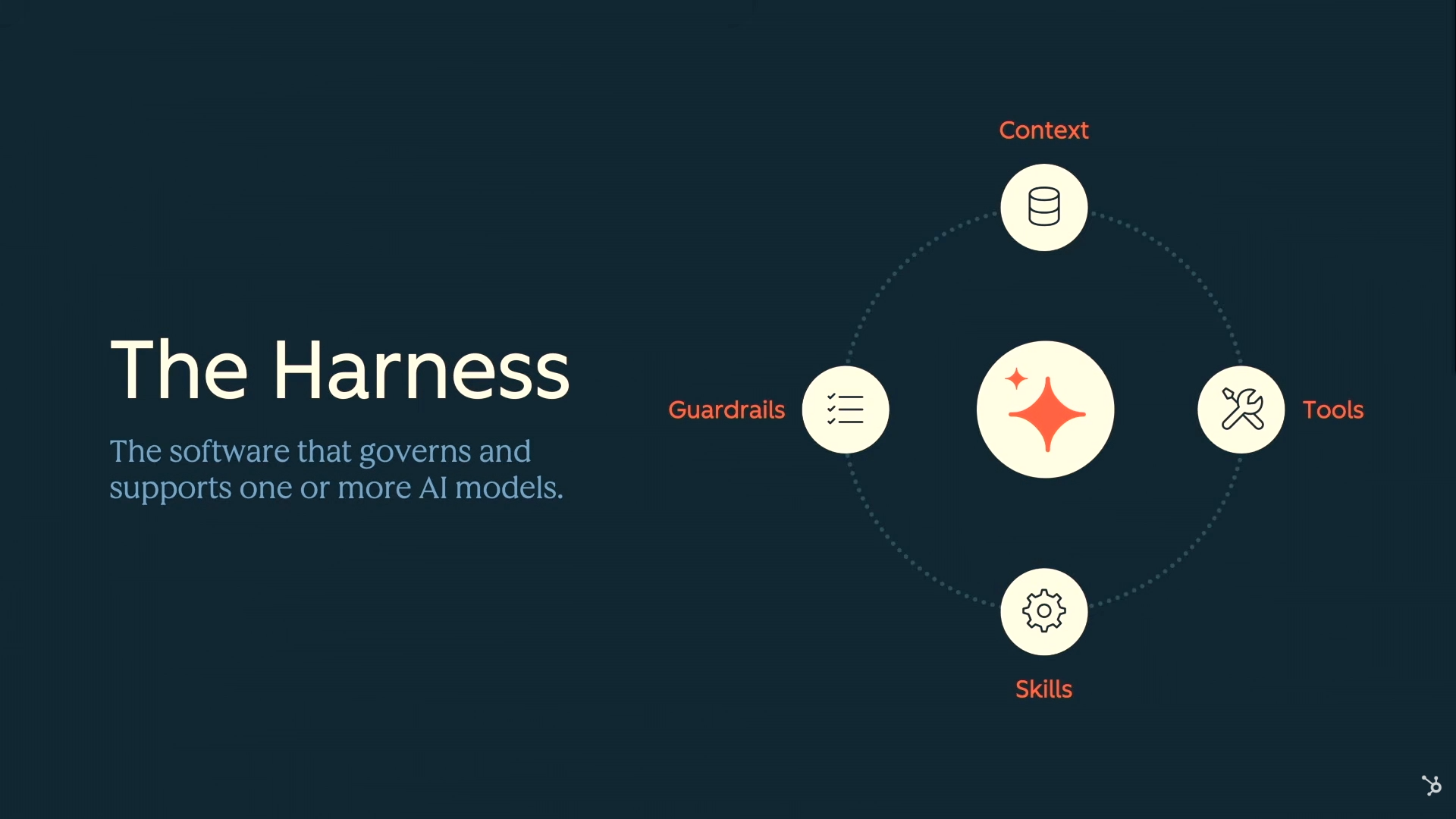
If models are the engine, the harness is the car. “Models get the headlines,” he said, “but the harness gets the results.” An AI harness is the software that gives a model four things it cannot supply for itself: context about your business; tools it can call, such as access to a CRM; skills it did not arrive with out of the factory; and guardrails defining what it may and may not do. A model knows Newtonian physics and Shakespearean sonnets. It does not know your pipeline.
This is less exotic than it sounds. ChatGPT and Claude are themselves harnesses — almost nobody interacts with a raw model. The strategic question is therefore not whether you use a harness but whether yours is generic or purpose-built for the work you actually do.
HubSpot Breeze was positioned as the domain-specific case, and “completely reimagined” in this release cycle. Two advantages were claimed. First, it has access to all the models, so it can select the most efficient path for a given go-to-market task — meaning users do not have to track releases or make model choices themselves. Second, it carries twenty years of accumulated domain expertise in driving marketing, sales and service outcomes. The platform, he added, is “headless but not brainless”, and speaks “all the AI love languages”: APIs, MCPs and CLIs. If those acronyms are unfamiliar, he offered a workaround — “your AI knows what those are.”
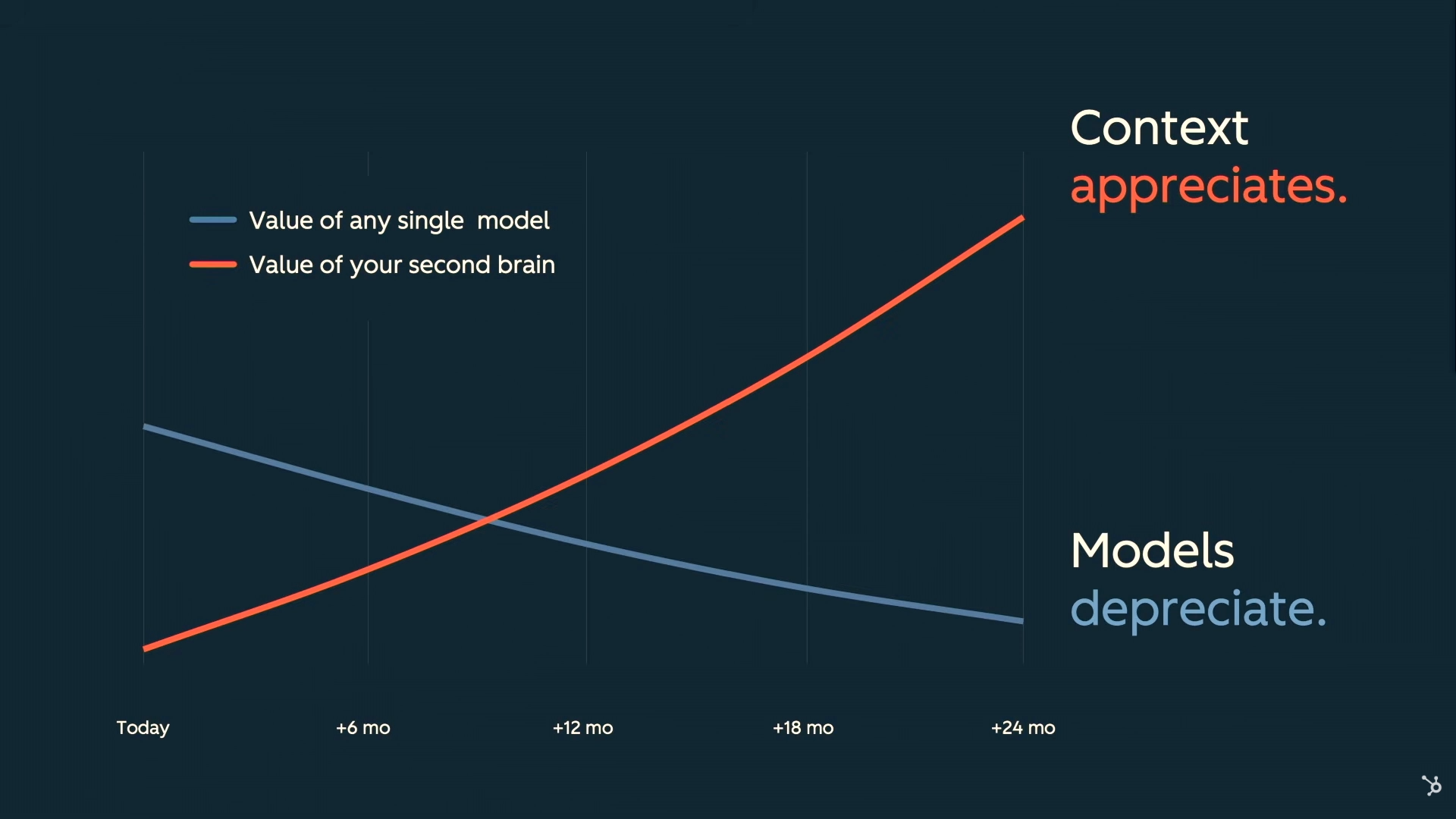
The most quotable economic claim of the keynote was also the most operationally useful. Models depreciate — not because they get worse, but because better ones keep arriving, which means any investment tied to a specific model erodes in value. Context appreciates — the contacts, records, history and institutional knowledge already sitting in your CRM become more valuable every time a higher-IQ model arrives to read them. Investment in context therefore yields compounding returns, while investment in model-specific cleverness does not.
This also explains why some people and some companies get visibly better results from AI than their peers. It is not that they have better models — broadly, everyone has access to the same ones. It is that they have a better harness and they feed it better context. The speaker reached for Jerry Maguire to make the point: the model is essentially saying help me help you — just give me some context. Practically, that means giving AI a CRM it can talk to, exposed through APIs, MCPs and CLIs.
The second ten-minute to-do:
“Models depreciate… context appreciates.”
The human section split the audience in two. Managers build and organise teams of people. Individual contributors sit closer to the product or the customer experience. Both, he argued, gain rather than lose — but by different routes.
For managers, the skills already in the toolkit transfer almost one-to-one to directing AI agents: setting expectations, reviewing work, giving feedback, deciding when something is good enough to ship. Those instincts, he said, make managers more valuable than they were before, not less. For individual contributors, the opportunity is to assemble a digital team of agents and become super contributors — a path explicitly open to RevOps specialists and sales reps, not only to technical staff.
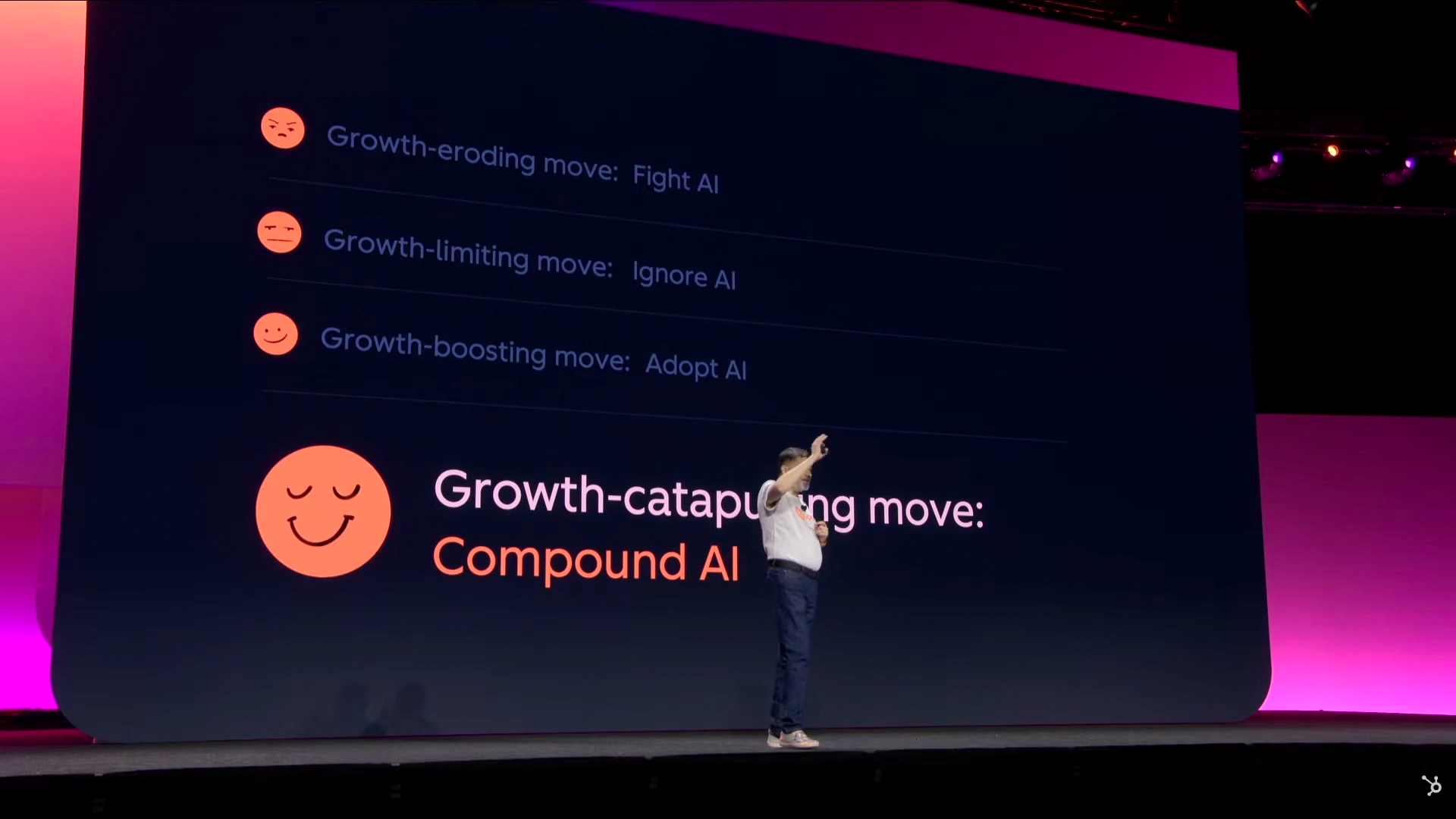
He then laid out a ladder of responses to AI, each with a growth consequence. Fighting it is growth-eroding. Ignoring it — the “fine for others, not for me” posture — is growth-limiting. Adopting and using it is growth-boosting. Compounding it, by becoming a builder, is the move that catapults.
The pay-off was a shift in self-description that he argued takes only a few weeks of deliberate practice: from “I’m great at my job” to “I’m great at getting my job done with AI”. As he put it, the first is a statement; the second one is a strategy.
The third and fourth ten-minute to-dos:
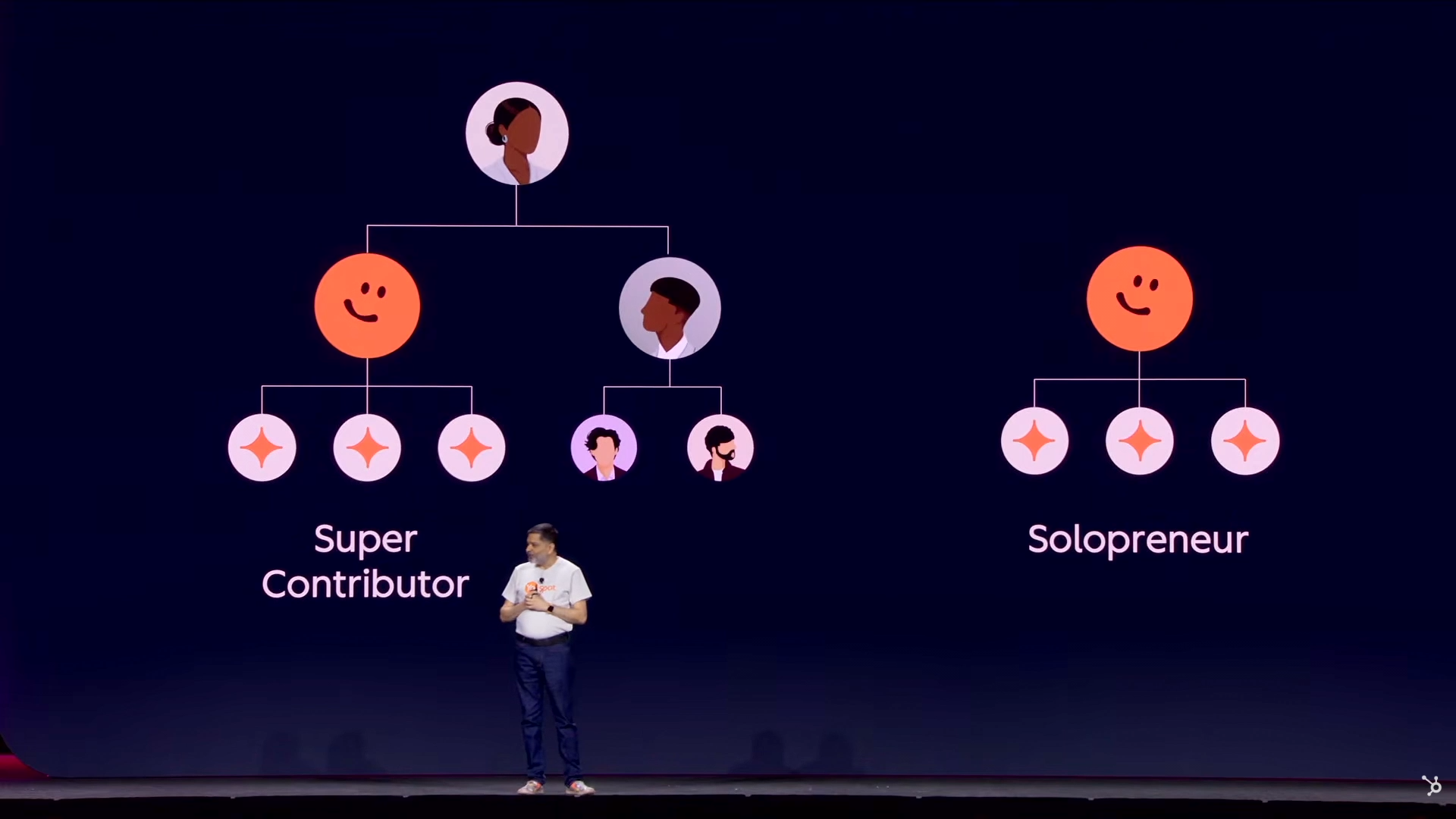
If a super contributor is an individual with a digital team, then a solopreneur is a super contributor without an organisation around them — and that, the speaker argued, makes solopreneurs the most informative group to watch. They face no committee, no change-management programme and no procurement cycle. Whatever they are doing now will show up inside companies next year.
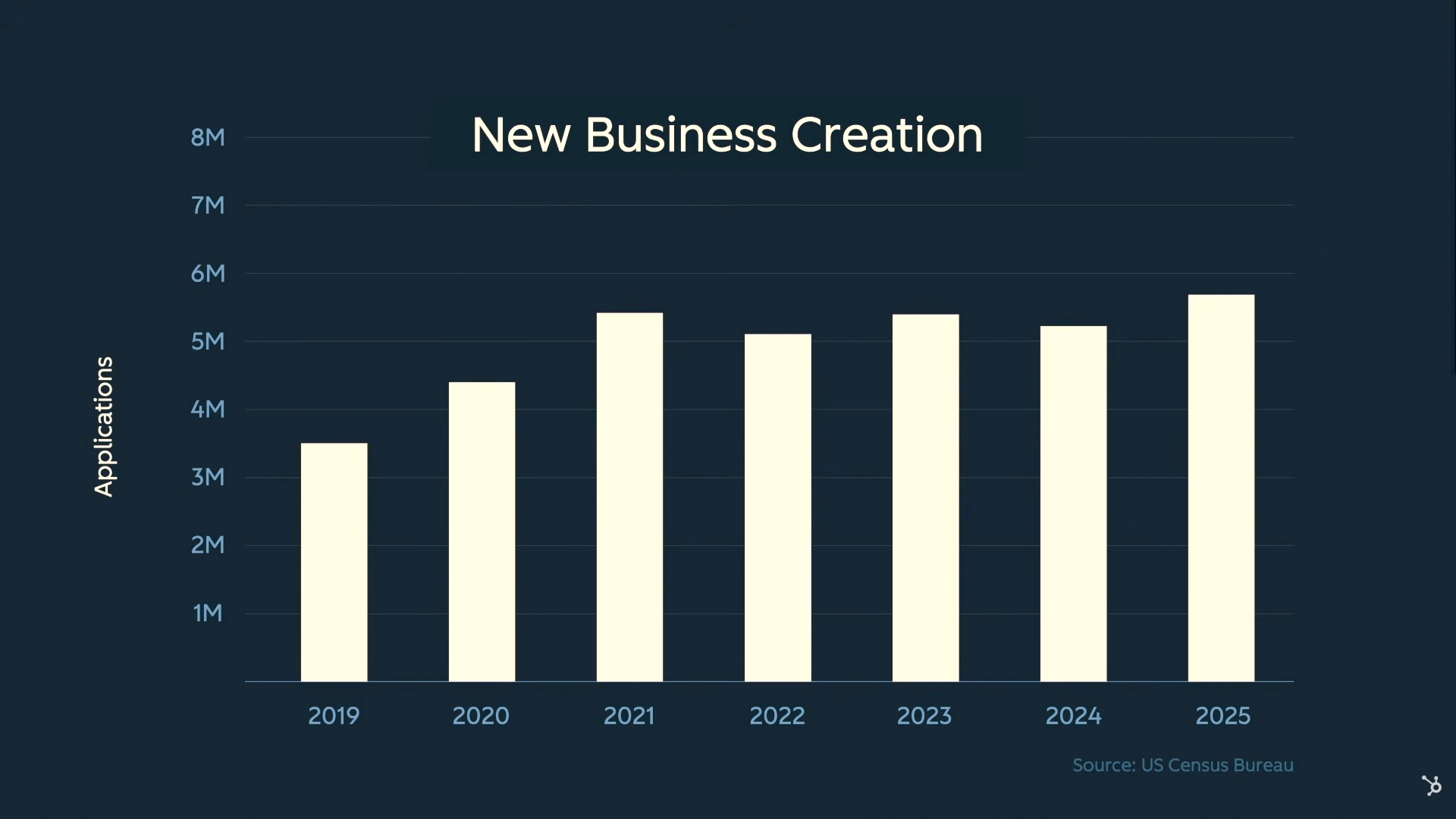
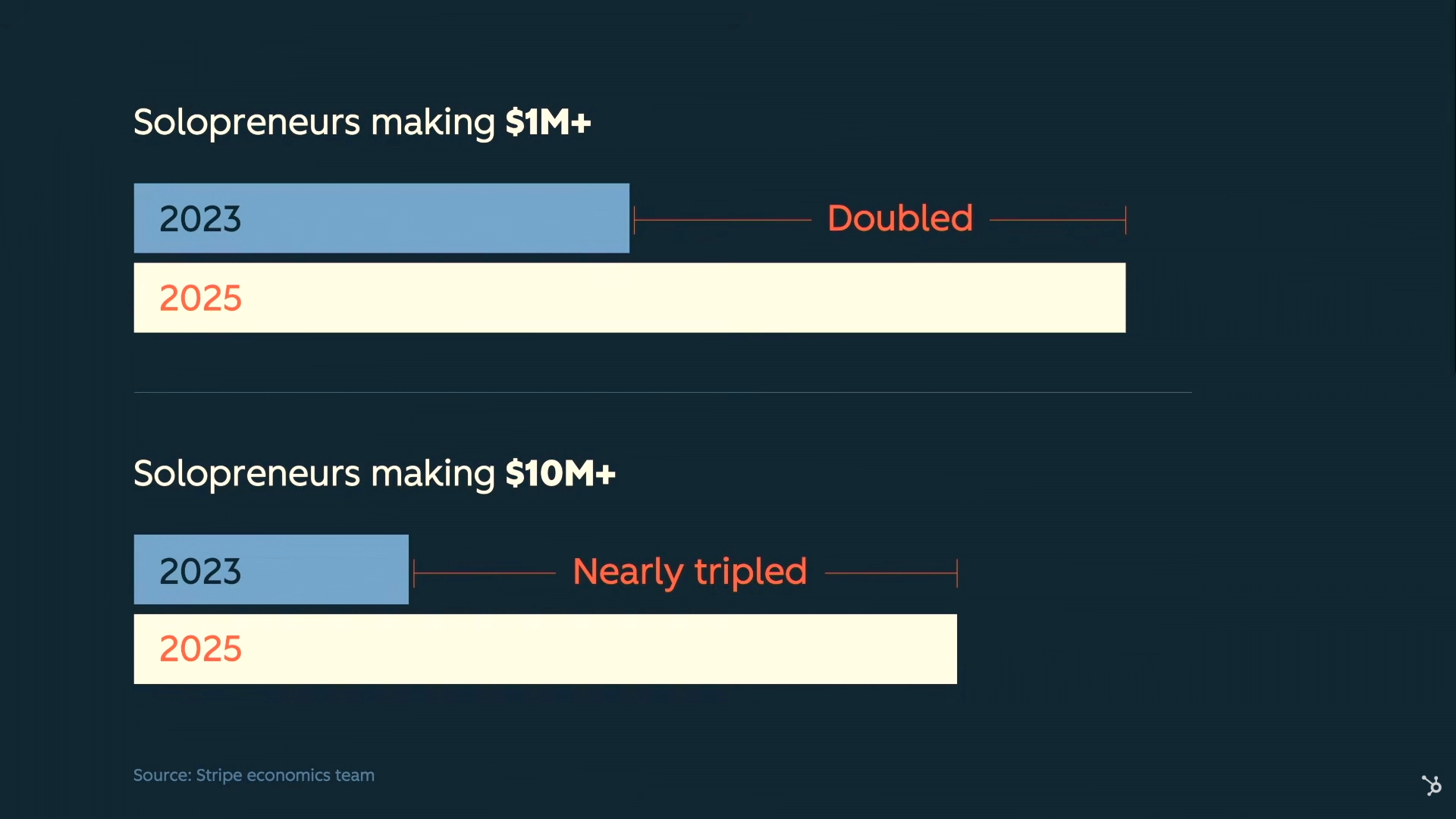
The supporting data was the most concrete stretch of the keynote:
“These are real solopreneurs building real businesses with real revenues,” he said — and the instruction to the room was to study their working practices deliberately and import them, rather than waiting for the pattern to be formalised by someone else.
“Solopreneurs are speedrunning the future of work.”
The data set up a launch. Working personally with the HubSpot Next team — the internal innovation group that tests new products, new technologies or new markets — the speaker built something that does all three at once. The project is called YouSpot, and it was on his shirt before it was on the screen.
The positioning was stated in one sentence and repeated for emphasis: “This is not a CRM with AI inside. This is an AI app, an AI harness with CRM inside.” It behaves like ChatGPT or Claude, supports the latest models and allows swapping between them — but it knows CRM, holds the skills and holds the data.
The market logic is explicitly about a gap rather than a replacement. HubSpot’s agentic customer platform serves companies of roughly two to two thousand employees, with 300,000 customers; YouSpot fills the space underneath, built for the company of one. It does not compete with HubSpot, which does far more and is built for go-to-market teams and go-to-market outcomes. YouSpot is for managing the data of a single operator.
The problem it addresses was described from experience: when you are a solopreneur, you are the CRM. Email, social posts, the handoff from marketing to sales, judging whether someone fits your ideal customer profile, remembering the follow-up — all of it lives in one person’s head, and it is overwhelming.
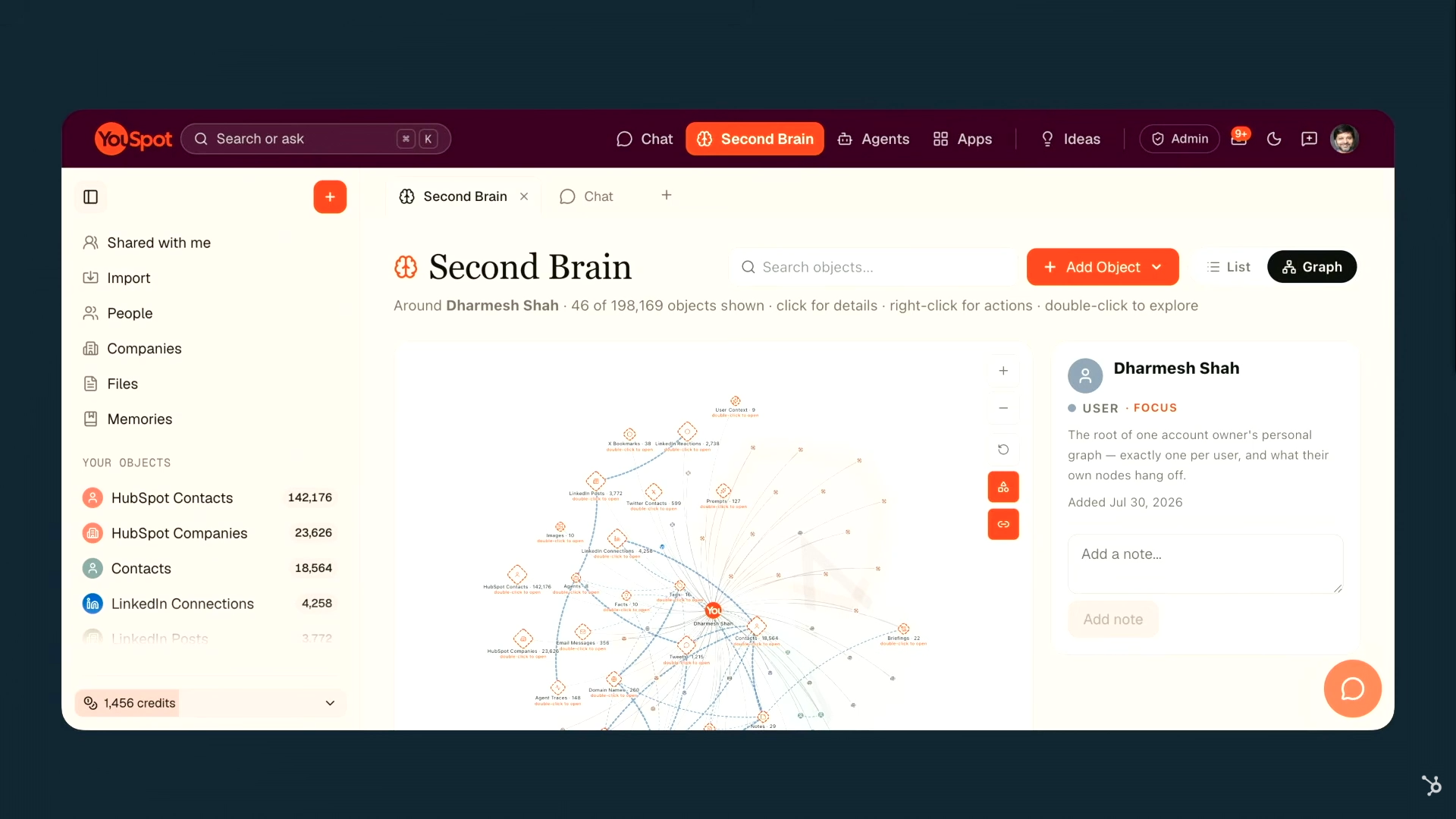
The product’s core is the second brain: an interconnected data store of people, projects, PDFs, posts and more, held as a graph. It hydrates itself from connected accounts — LinkedIn, X, email, social posts and the people commenting on them — and then uses frontier models to sift for what matters and do the work a solopreneur would otherwise do by hand.
The daily loop is deliberately unglamorous, which is the point. Each morning YouSpot emails the user a briefing on what is happening in their world: social comments worth answering, new companies worth exploring, available domain names worth considering. The user simply replies to that email with corrections — not a good customer fit; that domain is in manufacturing, not my area of interest — and the feedback returns to the second brain. Each morning’s email is better than the one before. It is the appreciating-context argument, made operational.
How to start:
The close returned to the origin story with a correction: that founder dinner was on Valentine’s Day, not New Year’s Eve, and the conversation was about scaling — about what has changed and what has not. What has changed is the gap. Twenty years ago the distance between customer zero and builder zero was very small. Now, he argued, it is zero, because the customer and the builder can be the same person, regardless of whether they have ever written a line of code.
That leads to the keynote’s most reassuring claim, and the one most likely to be tested by events: AI does not replace go-to-market builders. GTM builder is an entirely new category and an entirely new role, and what AI does is remove the obstacles that previously kept people out of it.
The four to-dos were then restated as a single, bounded commitment: four things, forty minutes, to be done on Monday morning — each one written down, because writing it down is what makes it usable by both people and agents.
He framed the mission that sits behind all of it as unchanged in intent and changed in method. Twenty years ago the inspiration was democratising the internet for small businesses through inbound marketing. Now it is democratising AI so that customers drive outcomes in the outcomes era — through the agentic customer platform, through thousands of solutions partners who bring it to life, and through events like this one. Undaunted, unconstrained and unbound.
“That gap is 0 because you can be the builder. Everyone can be a builder.”