Michelle Lim
CHIEF EXECUTIVE OFFICER @ FLINT
Michelle Lim is the CEO and co-founder of Flint, an AI platform that helps growth and marketing teams build, optimize, and scale landing pages. Flint is backed by Accel, Neo, and HubSpot Ventures.


CHIEF EXECUTIVE OFFICER @ FLINT
Michelle Lim is the CEO and co-founder of Flint, an AI platform that helps growth and marketing teams build, optimize, and scale landing pages. Flint is backed by Accel, Neo, and HubSpot Ventures.

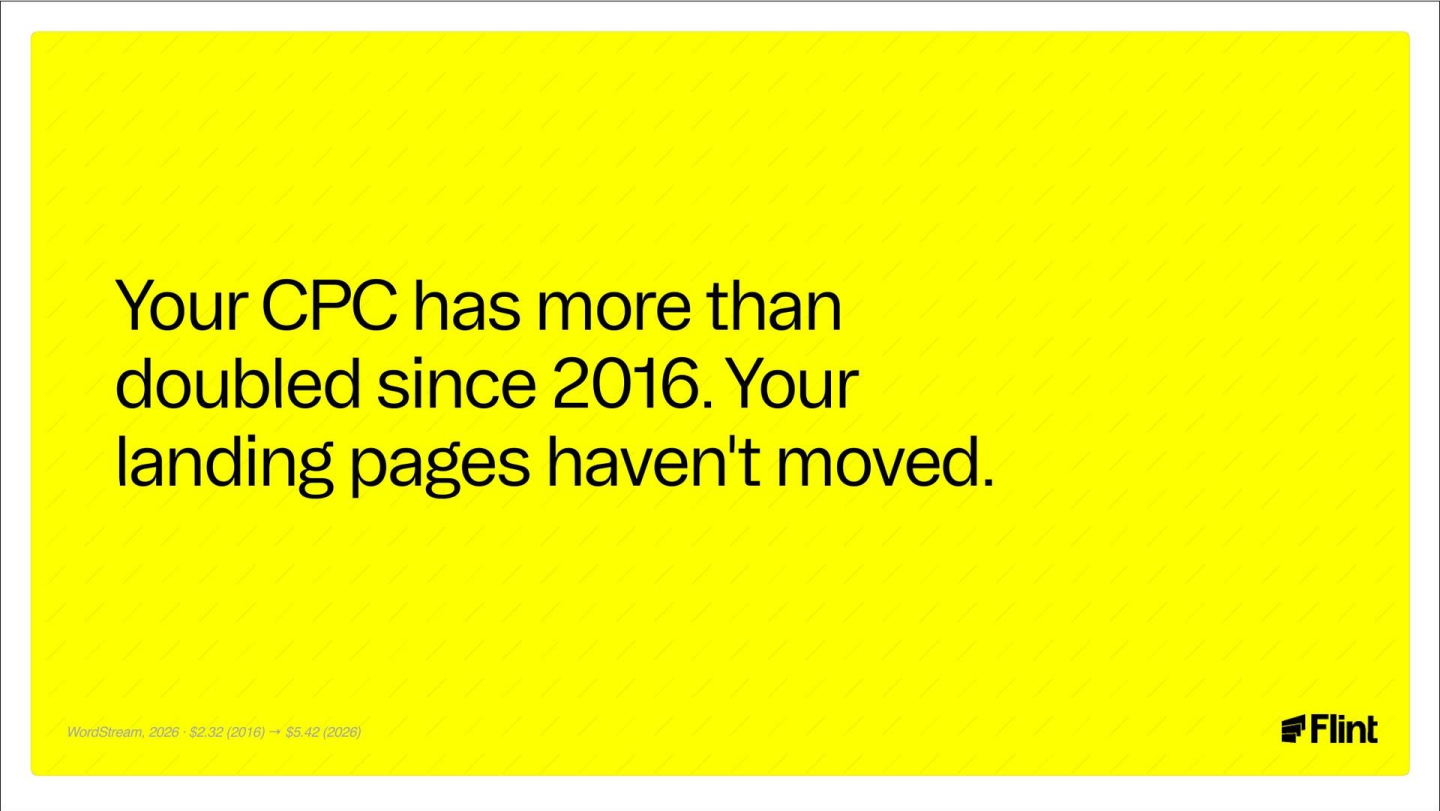
Michelle Lim, co-founder and CEO of Flint, opened the stage with an uncomfortable piece of arithmetic: the cost of buying attention has more than doubled since 2016, while the page that attention lands on has barely changed at all. Her argument was not that landing pages are broken in some cosmetic sense, but that they have become the slowest, least-maintained component in an otherwise automated acquisition machine — a bottleneck sitting directly between rising media spend and the revenue it is supposed to produce.
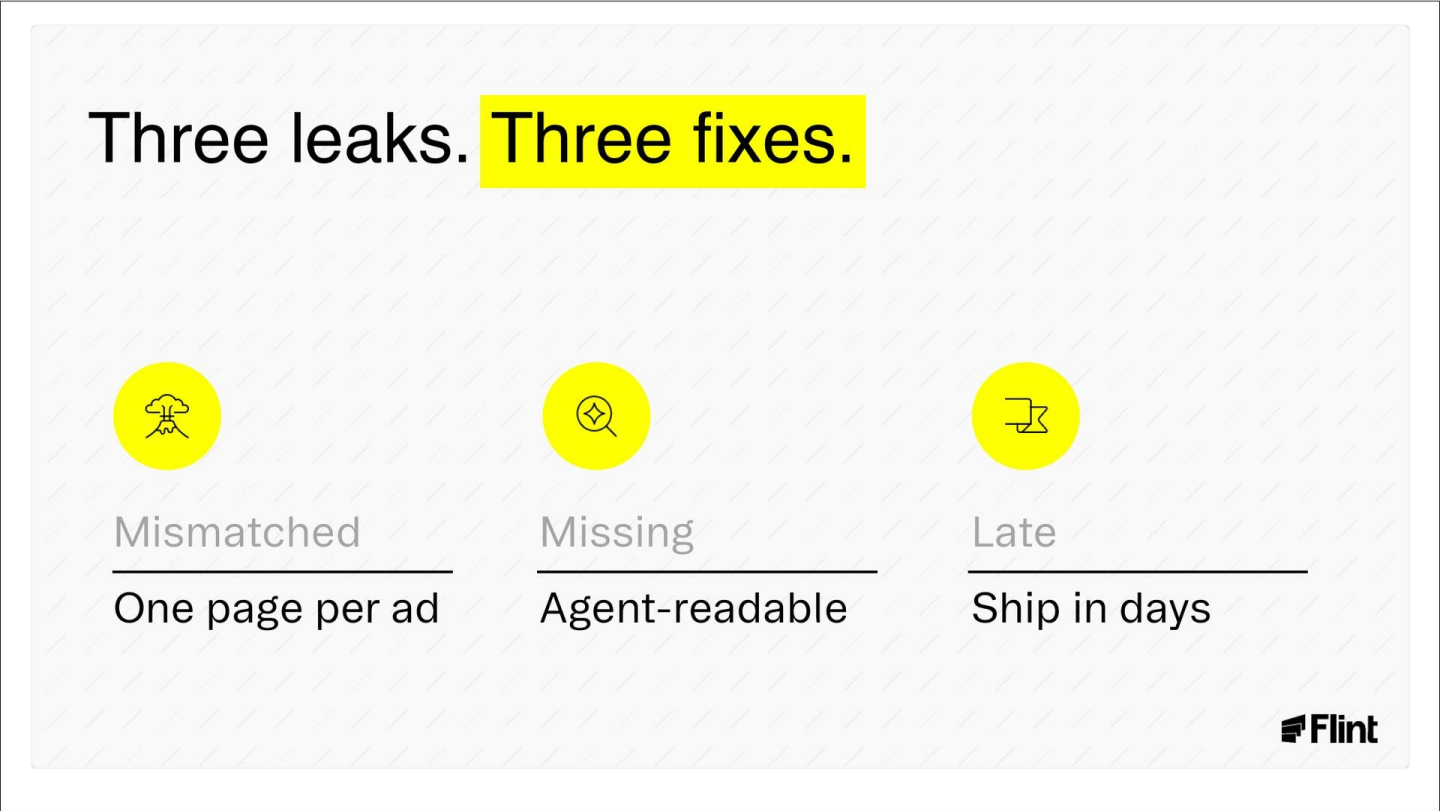
Drawing on what she described as a year of work with around 250 brands trying to lift conversion, Lim framed the problem as three distinct leaks: pages that are mismatched to the volume of ad creative now being shipped, pages that are simply missing for the queries buyers and AI agents actually generate, and pages and experiments that arrive late, after the demand has already moved on. Each leak came with a fix that a marketing team could start on the same week.
She also asked the room to self-assess before she began. Almost every hand went up for sending ads to at least one landing page; a healthy number stayed up at four; very few remained at twenty. That gap — between what teams run today and what the maths of modern paid media demands — became the through-line of the session.
The opening slide carried the whole thesis in a single sentence: cost per click has more than doubled since 2016, and landing pages have not moved. Every other layer of the funnel has been rebuilt in that decade — bidding, targeting, creative production, measurement — but the destination page is still, for most teams, a handful of hand-built templates maintained by a web queue that cannot keep pace.
That imbalance is what turns rising media costs into wasted media costs. If the price of the click is set by the market and the conversion rate of the page is set by whatever was built eighteen months ago, the only variable left moving is the one moving against you.
Lim introduced herself briefly — Flint builds self-improving systems for performance marketing, closing the loop between ads and pages, backed by HubSpot Ventures and Sheryl Sandberg, and working with brands including 11x and Pickle — before moving straight into the three leaks that structured the rest of the talk.
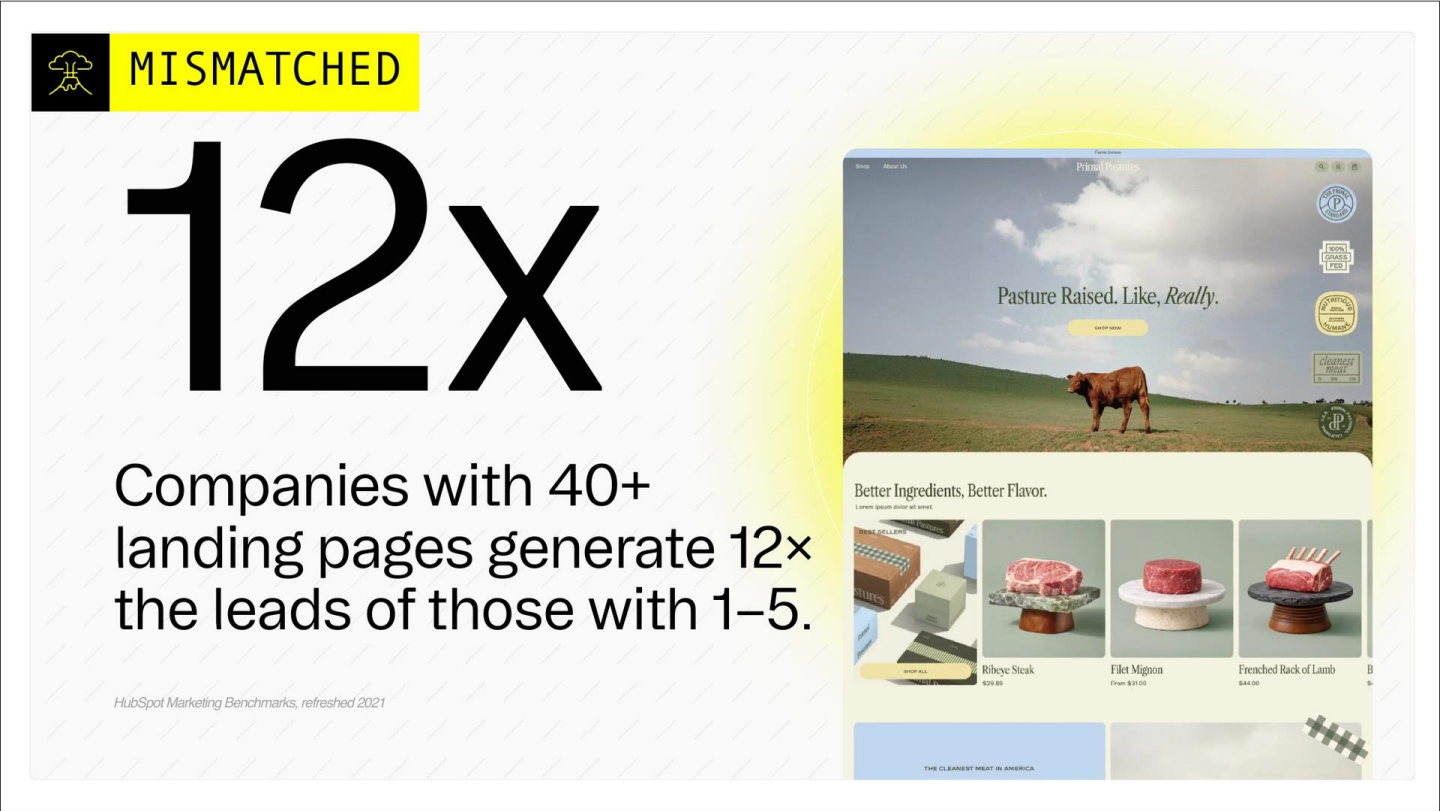
The first leak is a volume mismatch. Top spenders, Lim said, now ship between 15 and 19 new ad creatives every week — not because they enjoy the production burden, but because the algorithms demand it. She pointed to Meta's Andromeda algorithm, released at the end of 2025, which removed much of the manual segment selection advertisers once relied on. The new bargain is simple: upload enough creative variety and the platform will find the audiences for you.
Because roughly one in twenty creatives wins, volume is not optional. But the maths then cascades into the web team's territory. Five messaging angles, four audience segments, repeated weekly across a quarter, produces something like 240 pages per quarter. As Lim put it, nobody in the room has a web team that can support that — and yet the evidence says the pages matter. HubSpot's own data, which she invited the audience to photograph, shows companies with 40 or more landing pages generating 12x the leads of those running just one to five.
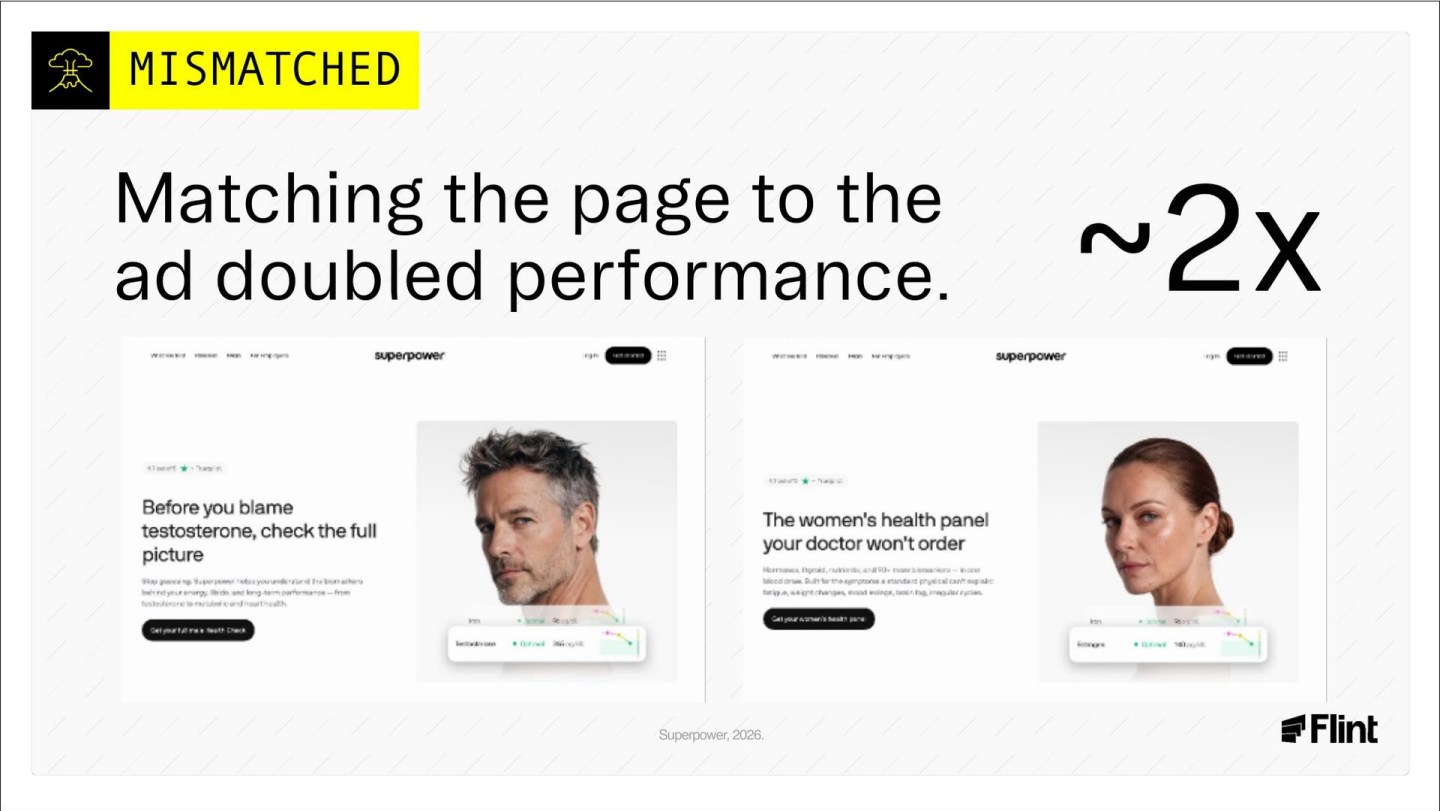
The reason the correlation holds is intent. If someone searches for one thing, clicks an ad, and lands on something that does not match, they bounce. Matching is not a cosmetic exercise either — Lim was explicit that swapping the H1 is not enough. She used Superpower, a blood-testing brand, as the worked example: tailoring pages to the creative roughly doubled conversion, with the men's page leading on testosterone and prostate health while the women's page led on hormones and sleep, because the underlying intent differs.
The fix she offered for this week: pull your five best-performing ads and build five landing pages that match them properly. One week, five pages, measurable lift — and a working proof point for the argument that every ad deserves its own page.
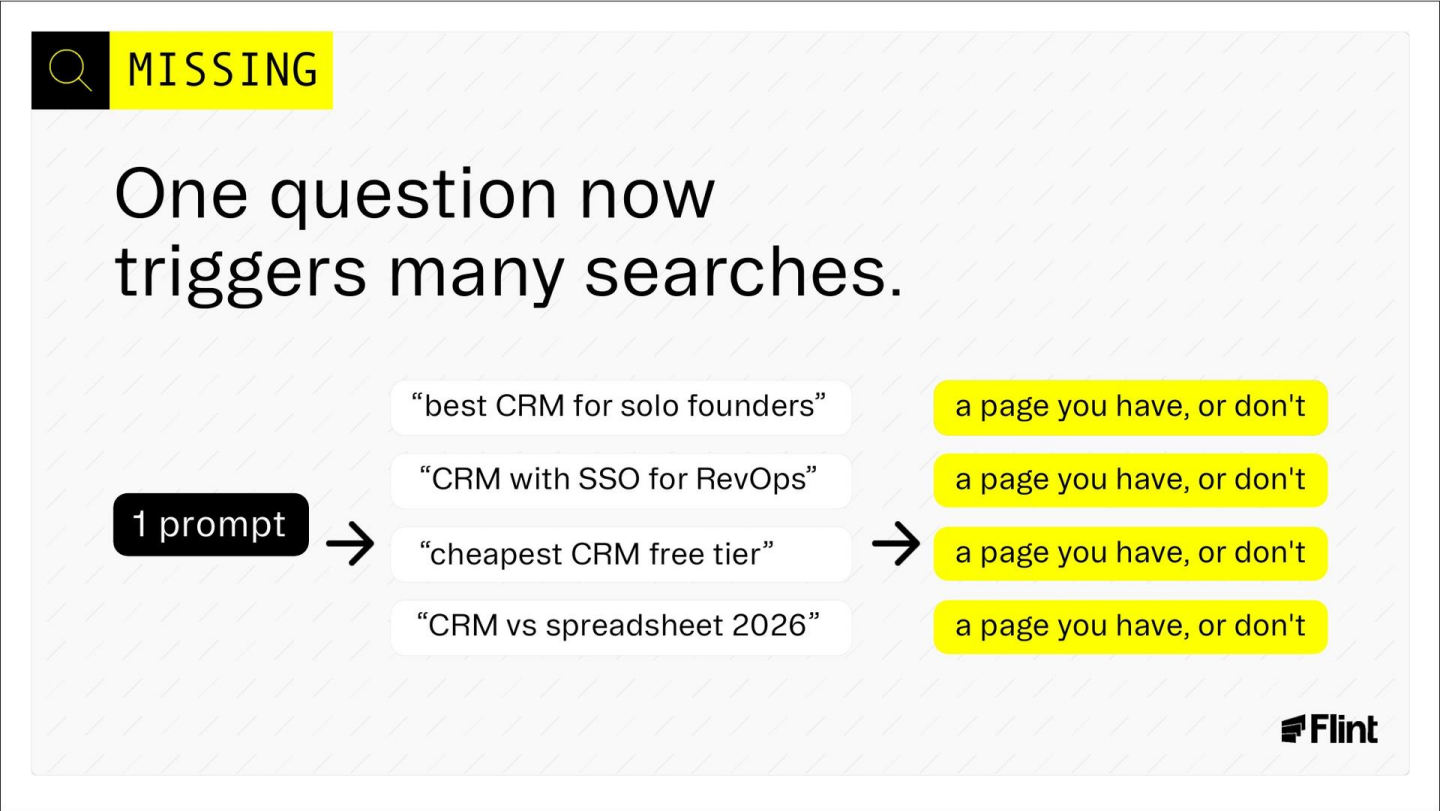
The second leak is subtler and, Lim argued, growing fastest. Search used to be one-to-one: someone typed "best CRM" and landed on a page about the best CRM. In an AI-mediated world, a single prompt fans out into many underlying searches, each enriched with context about the person asking. One question becomes "best CRM for solo founders", "CRM with SSO for RevOps", "cheapest CRM free tier" — and each of those queries lands on a page that most brands simply do not have.
The structural consequence is that the page now has a second reader. Alongside the human visitor there is an agent parsing the page, and in 2026 you have to convert both. This is the territory most people currently label AEO, and which Lim suggested is becoming answer engine marketing as advertising formats appear inside chat interfaces.
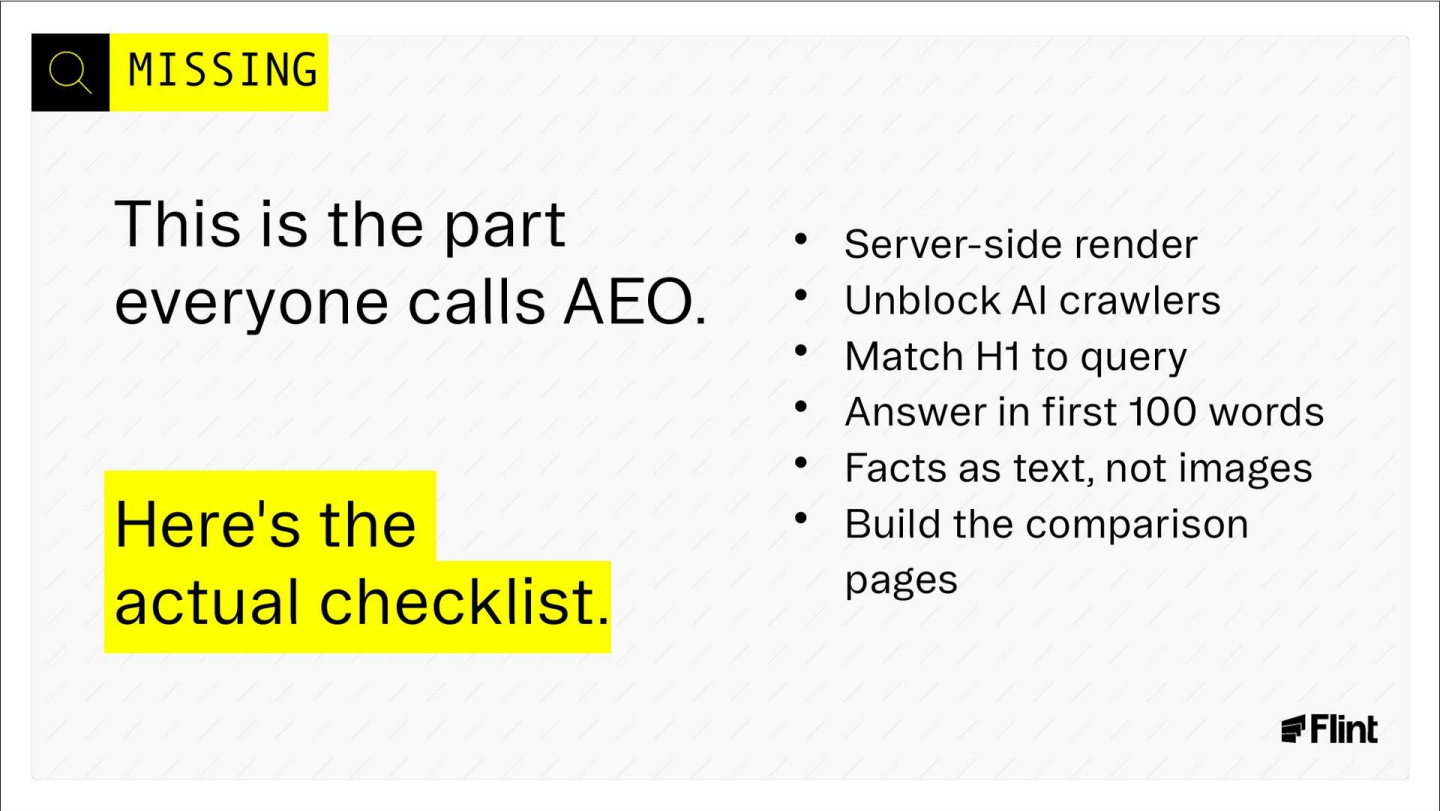
Her guidance here was deliberately practical rather than philosophical: there is a technical checklist — server-side rendering, an updated robots.txt that does not block AI crawlers, consistent heading structure and related agent-friendly properties — that a web team can implement across existing pages. She flagged it as the second slide worth photographing and forwarding internally.
The third leak is timing. Rising demand changes daily, but catching it is, in Lim's phrase, a full-time job with part-time coverage from one person. By the time a spike has been spotted, briefed, designed, built and approved, the moment has usually passed.
Her illustration was Pickle, a second-hand fashion rental marketplace. Over a weekend, search interest surged around a music festival as people looked for outfit ideas — a large volume of intent compressed into a very short window, and no bandwidth to build new pages for it. An ads agent connected directly to the ads account had been watching the Google Ads data, surfaced the rising queries, looked at what competitors were bidding on, and drafted a collection page pulling together the relevant rental outfits. The marketer logged in, reviewed the draft, clicked approve, and both the page and the ad deployed into the account.
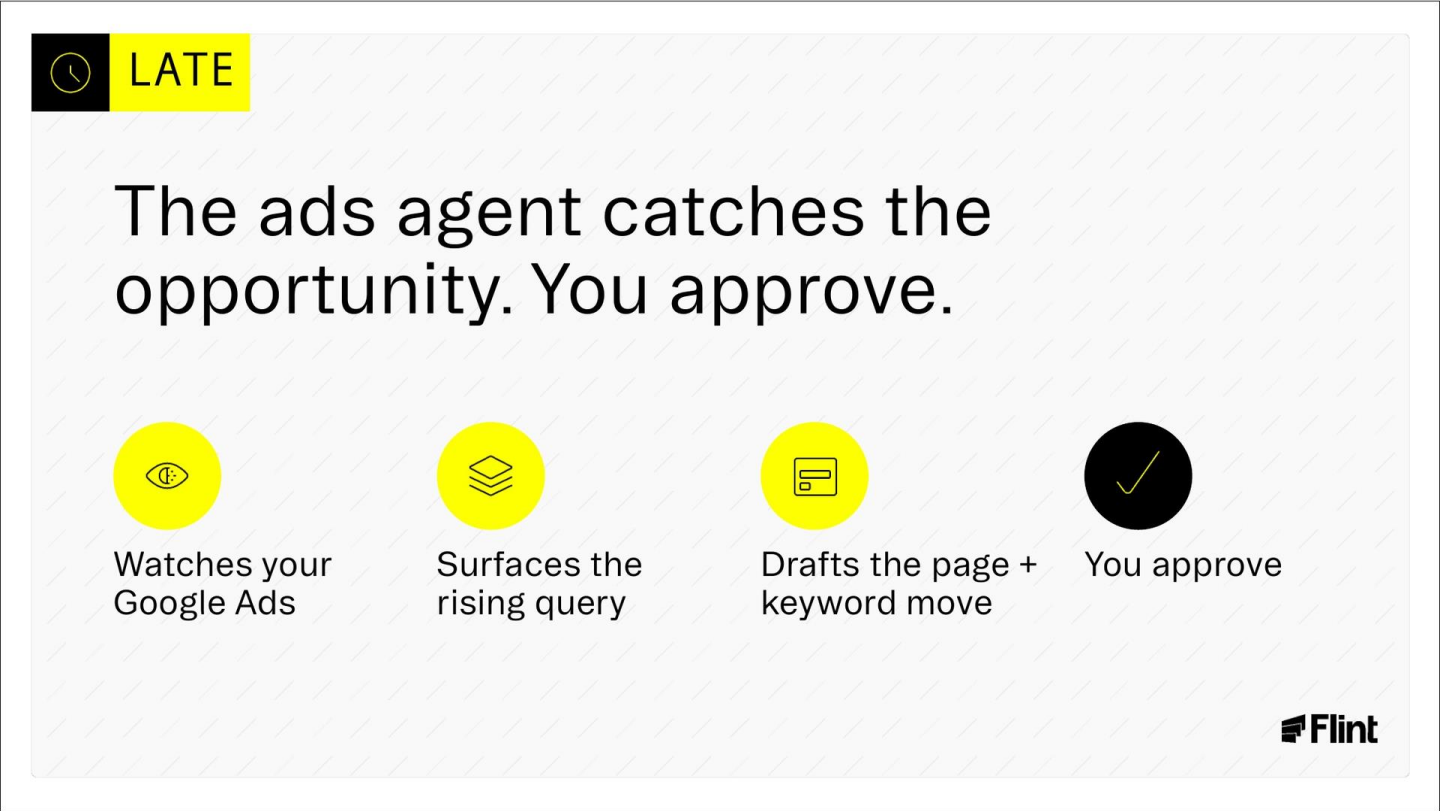
Lim was emphatic that the approval step is not a formality. Based on what she is seeing from AI systems today, it is not enough to trust automation to launch ads and pages autonomously without review. The point of the agent is to compress detection, research and drafting — the slow, unglamorous middle — while the marketer retains full control over brand and strategy.
That framing matters for anyone evaluating agentic tooling: the value is in the time-to-draft, not in removing the human decision. Speed without judgement is just a faster way to publish something off-brand.
The same agentic capacity that catches a demand spike also unlocks the discipline Lim cares most about: continuous testing. She invoked the old growth-marketing rule, ABT — always be testing — and grounded it in experience rather than theory, noting that one of her team members previously led growth design at Netflix for seven years and found that testing was the thing that actually moved conversion.
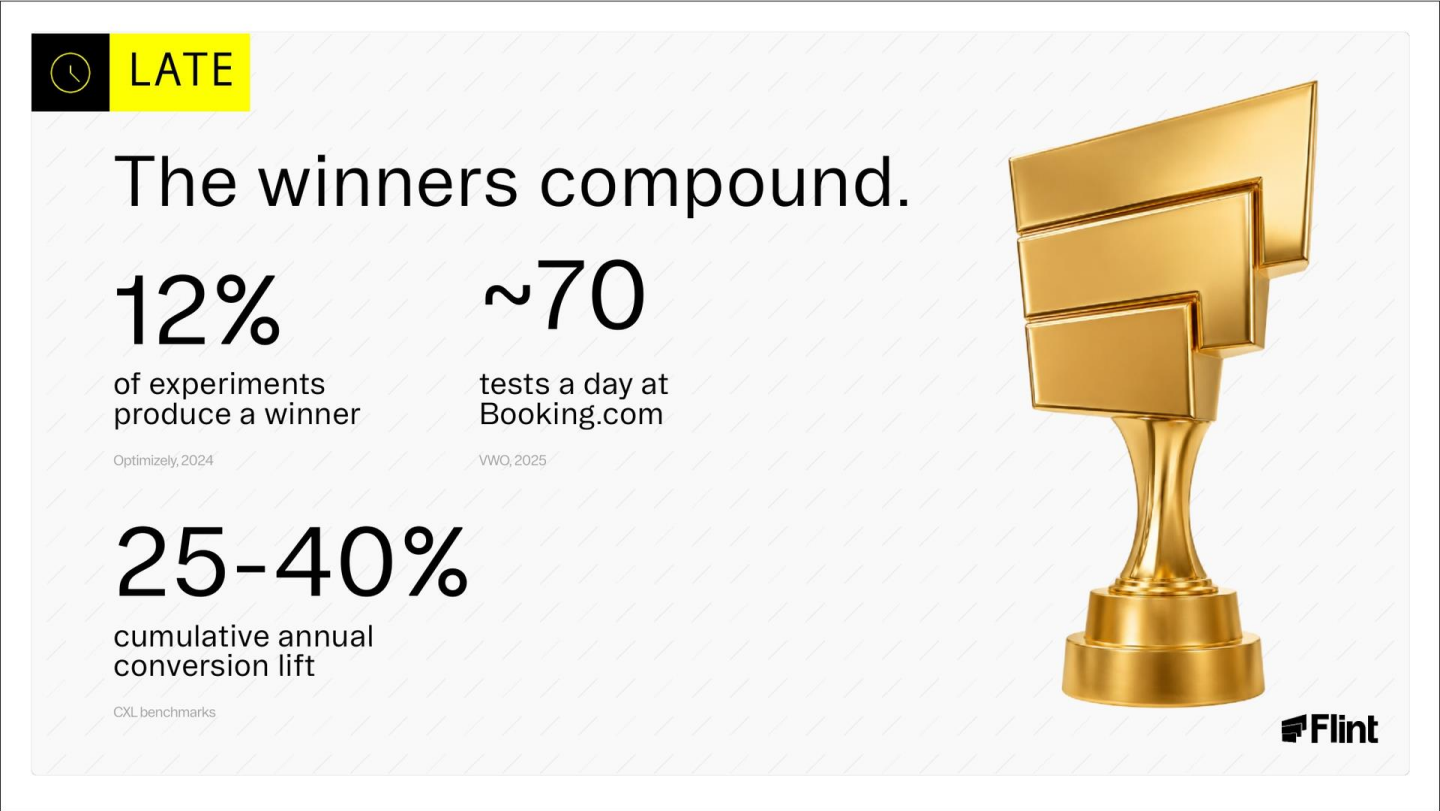
The numbers she showed explain why volume matters so much in experimentation. Only around 12% of experiments produce a winner, which means the teams that run the most tests simply find the most winners. She cited Booking.com — present at the event — running something in the order of 70 tests a day, and put the cumulative effect at a 25 to 40% annual conversion lift for organisations testing at pace. Winners compound; the losers cost little beyond the effort of shipping them.
"Velocity is the new conversion rate optimisation."
It was also, she noted with a smile, the reason she and her team were on stage in racing suits: the whole argument reduces to being fast enough to catch rising demand before it disappears.
Lim closed by collapsing the argument back into three sentences. Pages are mismatched to the volume of ad creative being produced, so the answer is a page for every ad. Pages are missing for the queries agents now generate, so the answer is agent-friendly practices applied across a much larger page library. Pages and experiments are late while competitors use AI to catch trends and test faster, so the answer is an ads agent that ships pages and experiments while the demand is still there.
Read together, the three fixes describe a shift in where marketing effort sits. The bottleneck is no longer ideas or media budget; it is production capacity and review throughput. Teams that industrialise page creation — with human approval kept firmly in the loop — convert the same traffic into materially more pipeline.
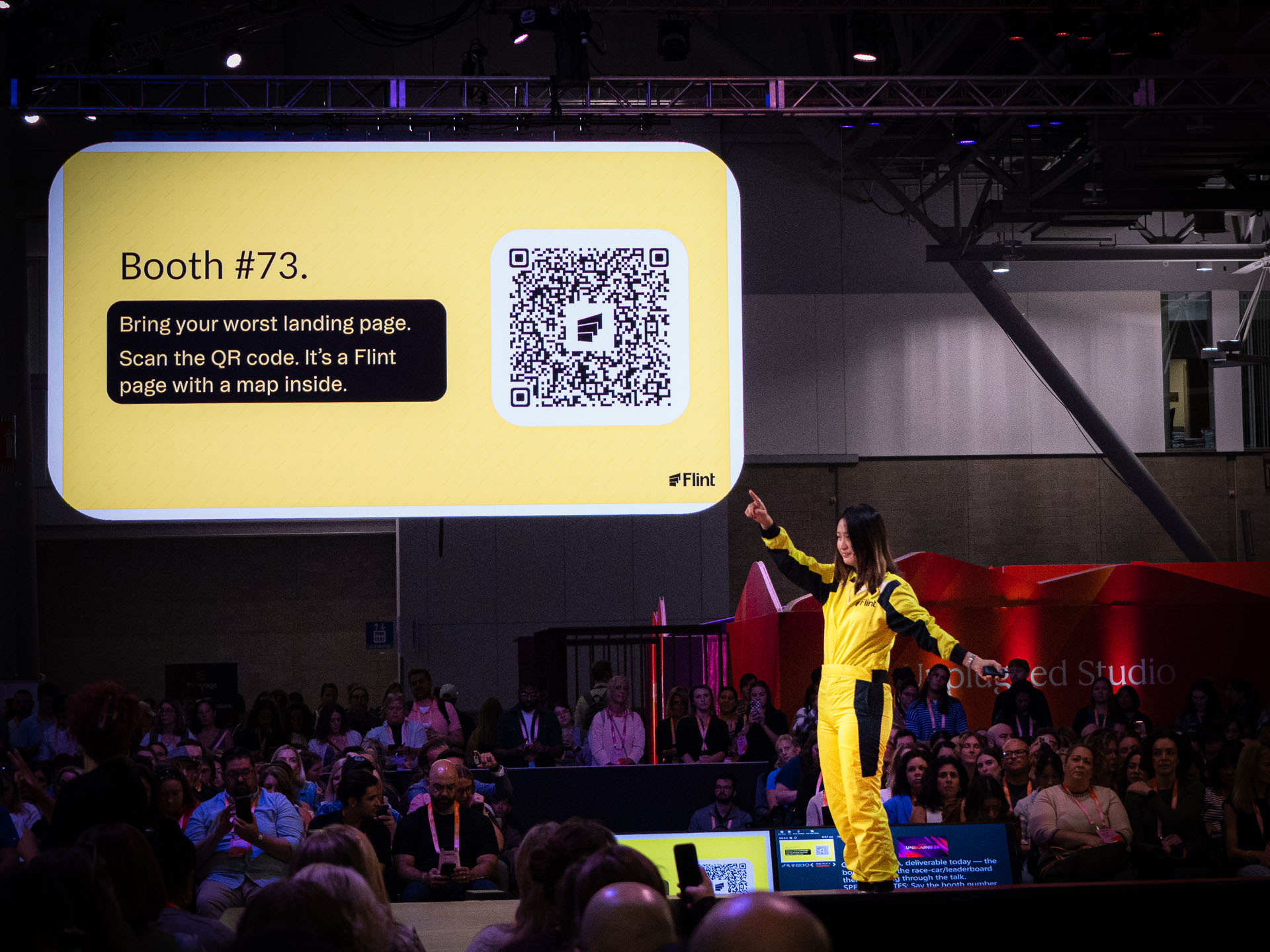
She ended with practicalities: her team, still in racing suits, would be at booth 73 behind the main stage for the rest of the day, and a QR code on the closing slide led to a page the agent itself had built.