
Mel Robbins
NYT BESTSELLER & AWARD-WINNING PODCAST HOST @ THE MEL ROBBINS PODCAST
Mel Robbins is a bestselling author and podcast host sharing practical insights on mindset and behaviour change.


NYT BESTSELLER & AWARD-WINNING PODCAST HOST @ THE MEL ROBBINS PODCAST
Mel Robbins is a bestselling author and podcast host sharing practical insights on mindset and behaviour change.

FOUNDER AND BESTSELLING AUTHOR @ THE LEADERSHIP CONSORTIUM
Anne Morriss is a leadership coach, author and podcast host who helps leaders build trust and accelerate team performance.
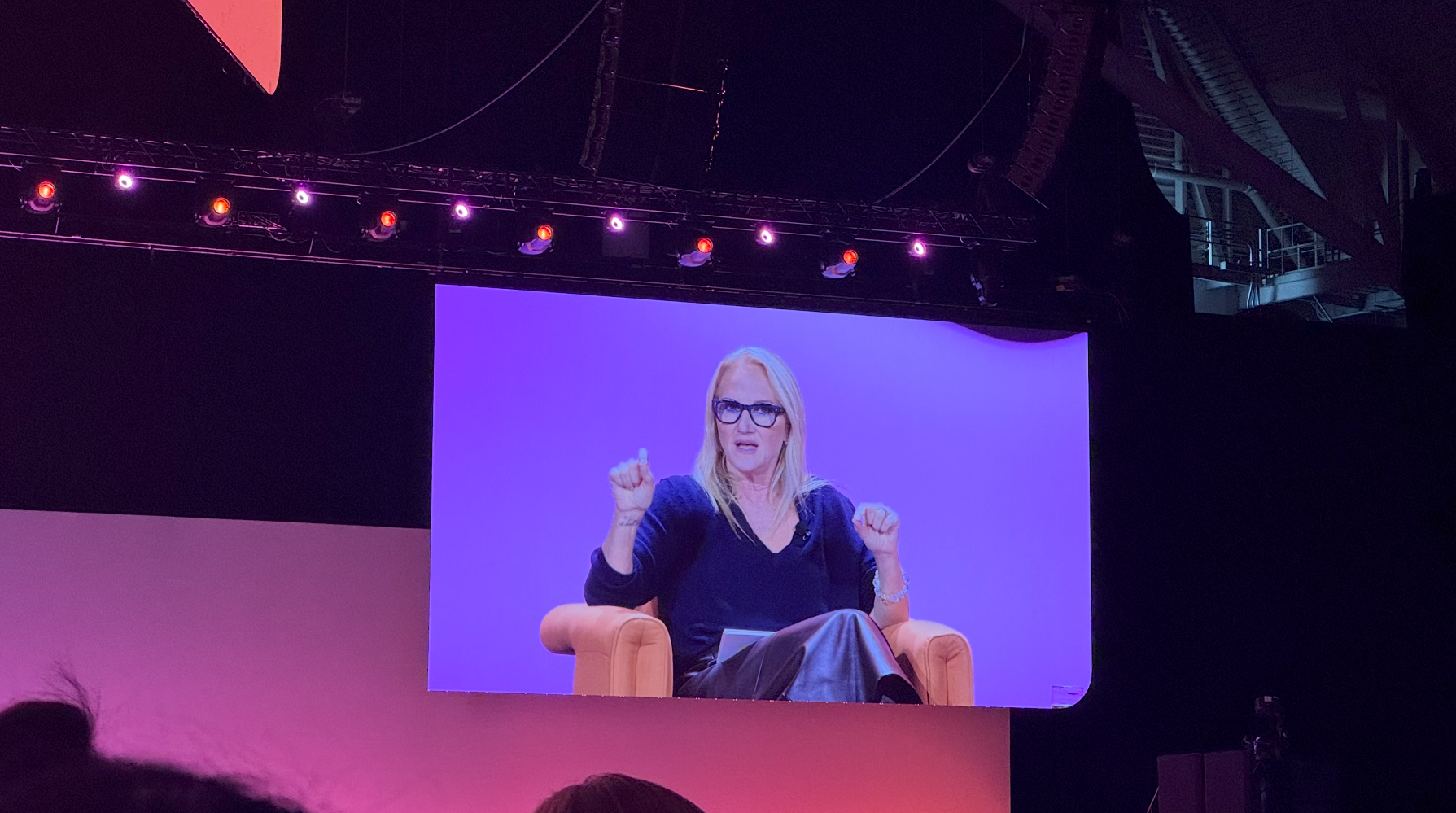 Mel Robbins and Anne MorrissHow the 5 Second Rule Moves Teams Forward With Mel Robbins
Mel Robbins arrived on stage with a correction to make. She is not, she insisted, best described as a podcast host or an author. She is the CEO of a media company and a serial entrepreneur whose products, in her own words, are “making a difference in the lives of millions of people”. Almost all of the recognition she now receives comes from work built in the last four years — in her late fifties. That detail was not vanity. It was evidence, offered early and deliberately, against the quiet arithmetic most people run on themselves: “You’re telling yourself you’re too old. You’re too young… You’re wrong.”
What followed was less a motivational set than an operating manual, delivered in two registers at once. One register was commercial: how a podcast syndicated in 194 countries and averaging around eleven million listeners a week is actually run, and why intention rather than instinct governs every decision inside it. The other was managerial and intensely personal: how leaders create the conditions in which other people can do well, and why so many of them accidentally do the opposite.
The through-line connecting the two was control — specifically, the narrow band of it any of us actually possess. Robbins kept returning to the same boundary: you control what you think, what you do, what you don’t do, and how you process what you feel. Everything else — markets, algorithms, other people’s moods, the pace of AI — sits outside it. Her argument is that leadership, growth and even purpose all live inside that narrow band, and that most of us leave it almost entirely unused.

Asked what would most surprise an outsider looking inside her business, Robbins named two things: the sheer scale and complexity of it, and how relentlessly intentional she is about running it. The public sees a microphone. Behind it sits roughly 8,000 square feet of studio space in Boston — the city where she and her husband raised their children, though she now lives in southern Vermont — and a portfolio that spans the podcast, book publishing, corporate partnerships and corporate training programmes.
She is also a co-founder of a protein company, Pure Genius Protein, and she was pointed about the distinction. She is not, she said, “an influencer with an affiliate code”. She was approached about a year before and has driven every decision since. It was a small clarification that carried a larger principle: ownership and intention are the same discipline expressed in different places.
The growth number she chose to highlight was not the audience size but its composition. Almost half of the people who listen to or watch the show had never heard the podcast before — a word-of-mouth signal rather than a paid-reach signal, and the metric she treats as proof that the underlying marketing thesis is working.
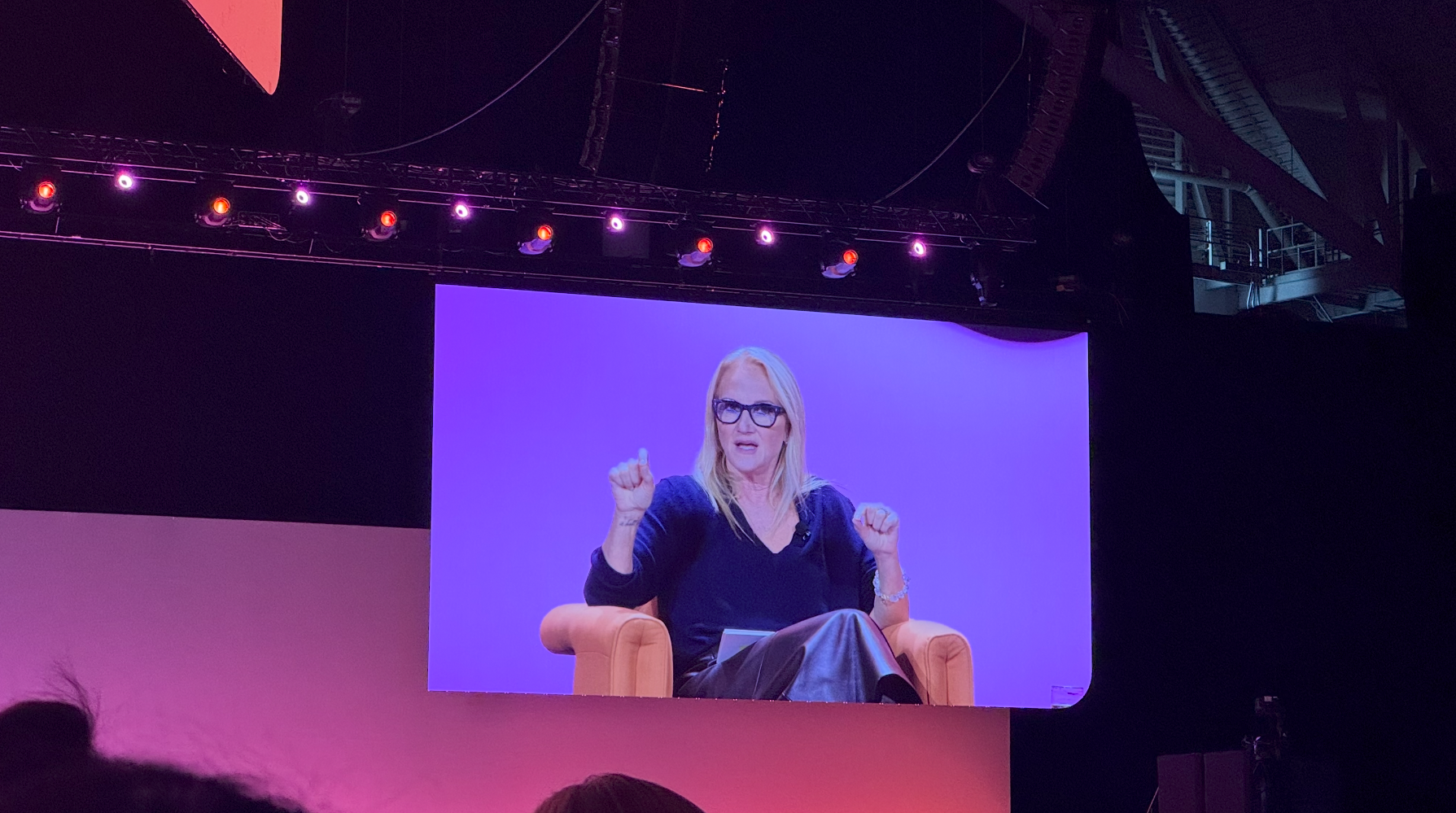
Every decision in the business, Robbins said, is aligned against a stated intention, and the test she uses is borrowed from Seth Godin: two questions, asked before anything is built or published. Without clarity on what you are doing, why you are doing it, who it is for and what it is for, “you actually do not have a business”. You have no target — only reaction.
“Who is this for? What is it for?”
Her answer to the first question is deliberately singular. She thinks constantly about “the person in line with me at the grocery store” — time-poor, tired, wanting to feel better and do better, and choosing to spend scarce time with her. Not a segment, not a persona deck: one person, imagined concretely enough to make trade-offs against.
The marketing tenet follows directly. Serve that one person well; shift something for them or create real value, and they recommend and share. It is a slower engine than paid distribution and a more durable one — which is precisely what the 50% figure for first-time listeners is measuring.

Her most controversial habit, she said, is routinely telling her audience and her expert guests “I love you”, “I’m proud of you”, “I believe in you”. It draws frequent complaints. She had said it to Adam Grant that same morning, which visibly made him uncomfortable.
Her definition disarms the objection. Love, in this context, means consideration and admiration: admiration for people who choose to spend time they do not have on positive, empowering, research-backed content, and consideration in the sense of keeping them in mind in every decision the company makes.
The workplace translation is the part leaders should take seriously. People need to feel seen and valued, and belief is transferable.
“If somebody doesn’t believe in themselves, they can borrow your belief in them until they do.”
Leaders, she argued, systematically under-use their power at work — above all their power to affect other people. She has reason to believe change is possible: sixteen years ago, about twenty miles from the venue, she was $800,000 in debt, unable to get out of bed, unemployed, with liens filed against a failing restaurant business and a life that had to be fundamentally rebuilt at 41. Neuroplasticity supplies the science; that period supplies the conviction.
The first of three ways to create conditions where people believe in themselves was also the most quotable, and the easiest to act on before lunchtime. You have worked for a thunderstorm, and you have worked for a sunny blue sky. Your energy has power, whether or not you have consciously assigned it any.
The practice is a checkpoint rather than a personality change: before you walk into work, and before you walk into your home, check yourself and take responsibility for the power of your energy. Arrive as a thunderstorm and you are a nightmare to work with, regardless of your competence. Arrive calm, centred and optimistic and the effect inverts.
She later reinforced the point from the other direction: calm is not a temperament, it is a leadership requirement. A team that finds its leader frightening or chaotic will not trust that leader and will not do good work for them.
Robbins credits Dr Stuart Ablon, whose research institute works on child development, with the principle “kids do well when they can”. She extends it without softening it: people do well when they can. The leader’s job, therefore, is to create the conditions in which people are able to succeed — and that begins with defining what success actually looks like and setting measurable standards.
“If you don’t have a target, you can’t hit it,” she said. Without that clarity, people arrive anxious, insecure and overwhelmed every single day, and no amount of encouragement compensates. When the interviewer floated the view that a manager’s job is “not to let them” fail, she rejected it flatly: she would not want to work for that leader. People want a leader who defines success and then lets them do the job.
That reframing turns micromanagement into a diagnostic. If you are micromanaging, the failure is yours, not the team’s: it means they do not know what matters. Setting priorities is the leader’s work and cannot be delegated upwards or sideways.
“If everything is important, nothing is.”
She named her own version of the failure while building the company: she did not give her team clear guidance on what success looked like, and then micromanaged them for missing it. The worst workplace behaviour she named follows the same logic — being angry or frustrated with someone and never telling them what to change.
The “Let Them” theory is, by her own description, a modern form of stoicism and radical acceptance compressed into four words. When someone annoys or frustrates you at work, you say “Let them”. The common misreading is that this is permission. It is not.
“You’re not allowing people to do anything. You’re forcing yourself to recognise that someone else’s behaviour is not in your control.”
The second and far less popular half of the framework is “Let me” — the reminder that what you do control is your own response. The controllables are short and finite: what you think, what you do, what you don’t do, and how you process your feelings. “Your power is in your response.”
Applied to management, it becomes a sequence to run before correcting someone:
If the self-check clears and feedback is warranted, Robbins offered a single sentence drawn from university research on belonging and motivation, which she calls the magic sentence. It is designed to deliver accountability and encouragement in the same breath, so that neither cancels the other out.
“I have very high standards for this team, and I think you can reach them. That’s why I’m going to give you this feedback, even though it’s not fun to tell you this.”
The sentence does three jobs at once: it signals high standards, which is motivating rather than punitive; it states belief in the person’s potential; and it makes the discomfort of the conversation legible as care rather than attack. The third move, which most leaders skip, is to say what you will do to help them correct it.
“Your potential is not where you are right now. Your potential is how far you can go.”
“Right now, in this second, it’s the slowest rate of change you and I will ever experience in our lives.” From that premise, Robbins argued that the old rules for getting ahead were written for a static world and no longer hold. The old rules were: have the most information, have the most ability, know the right people. A dynamic, information-saturated world reverses all three.
She applies this to her own business with unsentimental regularity. Her show was the third largest podcast in the world last year; she tells her team daily that what worked in 2025 will not work in 2026, and that 2026’s approach will not work in 2027.
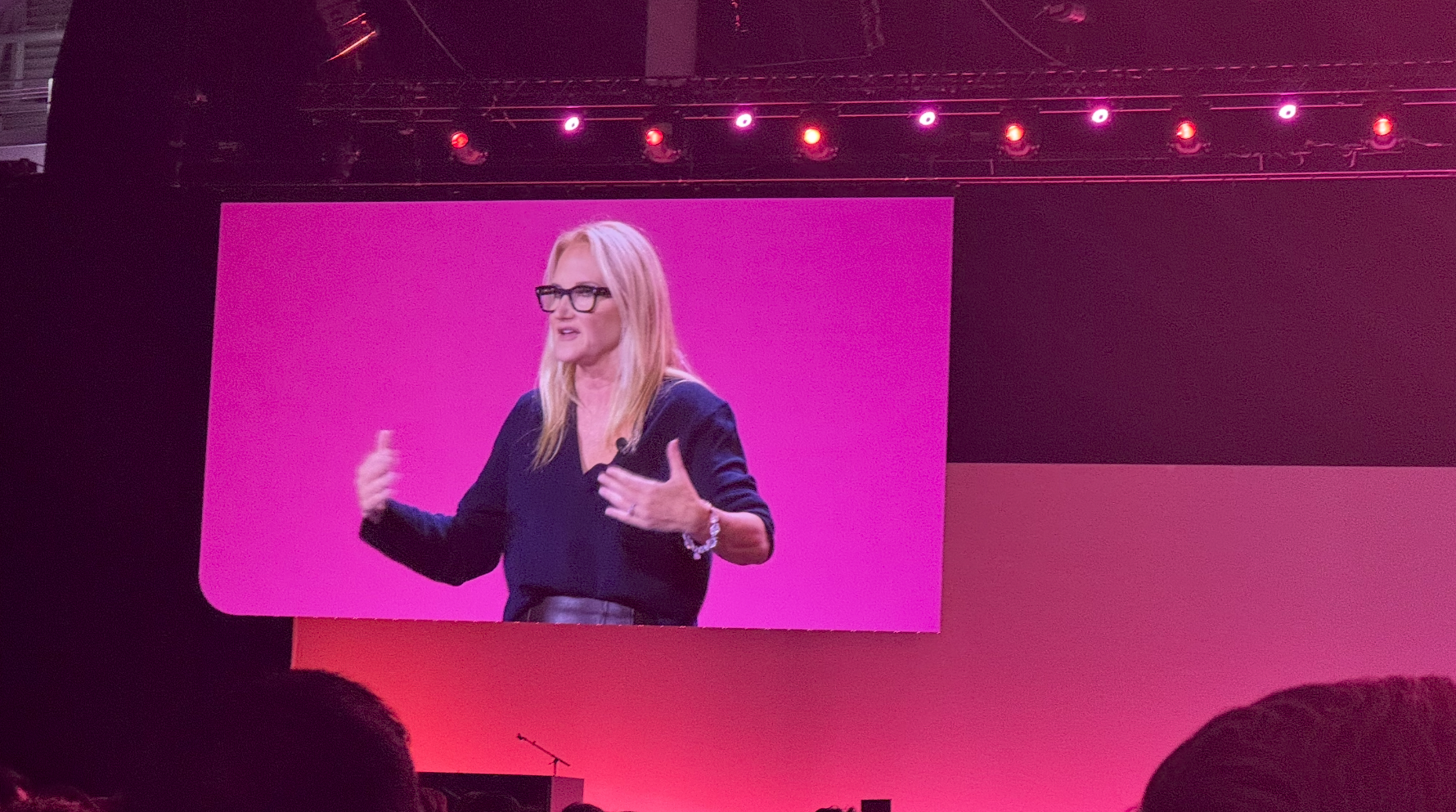
The maxims stacked up quickly: “If you change nothing, nothing changes.” “Knowing what to do is not the same thing as making yourself do it.” And, against the fantasy of the perfect decision, a correction that ran through the whole session — there is rarely one right move.
“It’s not about making the right move. Oftentimes it’s about making a move and then making it right.”
Her warning to anyone tempted to spectate: the cynic who simply watches the world change forfeits the only power available, which is the power to change your mind, your habits, your knowledge and how you show up.
Decision paralysis, in her diagnosis, is rarely a thinking problem. It is a space problem: meaningless inputs and other people’s emergencies occupy the mental room where judgement should sit. The typical pattern is seven hours lost to low-value email and requests, followed by the feeling of having done nothing that mattered.
The 5 Second Rule sits alongside these as the ignition switch rather than the map. Counting 5-4-3-2-1 to trigger action was invented sixteen years ago, when she could not get out of bed and was, in her phrase, “marinating in fear”; the idea came from watching a rocket launch. She describes it as a self-coaching tool with supporting science behind it — science she deferred explaining on the day — and is candid about its limits: it works best when you already know what to do and are struggling to make yourself do it.
Robbins then turned on the audience, gently. The value of a conference, she argued, is at least as much in the people as in the content. Someone in that room could change a sector’s trajectory, become a best friend, introduce a next job, provide seed funding or solve a problem that has been stuck for a year. Operate as you do at “every conference” and all of that stays locked.
A quick poll confirmed her suspicion: most people were sitting beside someone they already knew. Her explanation is developmental rather than critical — the habit of scanning a room for familiar faces and gravitating towards them was formed in primary school, in the discomfort of the big-kid cafeteria, and has never been retired.
Habits, she insisted, do not change through discussion. So she ran the experiment live: the whole room stood, she counted 5-4-3-2-1, and everyone was instructed to walk up to someone they did not know and introduce themselves quickly.
The debrief was the point. The resistance people felt in those seconds is exactly what changing behaviour feels like; pushing through it is the practice. Those who avoid the discomfort miss twice over — they miss the people in the room, and they miss the rehearsal of showing up differently.

Her claim for repeated practice was specific: within a year, people who keep doing this will earn more, be happier and healthier, and be known by more people. Amid technology and AI-driven change, she argued, human connection is the differentiator that carries you forward.
The in-room norm she proposed for the rest of the event:
The closing movement reframed purpose away from introspection entirely. It is not something you find, and not something you think your way into.
“Purpose is the thing that happens in other people when you do what you do. It’s the impact, it’s the energy that you give. It’s the kindness.”
On that definition, purpose becomes a question of contribution rather than vocation: what is the unique thing only you bring? For Robbins it is encouragement, and she traced it back to the period when she was at risk of losing her house, her sanity and her marriage, and what she needed was a friend who would stand with her. Other contributions she named as equally valid: supporting family, innovation and creativity, inspiration. The instruction is to start where you already are — with a sibling, your family, your community, your colleagues — rather than waiting for a grander platform to be handed to you.
She was realistic about what happens next. On returning home there will be a thousand emails, texts and tasks, and the overwhelm will arrive on schedule. Purpose and intention are what anchor your energy against that tide. And she cautioned against the opposite error — “gaslighting yourself” into believing you have no control. A great deal genuinely is outside your control. Not everything is.
The mechanism she offered has a neuroscientific frame. Citing Dr Lara Boyd, who studies the brain and stroke recovery, she reiterated that the brain is plastic — it changes and it grows. Setting an intention brings the brain’s spotlight effect online: it tells the brain what to look for and organises the body’s chemistry around it, and the difference is visible in brain scans. Which makes the morning ritual less sentimental than it sounds.
“You are powerful beyond belief when you get clear about the difference that you want to make and the kind of person you want to be.”
The memo she left for the year ahead:
Two questions were left open for the audience to answer for themselves: Why did you come here, and what is your intention for being here? And: What is the unique thing that only you can contribute?